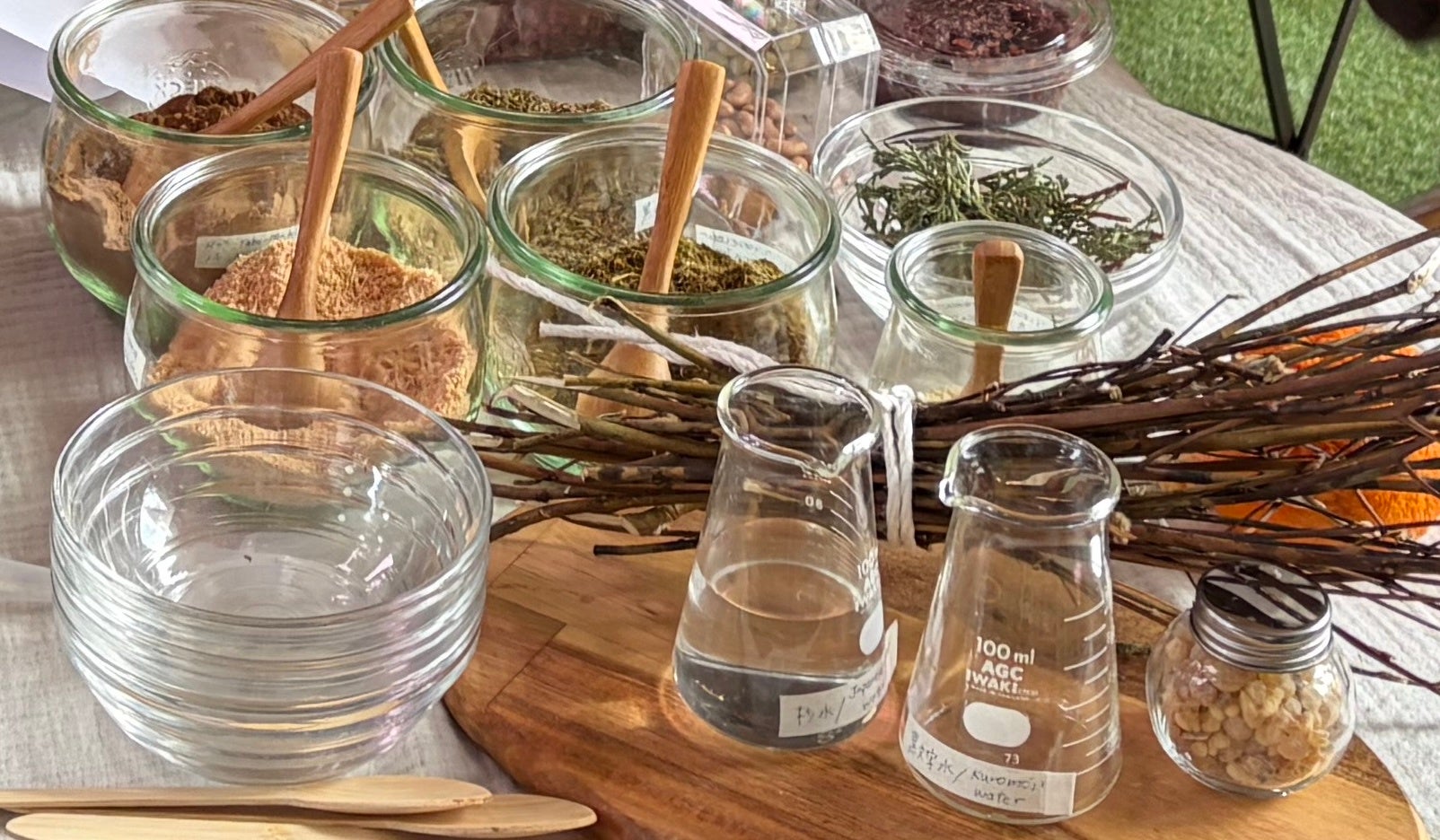
Official materials show powdered ingredients, dried branches and leaves, and small measuring tools arranged across a table. This is not a retail display of finished objects, but a work surface where materials still await names and roles. The school places sessions for observing plants beside sessions for making things within the same three days.
The venue is IMAGINUS, a science-experience facility using the former Suginami Fourth Elementary School. The school runs August 14–16 from 10:00 a.m.–5:30 p.m. overall and is for elementary students. Each workshop’s time, grade range, and fee appear on the official special page; reservations opened at 10:00 a.m. July 24 through Petit Bateau’s official LINE account.
Returning Scent and Flowers to Materials in the Hand
In Make Insect-Repellent Incense with Plants, children follow botanical scents while making incense from natural ingredients; older students also make molds. RareDex looks less at the strength of a finished fragrance than at leaves, barklike materials, and their differences in grain as they are crushed, mixed, and shaped. Plants retain texture after leaving the pot.
The Lost Flower® Lantern uses pressed flowers discarded for reasons such as being outside commercial standards. Children learn about flower growth, disposal, and farm work while making a lantern; older students also make tassels. This does more than preserve flowers at their most beautiful. Once stem length or petal form falls outside distribution standards, handwork selects it again as a surface transmitting light.
This article does not evaluate the incense’s insect-repellent effect or recommend home use. Confirm materials, safety directions, and handling after taking work home with organizers and instructors. RareDex records the design of learning that approaches plant-derived materials.
Bringing an Eye for Nature into the Lines of Clothing
A nature observation session led by the Nature Conservation Society of Japan combines a biodiversity lesson with fieldwork in central Tokyo. Its purpose is less counting species than carrying home attention to leaves underfoot, places insects stop, and differences between sun and shade—an observation that begins in earnest outside the venue.
Beside it is a fashion-designer experience. Younger students use magazine clippings and fabric to make inspiration boards for a character’s summer-adventure clothes. Older students learn a professional design process and compose clothing for an explorer. Nature observation and clothing are separate classes, but share looking, selecting, and combining.
Plant lines need not become literal floral pattern. Layered leaves may suggest pocket placement; walking outside may inspire clothing that allows air to circulate and the body to move easily. This year’s words are “connection with nature” and “Freedom to Move.” Clothing becomes a tool for a body observing the world, not mere decoration.
Two Years of Handwork Lead into This Summer
This is not a one-time project. Petit Bateau records that in 2024 at CIRTY in Daikanyama, sessions included flower making and growing carrots in small planters. In 2025 at IMAGINUS, they expanded to a seed-to-seed planter, papermaking from plant fiber, cicadas, DNA, and photography. Last year offered eight types across 38 sessions, reporting 423 total attendances by 273 individual children.
In 2026, clothing, photography, and journaling enter the schedule beside scent and pressed flowers. It is neither gardening class nor career experience alone. Growing plants, using materials, and recording one’s view on paper share a summer editorial spread. The program does not narrow children to one correct answer.
A parent might choose not the class that appears most useful, but what has lately made the child stop: leaf undersides, layered cloth, or mechanisms of light. The three-day school can be read not as a place classifying curiosity, but one where an interest without a name can come home.