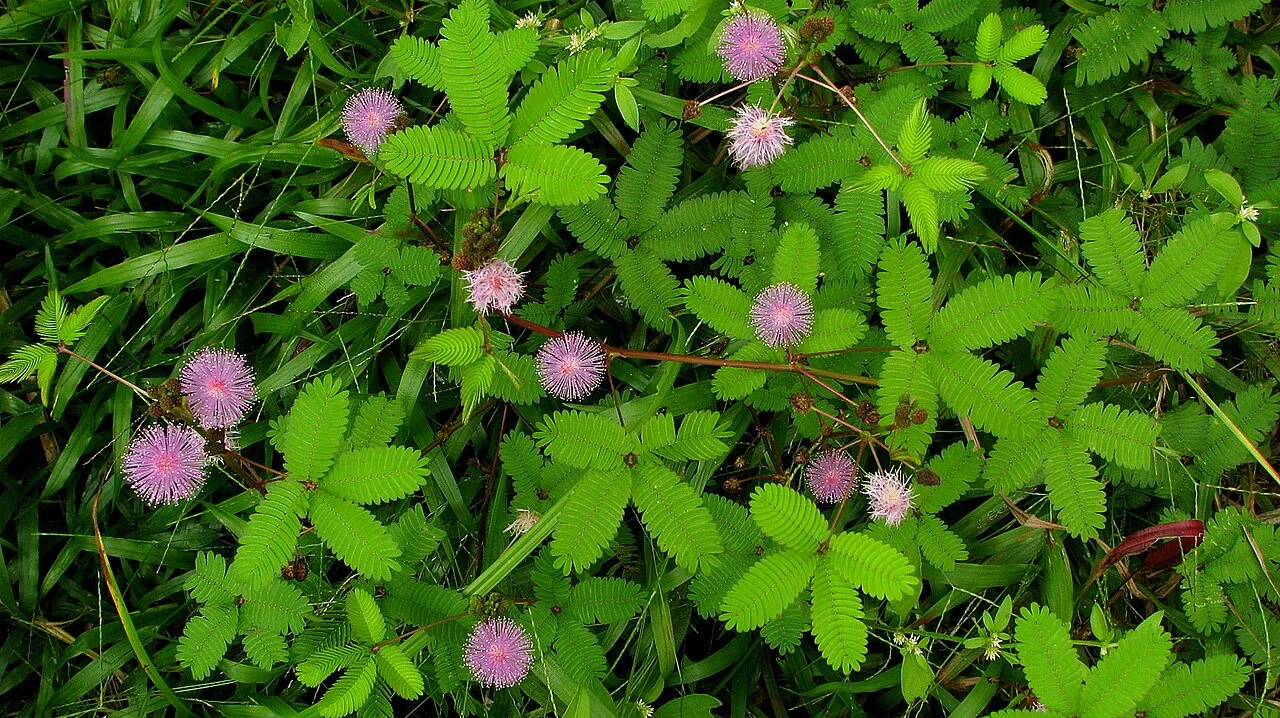
In the photograph, lime-green feathers overlap beside the pink flower heads. What looks like a blade cut into a fine fringe is a row of separate leaflets on either side of a rib. Pick out one rib while the leaf is spread wide; it is much easier to follow what happens to it later.
Leaflets up, stalk down
As the leaflets tilt upwards, the stalk that joins the whole leaf to the stem can tip down. From across a room the plant seems simply to droop. Up close, the two movements run in opposite directions. At the base of both the leaflet and the stalk is a small swelling called a pulvinus. As water moves into or out of its cells, their firmness changes. A small bend there shifts the green held out beyond it.
A fingertip brushing a leaflet can bring the two sides together in an instant. Researchers at Saitama University and their colleagues tracked signals travelling from a wound; the leaf moved just after the signals reached the pulvinus. Offered leaves that could move alongside leaves that could not, grasshoppers ate more of the motionless ones. This is a fold fast enough to interrupt a meal.
Evening inside a cupboard
The unprompted folding towards evening has a different timing. Botanists call it a sleep movement, and fading light alone does not account for it. In 1729 the French astronomer Jean-Jacques de Mairan put a sensitive plant in a dark cupboard. As Cambridge University Botanic Garden recounts, the leaves kept opening and closing on a daily rhythm even out of reach of daylight.
With a plant on a windowsill, choose something you can see between the open leaflets. Look again from the same spot towards evening. The broad feather has narrowed and the gaps around it have changed shape. The leaf that answers a fingertip in an instant also keeps time when left alone.