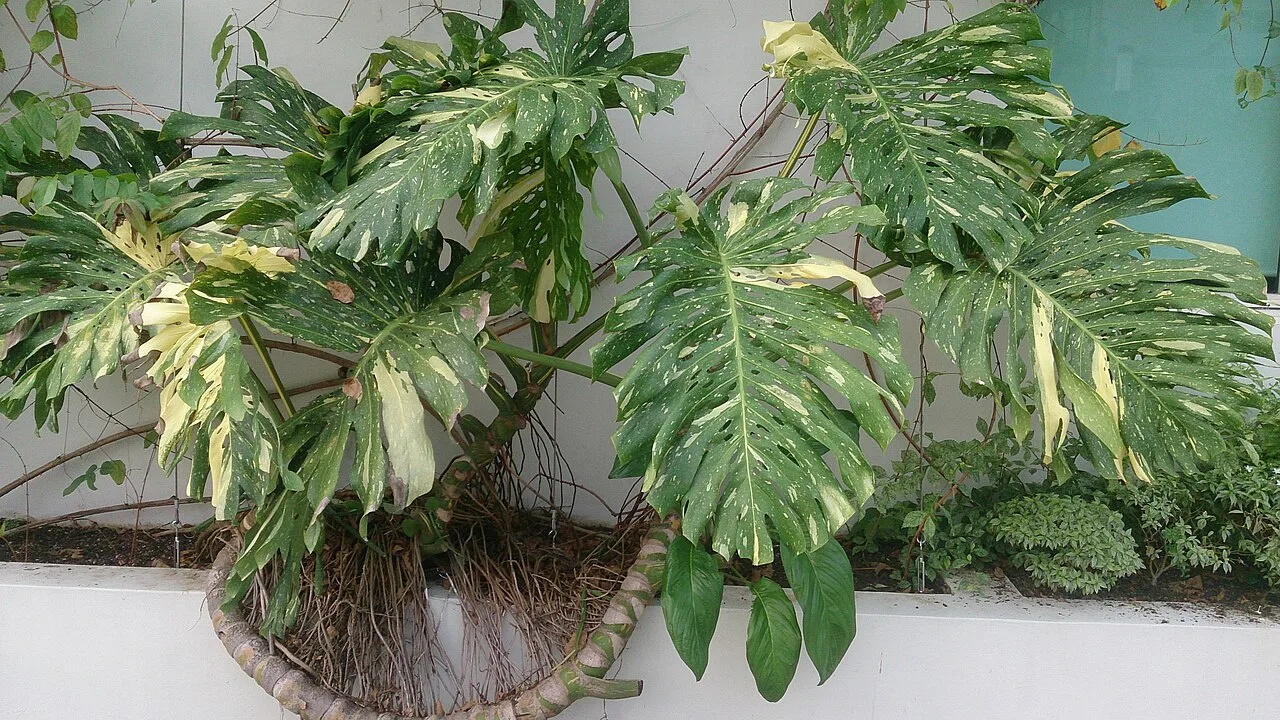
White and green share a single variegated Monstera leaf. The pale tissue is not decoration designed to gather more light; it contains little chlorophyll. Moving the plant closer to a window will not add white to a leaf that has already opened. To care for variegation, look at the amount of green and the next shoot rather than chasing brightness alone.
The pale tissue depends on the green
White and cream patterns appear where parts of the leaf produce little or no chlorophyll. Those areas photosynthesise less than the green tissue, so a variegated plant often grows more slowly than an all-green Monstera. More white is not automatically a sign of better health.
The mechanism and stability of variegation differ among cultivars and methods of propagation. Some leaves carry fine constellations of pale marks; others open with broad white sectors. One pattern is not enough to identify a cultivar or predict the next leaf. The beauty of the pale area and the green area available for photosynthesis must coexist on the same plant.
Be cautious with listings that promise variegation from seed. University of Minnesota Extension advises against buying supposed variegated Monstera seeds and recommends checking that a cutting contains a healthy node. Look beyond rarity to how the plant was propagated and which piece of the parent plant it came from.
Separate a bright position from hard sun
With less green tissue, variegated plants may need more useful light than their green counterparts. That does not mean strong direct sun. Bright, indirect light is the safer distinction: pale tissue is prone to scorching, and a sudden move to a hot window can leave bleached or dry brown patches.
When changing position, shorten the distance to the window in stages over several days. Notice whether midday shadows become hard, whether the leaf surface feels warm and whether new growth leans sharply toward one side. With a grow light, do not change both distance and duration at once.
A brown edge on a white section does not prove that the plant needs water. Hard light, dry air and a root zone that stays wet can all damage leaves. Let the upper few centimetres of mix dry, water the pot thoroughly and empty the saucer. Record the pattern and the drying of the mix as separate observations.
Watch the next leaf, not the current one
Variegation is not repainted across a leaf after it opens. Watch the next leaf and the stem or node from which it emerges. New growth can carry more green, and tissue with more chlorophyll may grow more vigorously than the variegated sections.
Even so, one greener leaf does not settle the future of the whole plant. Photograph three successive leaves from the same angle and compare the balance of pale and green tissue, markings at the nodes and leaf size. Before considering a cut, find out whether the change continues from the same part of the stem. That separates one unusual leaf from a direction of growth.
The attraction of a variegated Monstera is not the greatest possible amount of white. It lies between the green the plant can use and the pale tissue it can carry. Increase light gently, read the drying pot and wait for the next leaf. Receiving the pattern chosen by growth is closer to the plant’s own time than trying to command it.