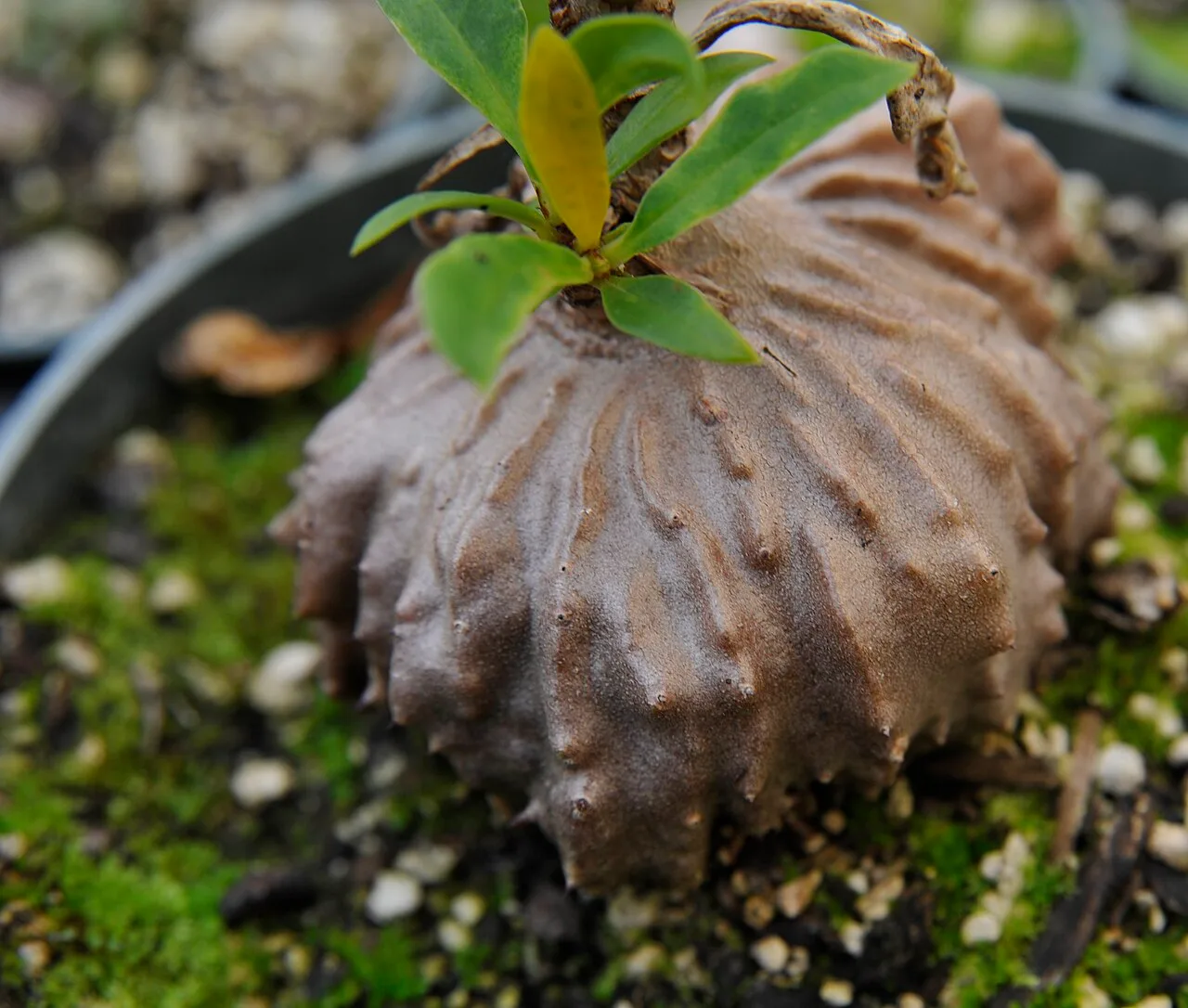
Above the potting mix, a brown base swells into a form marked by rib-like lines. From the outside it could be read simply as a dry caudiciform plant. Inside, however, it is not solid. As Myrmecodia tuberosa grows, passages form within the swollen base, and in the wild they become rooms for ants. The visible roundness and the unseen chambers belong to the same plant body.
Passages form inside the swollen base
Kew accepts Myrmecodia tuberosa as a species in the coffee family and records it as a wet-tropical epiphyte distributed from southern Indo-China to the Solomon Islands. A plant rooted on a branch approaches light, water and nutrients differently from one able to search deeply through soil.
Its first conspicuous feature is the swollen, semi-succulent base. The National Tropical Botanical Garden describes smooth-walled tunnels forming within it, with entrances opening to the outside. The interior cannot be read directly from the surface of a cultivated plant, but ridges and small openings suggest that another space lies behind the rounded outline.
The RHS notes leathery leaves crowded above the base, small white flowers produced directly from the main stem, and orange-red berries that follow. In the photograph, neither flower nor fruit dominates. Most of the frame belongs to the deeply ribbed base. The plant is shaped not only by leaves, but by a body that can become shelter.
On a branch, roots are not the only route
In the wild, ants enter the chambers and gain a place protected from weather and predators. The plant does more than provide empty space. Waste left by the ants becomes a source of nutrients, connecting an epiphyte to resources beyond the small area its roots can reach. It is difficult to reduce this relationship to an owner and a guest.
A photograph of a cultivated specimen cannot establish whether ants are present or how the interior is being used. What it shows is a ribbed brown base, branching growth and green leaves at the tips. The wild mutualism and the form preserved in a pot should not be collapsed into one claim. Instead, the exterior can be read as a trace of the ecology that shaped it.
Seen as a caudiciform, the rounded base resembles a sculpture made to hold reserves. Seen as an ant plant, that same volume becomes architecture, including the space within. The plant does not change when the viewpoint changes. What can be seen in one pot expands from a shape to a relationship.
In a pot, look for air around the roots
Indoors, it helps to separate the wild relationship with ants from the practical care of an epiphyte. The RHS recommends an open, free-draining medium such as orchid bark, or mounting the plant on cork, together with bright filtered light and high humidity. Poor drainage, by contrast, leaves it prone to root rot. Humid air and roots trapped in wet mix are not the same condition.
Rather than fixing watering to a number of days, watch how quickly the pot becomes lighter, how the bark dries and whether the leaves remain firm. Misting for humidity is not a substitute for keeping the medium permanently heavy. Leaving time for air to return around fine roots is closer to the plant’s life on a branch.
The Myrmecodia in the photograph does not open its interior to view. Even so, the brown base can recall the passages within and the animals that move through them in the wild. When a pot is not treated as one sealed individual, the rounded base stops being merely an unusual form. It becomes the body of a plant that carries a relationship inside.