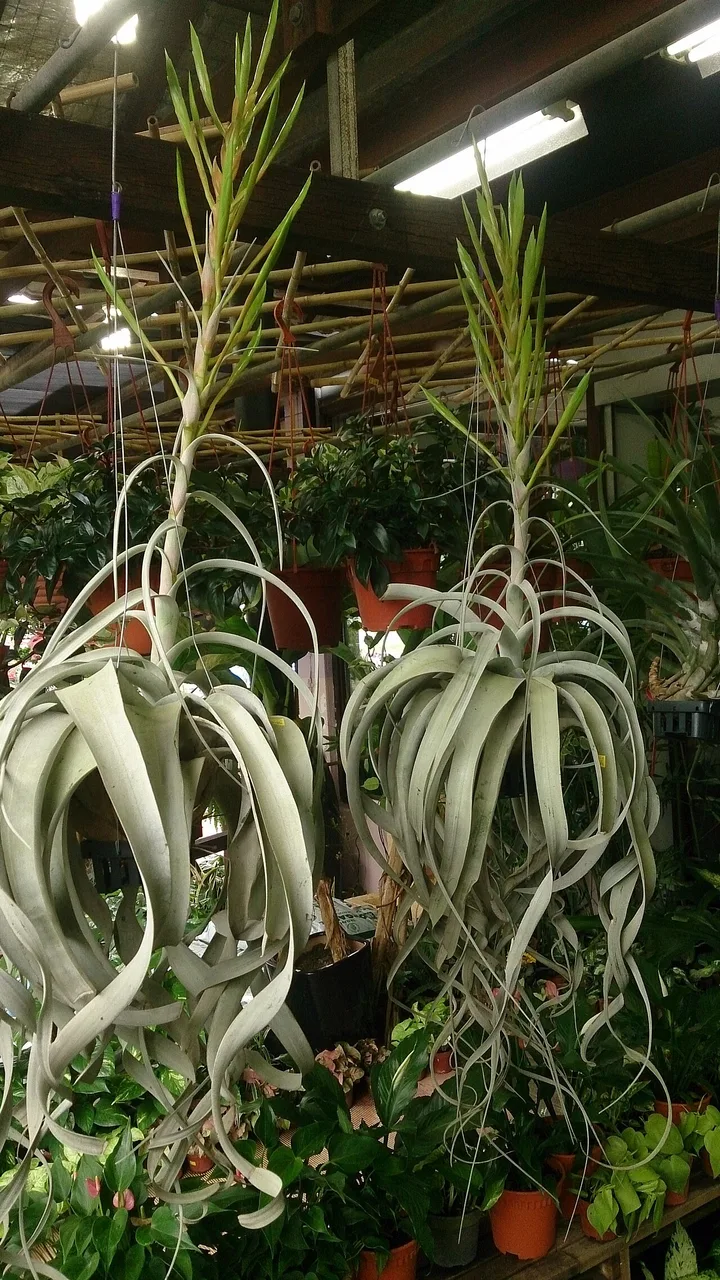
Lift a xerographica from water and its silver surface briefly leans toward a deeper green. Watering, however, is not finished. Water held between the curling leaves still has to be shaken free; the rosette must dry in moving air before it returns to its vessel. Seen as a surface that receives water and a form that releases it, this soil-free plant turns care into a continuous span of time. Display and drying do not have to happen in the same place.
A silver surface receives water
Tillandsia xerographica is an epiphytic member of the bromeliad family native from southern Mexico into Central America. Plants of the World Online at Kew records it in seasonally dry tropical habitats. Instead of sending roots into potting soil, it layers broad leaves from a central point and lets their tips curl into a large rosette. The silver is not decorative powder. Scale-like trichomes densely covering the leaf scatter light and create that pale appearance.
When dry, those fine scales soften the outline of a leaf with a matte haze. Once wetted, the whiteness recedes for a while and the green below looks deeper. The photographed plant shows both the curl unfolding from the centre and a remarkably even silver surface. Its colour changes across a watering not because the plant becomes another colour, but because water enters the surface and changes the way light returns from it.
A 2007 study of the related Tillandsia ionantha found water moving rapidly through epidermal trichomes by capillary action and then continuing into leaf tissue in a second phase. The first collection occurred within one minute, while transport within the tissue was measured across three hours. Those are results for T. ionantha, not a timetable for watering T. xerographica. Their value here is more modest and more useful: the silver surface is a living boundary through which water is received.
Trichomes should not be reduced to a single slogan. Research on the desert species Tillandsia landbeckii described its scales as a valve-like structure that captures fog, passes water inward and limits the outward route. A separate comparison of twelve Tillandsia species found that trichome-enhanced boundary layers alone did not measurably reduce whole-plant transpiration. Rather than concluding that silver automatically means drought-proof, it is better to watch the same surface collect water and then return to dryness.
Watch drying time, not only soaking time
Care advice for xerographica changes with place. North Carolina State University Extension suggests soaking for about fifteen minutes every one or two weeks, with intervals extending to about a month in winter. Gardens by the Bay in warm, humid Singapore describes five to ten minutes of submersion or generous watering. Pulled out of context, the numbers look contradictory. Read together, they show why humidity, light, air movement and season prevent one interval from travelling unchanged between rooms.
What the two institutions share is an emphasis on drying thoroughly after water is given. Gently shake water from between the leaves, then angle or invert the rosette so the centre does not hold a pool. North Carolina State frames this as protection against rot at the base; Gardens by the Bay likewise says the plant should be completely dry immediately afterwards. How long the plant soaked matters less than whether the wet rosette found enough moving air to complete the day’s watering.
Xerographica leaves open outward, then turn back inward at their tips. Their sculptural curls become small channels after water. The visible surface may look dry while moisture remains among the central layers or at the leaf bases. There is no need to rub the scales. Lift the plant, change its angle and see whether water still leaves the centre. That small movement is also a way of reading its form.
Dryness is difficult to assign to a clock alone. Look for the silver cast returning, the loss of cool dampness where leaves overlap, and the absence of droplets beneath the plant. On a cool, still day, keep it in an open place longer before returning it to its vessel. On a shelf crossed by heated air, moisture may disappear more quickly. Comparing the plant after watering and again before the next one says more about a room than faithfully following a weekday.
Watering lasts until the plant returns
Needing no soil does not mean that every display is equally suitable. A deep glass vessel or a still shelf may frame the silver rosette beautifully while slowing the escape of moisture from its centre. Taking the plant out for watering and returning it only when fully dry lets display and drying happen in different places. A vessel is both a setting and a condition that changes how the plant gives up water.
Follow one leaf and a sequence appears. The long outer leaves meet water first, while younger leaves in the centre can hold it longer inside their overlap. Drying does not necessarily reverse that order. Air may reach the outside while the centre remains wet, which means the watering is still in progress. Rotate the rosette and compare how silver returns across the curves; different angles help reveal what cannot be seen at the base.
If you keep a record, note more than frequency. “Fifteen-minute soak” makes a still evening and a bright morning look identical. Add where the plant dried, roughly when it returned to display, and whether the leaf tips felt firm. Over time, these details reveal what changed in your own room. Care is less like obeying a universal number and more like repeatedly observing the relationship between a plant and its place.
Watering Tillandsia xerographica is not the instant it enters a bowl. Silver leans green, droplets leave the centre, paleness returns in moving air, and only then does the plant go back to its vessel. Treating that whole passage as one watering makes the curled leaves more than a shape: they become a record of time spent receiving, holding and releasing water.