Even after its white flowers have passed, a pot of fukiran still offers many places to look. Do the leaves stand narrowly or draw an arc? Does variegation appear as a line or a field? Root tips carry cultivar-specific colours, while a mound of moss and a tall pot lift the plant into view. On 24 and 25 October, the Fukiran Art Specimen Exhibition at Sakuya Konohana Kan in Osaka opens this flowerless way of seeing across leaf, root and vessel.
Read the line of a leaf without waiting for flowers
Fukiran are horticultural forms selected from the wind orchid native to Japan and carried forward through long cultivation. The exhibition notice points to leaf shape, pattern and root colour as different forms of gei—the distinctive traits through which a plant is appreciated. The act of looking is not confined to bloom. Follow the angle of a narrow leaf and the outline made where several leaves meet, and what first seemed like one green pot becomes a composition of separate lines.
Begin with length, width, curvature and the tip of the leaf. Some plants open evenly to either side; others overlap into a small fan. Stripes, margins and mottled variegation alter those forms again. The aim need not be to identify rarity on sight. Ask instead whether a pattern strengthens the movement of a leaf or interrupts the balance of the plant. That question gives a first vocabulary for comparison.
The name fukiran carries a history of admiration reaching back to the Edo period. The Japan Traditional Horticulture Society describes leaf posture and variegation, as well as stem and root colour, as clues that distinguish cultivars. Its vocabulary is precise, but it does not have to be memorised before entering the room. Choose one curve that holds your attention, then find how the next pot differs.
There is a language for the root tip, too
In fukiran, roots are not only structures hidden inside a pot. Freshly extending tips may show red, green or other colours, and those colours are observed as cultivar traits. Their appearance can also shift with season and active growth, so one encounter cannot settle everything about a plant. Still, moving the eye down from the leaves to the base reveals where growth is happening now.
The organisers say that plants cultivated for decades will be shown. Time does not translate simply into size. Older leaves fall, new shoots gather and roots renew, gradually establishing the density and direction of a clump. After looking from the front, take one step to the side. Layers of foliage, the points where roots emerge and the height of the moss begin to carry different measures of time.
The exhibition is in the second-floor gallery of Sakuya Konohana Kan, open from 10 a.m. to 5 p.m. on 24 and 25 October, with last admission at 4:30 p.m. Adult admission to the conservatory is ¥500. Sales and cultivation consultations are also planned. Rather than treating the room as a place to buy quickly, it can be used to ask about an unfamiliar term while the plant that gives it meaning is still in front of you.
Cultivated time appears between plant and pot
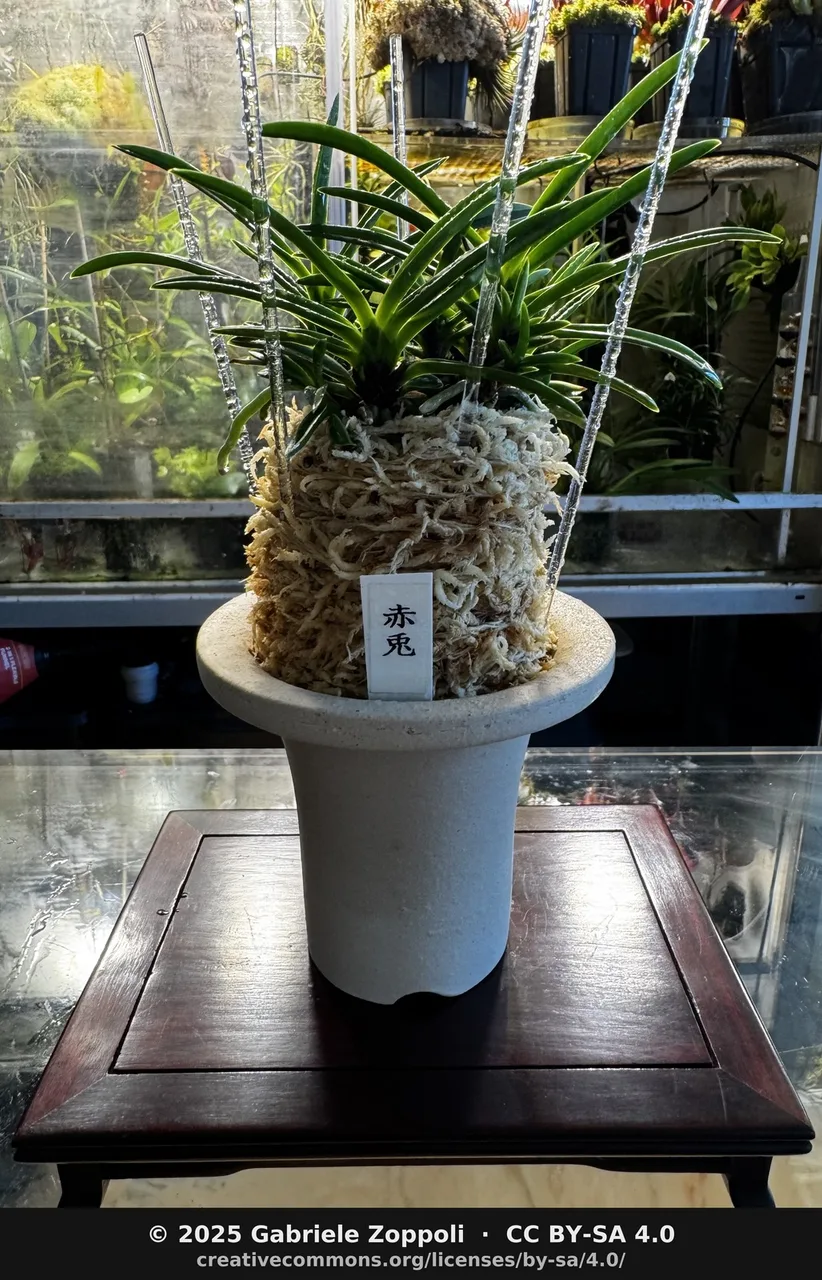
A fukiran display does not isolate the plant from its vessel. The height of the moss mound, the position of the clump, and the proportions and decoration of the pot all affect how the leaf lines are seen. The photograph used here shows a cultivated example of the cultivar ‘Akausagi’; it is not an exhibit confirmed for the 2026 event. It serves as a reference for the relation between upright leaves, a raised moss mound and a tall ornamental pot.
Once the vessel is included, collecting is no longer only the accumulation of cultivar names. The same plant can change when its front is chosen differently or it is remounted, allowing decisions by a grower to become visible. A plant with decades behind it may carry habits formed by previous hands as well as the present owner. Separating what can be observed from what can only be imagined is part of looking respectfully at an old specimen.
There is no need to learn every form of gei in two days. Stand before one pot and choose a single feature—the line of a leaf, the colour at a root tip, or the balance with its vessel. Look for that same feature in the next pot. Through comparison, the differences do not fade when flowers are absent; they rise more clearly as the outline of cultivated time.