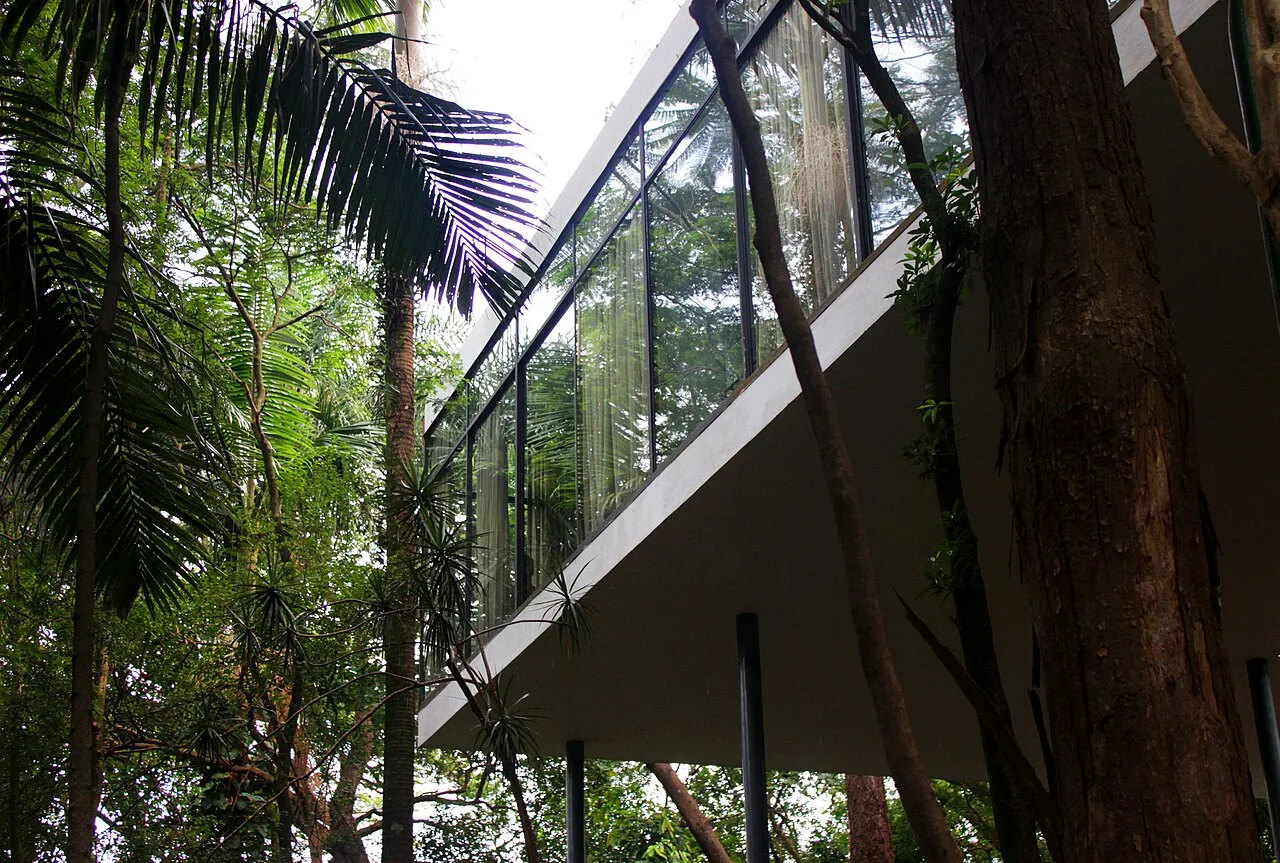
In a São Paulo garden, a glass room appears to float among the trees on slender columns. Lina Bo Bardi’s Casa de Vidro has changed its outline through seventy-five years of planting, repair and daily life since its completion in 1951. The anniversary exhibition Casa de Vidro 75 anos — Janelas de Afeto e Memória treats the vegetation beyond the glass not as background, but as part of the time in which the house has grown.
The glass box arrived after the forest
Lina and Pietro Maria Bardi chose an elevated site in Morumbi, in the south of São Paulo. According to the Instituto Bardi, the two lots acquired from 1949 still had a strong presence of vegetation originating in the Atlantic Rainforest. Completed in 1951, Casa de Vidro was Lina’s first built work. It is less a house followed by a garden than an inhabited level inserted into an existing slope and canopy.
The broad glazed front does not flatten the forest into a fixed picture. Trunks align with columns; layers of leaves alter the light behind furniture and artworks as the seasons turn. In the photograph here, slender supports stand below the pale floor while greenery approaches from the foreground. The building’s apparent lightness is not only a formal effect. It comes from lifting the eye away from the ground and placing domestic life at the height of the plants.
The garden is not a preserved remainder of a single day. The institute’s chronology records that granite and sandstone were added to external paths in 1954 and more plants were purchased for the garden; a third lot followed in 1958. The glazing has therefore held decades of growth, additions and increasing density. To read the architecture first and the plants second misses the more interesting fact: the two have moved closer together over time.
An anniversary exhibition opens the structure and the life
Casa de Vidro is now presenting Casa de Vidro 75 anos — Janelas de Afeto e Memória. Organized by Instituto Bardi, the exhibition is curated by Bruno Simões, with exhibition design by Giancarlo Latorraca. The official announcement draws attention to the landscape framed by the glass and to the views of ten invited photographers. Rather than closing seventy-five years into a number, it sets out the different gazes the same place has received.
The display brings together architectural drawings, a new model of the structural skeleton, sketches of furniture designed for the rooms, a reconstruction of a glass shelf once made for the library, correspondence between Lina and Pietro, and archival photographs. These materials return the visual lightness of glass and thin columns to a more substantial history of engineering, adjustment and use. The familiar idea of a house dissolved in forest becomes a house that people designed, repaired and inhabited.
The photographs are worth reading without placing the building alone at the centre. Leaves overlap with reflections, an internal garden interrupts the room, and the slope passes beneath the raised floor. Across changing light, rain and canopy density, the same pane becomes a different boundary. Plants are not green decoration around the work; they participate from the other side of the glass, filtering it, darkening it and casting moving shadows into the interior.
Read the architecture through garden time
On site, moving through the rooms cannot be separated from moving through the garden. Visits are guided, and visitors do not enter the house or grounds unaccompanied. That makes the sequence itself part of the experience: climbing the approach, nearing the space beneath the columns, then meeting the trees at eye level from inside. Following which trunk aligns with a support, or how far a leaf shadow reaches across a room, turns transparency from a material effect into a route.
Regular visits are offered Thursday through Saturday at 10 a.m., 11:30 a.m., 2 p.m. and 3:30 p.m., with advance booking. The current official page lists admission at R$58, reduced admission at R$29 and free entry for children aged ten and under. It also notes that there is no visitor parking, no food service and no accessibility provision for people with reduced mobility, so conditions should be checked before travelling. A 14 October report in PROJETO lists the anniversary exhibition through 5 December 2026.
Seen as architecture made with plants, Casa de Vidro does not use glass as magic that erases inside and outside. The pane keeps out rain, admits light and doubles the forest in reflection, continually measuring the distance between domestic life and the garden. Across seventy-five years, vegetation has thickened, the house has been repaired and the view has changed. Accepting those changes is what keeps the house from becoming a still masterpiece. At the window, the building looks into the forest—and the garden seems to look back.