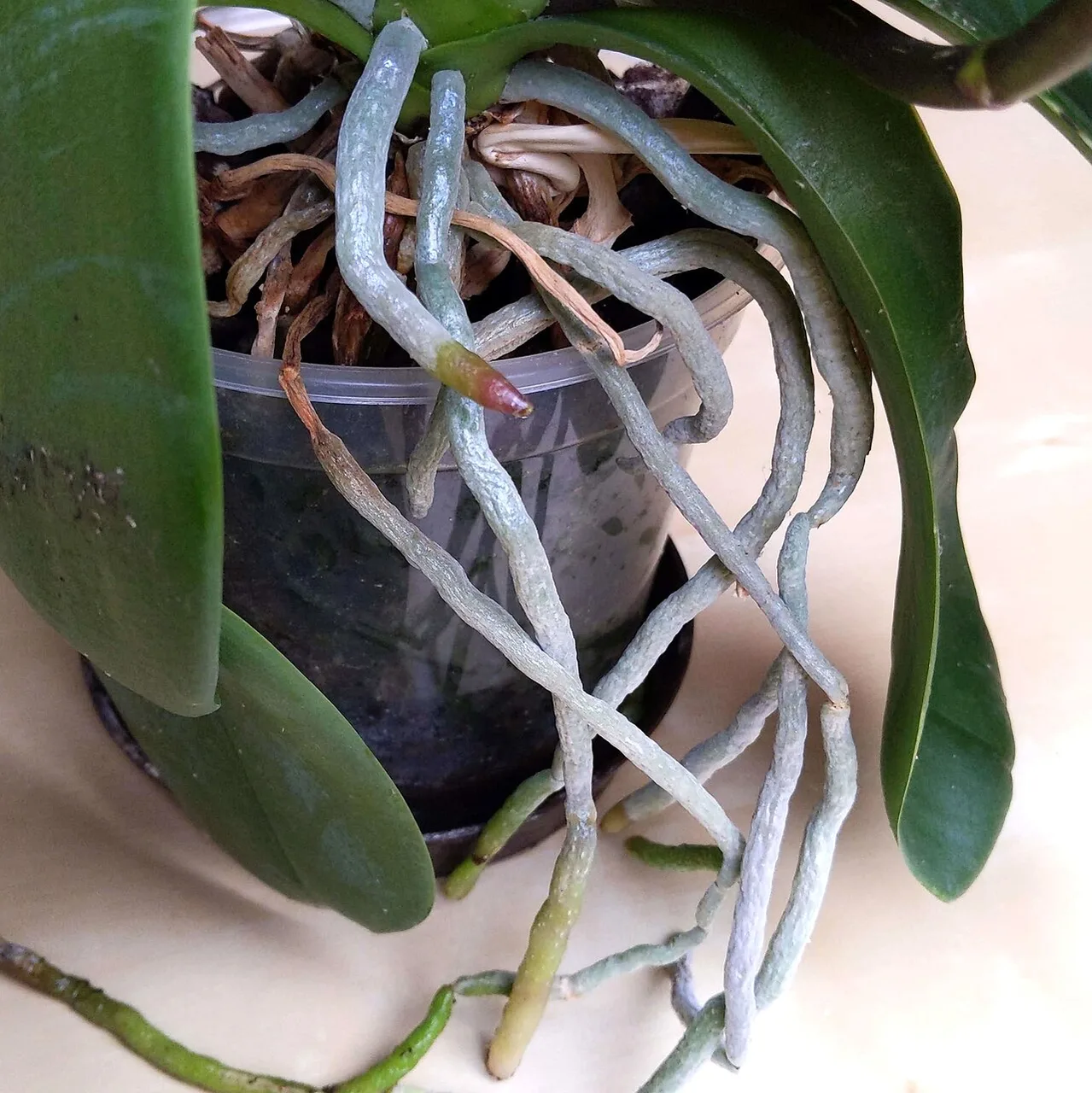
Silver-white roots ease over the rim of a clear pot. Add water and, within seconds, they turn green. The velamen covering a Phalaenopsis root holds air when dry and reveals living tissue beneath when wet. Even between flowers, the colour of the roots makes the plant’s present condition visible.
Silver is the colour of cells holding air
Velamen is a multilayered tissue at the outside of the root. Its mature cells are dead and hollow. While dry, their walls enclose air, and light scatters at those boundaries, making the root appear white or silver. A dry silver root is not necessarily a lost root; it can be a sound structure filled with air. This outer coat is not the whole living root: beneath it lie an exodermis that regulates entry and the living cortex. Epiphytic orchids live where rain does not remain as it does in soil. Their roots occupy an interval between brief wetting and longer drying, and the conspicuous outer layer is suited to that rhythm.
Through a transparent pot, one plant shows several versions of the same root. Some travel into open air, some follow gaps in the bark and others remain inside where moisture lasts longer. Their colour and firmness vary with position. In the photograph here, thick silver roots and small areas of green share the same pot. Flowers appear and pass with the season, but roots continue to register humidity, airflow and their distance from the potting medium.
Silver alone is therefore no reason to label a root old and remove it. Colour needs to be read together with shape: whether the root remains rounded and firm, or has become brown and soft. Colour carries information, but it is not a complete diagnosis. Healthy older roots may still be uneven in colour. A dark root that collapses when pressed belongs to a different question from the ordinary silver of a dry surface.
When wet, the green beneath becomes visible
As water arrives, the spaces in the velamen fill rapidly. With less air to scatter light, the living green cortex beneath becomes visible. A 2020 materials study links that green to chloroplast-bearing cortical cells, while describing the dry outer whiteness as an optical effect of air held in the velamen. Water does not simply pour without limit toward the centre; it is handed inward through structures including passage cells in the exodermis. Comparing the same root wet and dry makes clear that the green has not suddenly appeared. It was already present beneath the white outer layer; what changed was the path taken by light.
A 2013 study found that solutions from rain, mist or dew can enter velamen in seconds, while evaporation takes far longer. Some dissolved ions are retained at the root surface as well. For an epiphytic orchid, this outer layer does more than change colour: it extends the brief interval in which passing water can be received. The retention of ions also supports the “first flush” idea: after a dry spell, the first arriving water may carry a concentrated pulse of nutrients. The root is less a tank that stores one watering than a surface that makes a short opportunity harder to miss.
Green, however, is not a universal signal that watering is complete. The surface may be wet while the centre of the pot stays moist for a different length of time, depending on the medium, room temperature and airflow. A root returning to silver does not prove that bark or sphagnum deeper inside has dried at the same pace. Even within one season, terracotta and plastic, coarse bark and dense sphagnum create different internal times. Root colour can begin that comparison, but it cannot finish it.
Do not let colour make the watering decision alone
A clear pot is less a display case than an observation window. Read root colour alongside the moisture in bark or sphagnum, the weight of the lifted pot and the movement of air around it. Phalaenopsis roots receive water but also require air, so the pattern of drying says more than a fixed day of the week. An opaque pot can be read in the same way by combining weight, the surface of the medium and any aerial roots still in view. Compare the green immediately after watering with the same root a day later and again when silver returns. The sequence becomes a record of drying in one room—when heating begins, windows stay closed through rain, or the pot moves farther from the glass.
A root growing beyond the pot does not automatically need to be pushed back inside. Exposed roots make changes in wetness easy to see, and they are also part of the form the plant has made in response to its position. Leave them unbroken and watch how long silver takes to turn green and return; over time, the pace begins to describe the light and airflow around the plant. Turning only the visible surface green with mist is not the same as carrying water through the pot. The colour change can be enjoyed without losing sight of the medium below.
When the flowers are resting, a Phalaenopsis can seem silent. Yet every arrival of water changes the way its roots reflect light, and drying restores their silver surface. To understand velamen is not to reduce watering to a single correct signal. It is to add one quiet clue to the daily reading of how this particular plant has met water and air. Once root colour is treated as a changing trace rather than a measuring instrument, even a clear pot without flowers contains time worth watching.