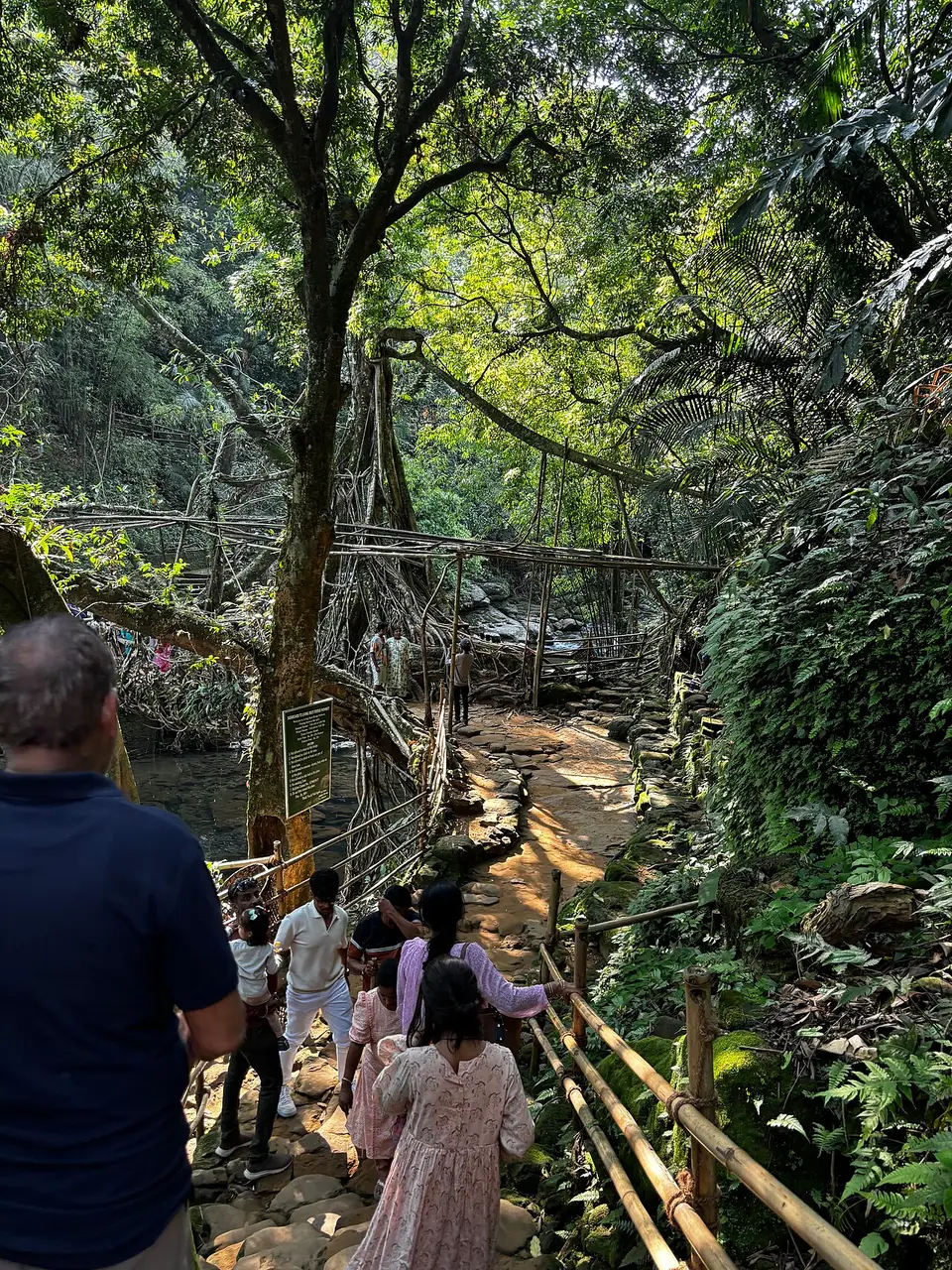
Brown roots rise like rails around a stone walkway. In Meghalaya, northeast India, a Jingkieng Jri is not a timber bridge later covered by a plant. Aerial roots of the rubber fig are guided toward the opposite bank, intertwined, thickened and grown into a crossing. The roots keep changing after people begin to walk over them, and village care continues with that growth. These bridges ask us to see time itself as part of plant architecture.
Directing aerial roots toward the far bank
The principal tree is Ficus elastica, a species that produces abundant aerial roots. In the Meghalaya Biodiversity Board’s account, young flexible roots are threaded through hollowed areca trunks or bamboo tubes and directed across a river or steep valley. Temporary bamboo scaffolds support the assembly and may also provide a provisional crossing. The method does not command a root to grow. It gives that growth a narrow route and keeps the route in place.
Reaching soil on the far bank does not finish the bridge. More roots are added, crossed and encouraged to join where they touch. This joining, known as inosculation, works with adaptive secondary growth under load to turn separate roots into a more stable network. Stones and soil are placed in gaps to form a deck, while other roots are trained as handrails. Plant tissue, mineral infill, temporary supports and ordinary footsteps accumulate within the same evolving structure.
A 2019 Scientific Reports survey recorded bridges ranging from about two metres to 52.7 metres in length. The form changes with the valley, the parent tree, the number of usable roots and the history of care, so there is no single blueprint. Nor can one universal number describe the years required for completion. Young bridges, bridges made by remembered ancestors and bridges known only through village histories remain present in the same region. The measurements describe site-specific responses, not standard dimensions.
A bridge is regrown while it is used
Being alive does not mean being maintenance-free. Documented work includes pruning and tying roots, removing mosses and epiphytes, replacing decayed bamboo, adding stones to the deck and clearing the paths around a crossing. Roots do not assemble themselves into bridges. People read continuing growth and repeatedly decide what to redirect, reinforce or leave alone. The green appearance contains a history of precise, repeated labour.
The arrangements of care also vary. Some bridges are watched by individuals or families; others are maintained by a village or a group of settlements. A route to fields, markets or neighbouring communities gives people reason to add roots, repair rails and inspect a crossing after high water. Structural strength therefore rests not only on the biology of Ficus, but also on relationships that keep a necessary path in use. The elegance of “living architecture” should not detach the bridge from that everyday setting.
At the bridge photographed in Nohwet village, the eye is first caught by the mass of thick roots. Look longer and human choices appear in the flat stones underfoot, the roots gathered at hand height and the ground that leads into the crossing. Neither root growth nor monsoon water repeats exactly from year to year. Use, observation and repair remain intertwined, allowing the bridge to be adjusted within the rhythm of local life.
Placing completion beyond one generation
“Jingkieng Jri: Living Root Bridge Cultural Landscapes” was submitted by India to UNESCO’s World Heritage Tentative List on 17 February 2022. Tentative status is not the same as World Heritage inscription. The submission describes a living practice across more than 75 villages and includes steps, platforms and forms of slope protection as well as bridges. Its scale shifts attention away from a single landmark toward knowledge and cooperation accumulated by Khasi communities across distinct sites.
It is also worth resisting the idea that this is a universal green technology ready to be transplanted anywhere. The 2019 study notes that whether Ficus elastica is native to Meghalaya or has long been cultivated there remains uncertain. Heavy rainfall, valley topography, land relations, a path that people still need and care that continues across generations all shape the structure. The deeper lesson lies less in copying its outline than in accepting plant time and local judgement as design conditions.
At the centre of the crossing, a root is both construction material and a living organ. It receives yesterday’s care while changing toward tomorrow’s thickness. Jingkieng Jri does not promise that architecture appears when nature is left alone. It shows people reading the capacities of a plant and patiently shaping a route that others will inherit. Once that duration is admitted into the structure, the bridge ceases to be a finished object and becomes an action passed from one life to another.