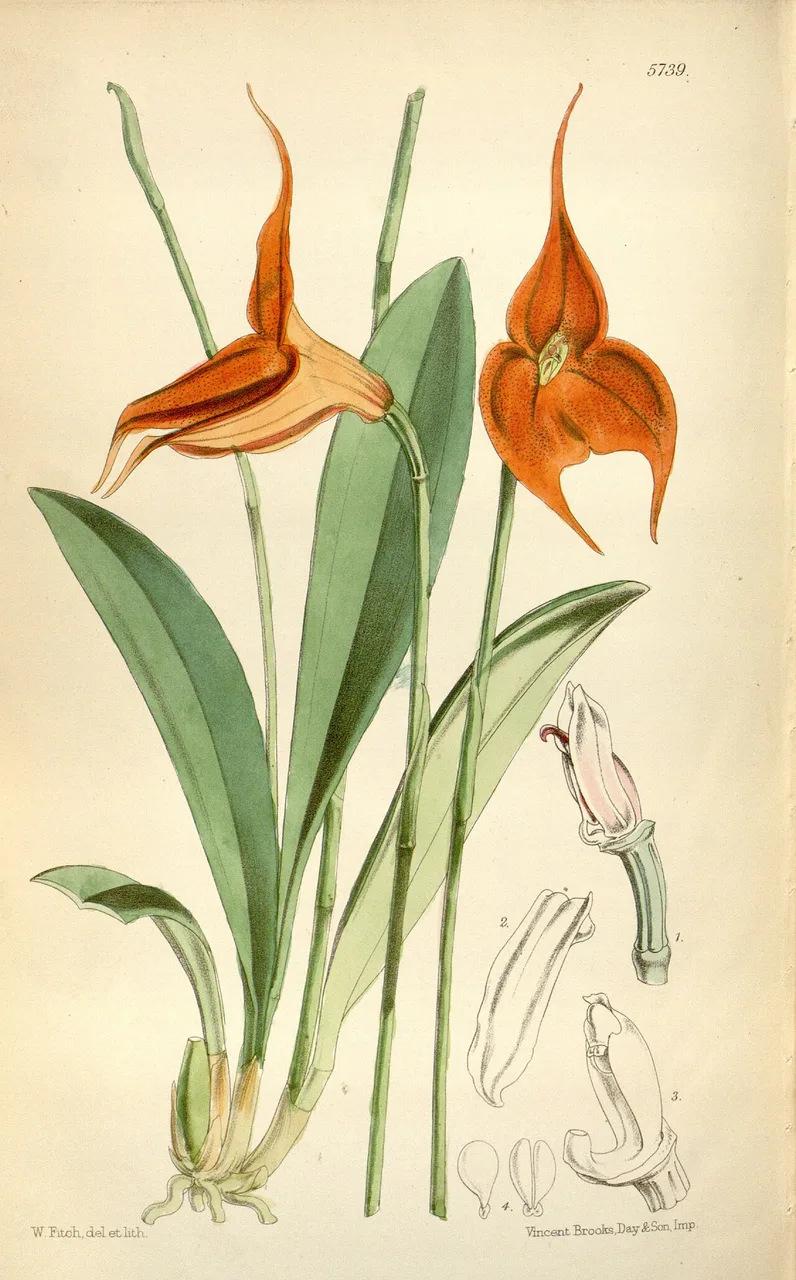
Three slender sepals open from orange into deep red. In an 1868 botanical plate, Masdevallia veitchiana carries more than the outline of a flower: its name retains a route from Peru to a London glasshouse. Instead of reading that name as a label alone, we can ask who moved the plant, where it was kept alive and whose gaze fixed it on paper. Behind the bloom stands the nursery as a system.
Before the name, there is a Peruvian flower
Plants of the World Online at Kew accepts Masdevallia veitchiana Rchb.f. as the current name and records Peru as its native range. It describes the species as an epiphyte of the wet tropical biome. That is the first fact to place on the page: before it carries the Veitch name, this is a plant rooted in a Peruvian environment. A nursery history should not quietly move the flower’s point of origin to London.
The plate shown here appeared as plate 5739 in volume 94 of Curtis’s Botanical Magazine. Walter Hood Fitch drew it and Joseph Dalton Hooker supplied the description in 1868, the same year in which the name was first published. A frontal flower, a side view, narrow leaves and the extended sepals are separated across white paper. The drawing makes structure unusually clear, while the land and the distance travelled retreat beyond the frame.
That makes the plate both a beautiful portrait and an entry into what is absent. The ending veitchiana preserves the name of the commercial network that circulated the plant, but it does not explain the flower’s homeland. Looking closely at the bloom and looking beyond the label toward provenance belong on the same page.
The glasshouse turned a plant into stock and record
The Royal Parks notes that the Veitch family sent plant hunters around the world and brought more than 200 kinds of orchid into its nurseries. In Chelsea, the Royal Exotic Nursery grew into an internationally known business in unusual plants. Its glasshouses did more than display arrivals. They received plants that had survived transport, restored them, propagated them, brought them into flower, attached names and images, and passed them into private collections.
Hortus Veitchii, compiled by James Herbert Veitch in 1906, records the family nurseries, their collectors and hybridists, and notable introductions. It is rich evidence, but it is also a company history written from within the firm. Successful introductions and named figures remain highly visible; local botanical knowledge, ecological costs and plants lost in transit do not appear with equal weight. The impressive inventory is best read as a primary source with a corporate point of view, not as a complete account.
Illustrations and catalogues formed the public surface of that system. Once a plant flowered under glass, an artist could fix its colour and structure, a botanist could describe it, and a nursery could present a named specimen. Collecting, shipping, cultivation, classification, printing and selling were distinct kinds of labour, but a flower name joined them. The pot acquired by a collector sat at the final point of a long chain.
Keep a plant’s route longer than its name
To bring this history onto a present-day shelf, rarity matters less than keeping provenance intact. Alongside a scientific name and seller, a collection record can hold the date acquired, whether the plant is seed-grown or a division, the route by which it was received, and photographs of flowering. Information that confirms lawful trade and distinguishes propagated material from wild collection is part of the quality of the collection.
Plant names can change. Recording the currently accepted name beside an older trade name or synonym keeps earlier notes connected to present taxonomy. A name then becomes an index from which research begins, not the final answer. The label shifts from a claim of ownership into a small archive capable of carrying the plant’s passage to its next keeper.
The plate of Masdevallia veitchiana presents the flower directly to the eye. Yet folded into its white ground are a Peruvian wet-tropical habitat, transport across the sea, a Chelsea glasshouse, drawing and description, and eventually the collector’s bench. To study nursery history is not simply to celebrate a name. It is to remember, beyond the name, whose place a plant came from and which systems brought it into view.