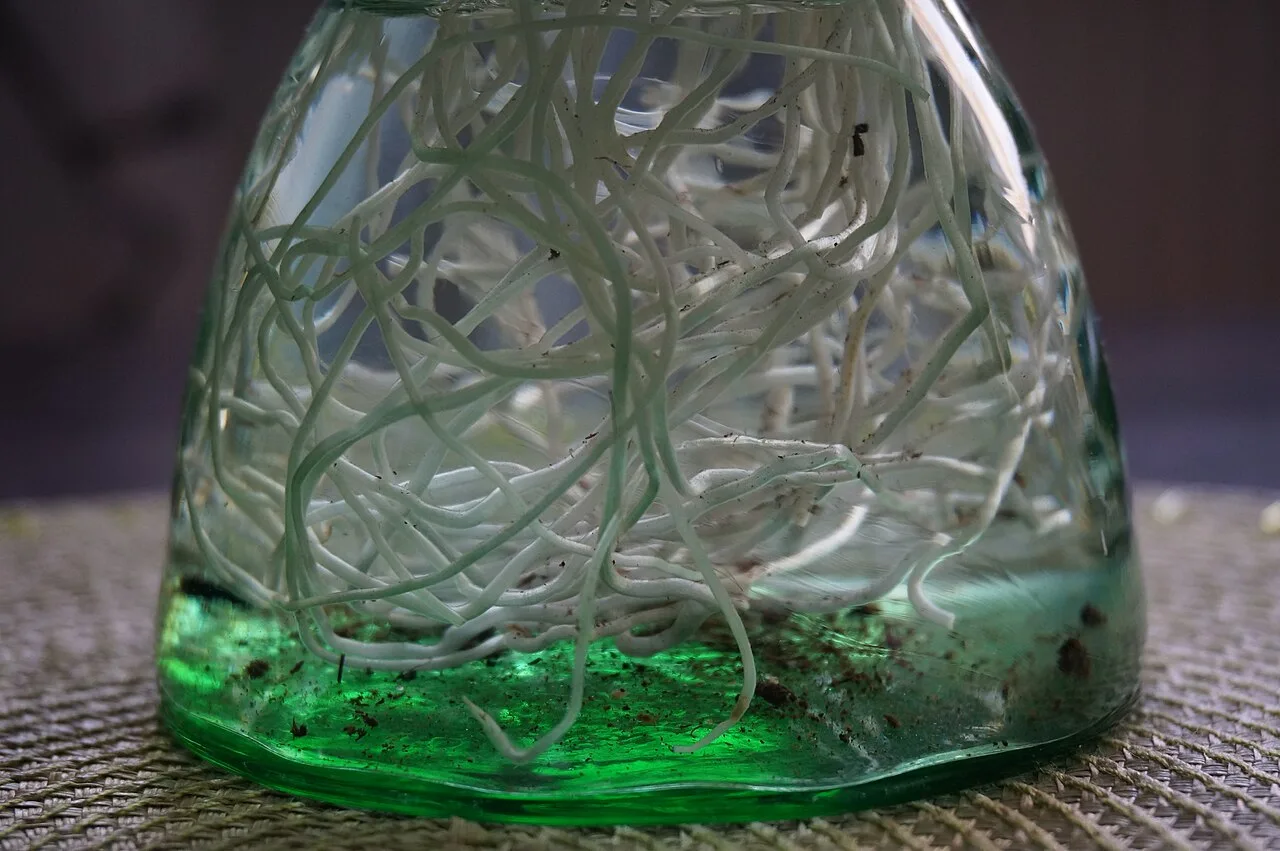
A bulb rests above a transparent vessel while only its white roots descend into water. A hyacinth glass uses a single constriction to set the distance between plant and water. Before it is a tool for bringing flowers forward, it is a vessel that opens underground growth to the time of a room. On an autumn windowsill, the first thing to wait for is not flower colour but those pale lines.
Support the bulb and hold it above the water
The purpose of a hyacinth glass is not to float a bulb. The Royal Horticultural Society advises choosing a vase whose opening is slightly smaller than the bulb, filling the glass to the neck, and keeping the water level just below the base. Water occupies the broad body, air remains in the narrow neck, and the bulb sits above. The curve of the vessel keeps these three zones apart.
That small gap directs the roots toward water without leaving the bulb itself wet. Because the vessel is clear, the waterline and the length of new roots can be checked without lifting the plant. Plants of the World Online at Kew records the accepted name Hyacinthus orientalis and describes it as a bulbous geophyte, native from southern Türkiye to northern Israel. The glass raises what would usually be hidden underground to eye level.
This form has long combined horticultural tool and interior object. An autumn bulb catalogue issued by Peter Henderson & Co. in 1900 offered tall, twisted and plain hyacinth glasses in green, purple, blue, opal and crystal, presenting bulbs in water as ornaments for parlour windows. Shapes and colours have changed, but the relationship remains recognisable: a narrow neck supports the bulb while a broader body receives water and roots.
Build roots first, in cool darkness
Do not make the bright windowsill the finished setting on the first day. The RHS recommends keeping a bulb grown in water somewhere cool and dark until the vase is full of roots and the flower stem has emerged. Darkness is not a way of concealing the display. It gives the lower root system time to establish before leaves extend upward. Top up the water as it falls, but preserve the small space beneath the bulb.
Autumn is the season for preparing indoor bulbs, but there is no single promised flowering date. Even specially heat-treated prepared bulbs differ by cultivar in the cool period and indoor time they require, and room temperature changes the pace. Rather than working backwards from Christmas alone, check how the bulb is labelled when you buy it and let the progress of roots and shoots determine the next move.
Bulbs placed in glasses on the same day do not necessarily advance into the same outline. In the photograph, the two bulbs differ in root density, shoot height and the visibility of the flower cluster. The clear body reveals not one ideal root system but the pace and density made by each bulb. Rather than moving a pair into warmth simply to make them match, read the waterline and root development of each one separately.
Once roots are well developed and shoots and flower stems are rising, move the glass first into a cool room away from strong light, then increase light and warmth gradually. A place directly above a radiator can accelerate the display and make a falling water level easier to miss. In a transparent vessel, checking the water becomes part of tending the arrangement rather than a task hidden beneath soil.
See the underground outline before the flower
The RHS says that bulbs grown in water in glass vases do not need feeding. After flowering, do not remove green foliage immediately; allow it to yellow naturally. If the bulb is to be kept, planting it outdoors afterwards is one option. Wear gloves when handling hyacinth bulbs and keep them away from mouths: they can aggravate skin allergies, and all parts can cause stomach upset if eaten. Those cautions belong beside the beauty of the vessel.
A hyacinth glass does not reproduce nature in miniature. It is an instrument of observation designed to retain a few millimetres of air between bulb and water and let roots alone cross that distance. When the flower spike rises, the eye will move upward. Yet the clear body still holds the time accumulated first in cool darkness, line by white line. An autumn bulb begins by making room for growth that usually remains unseen.