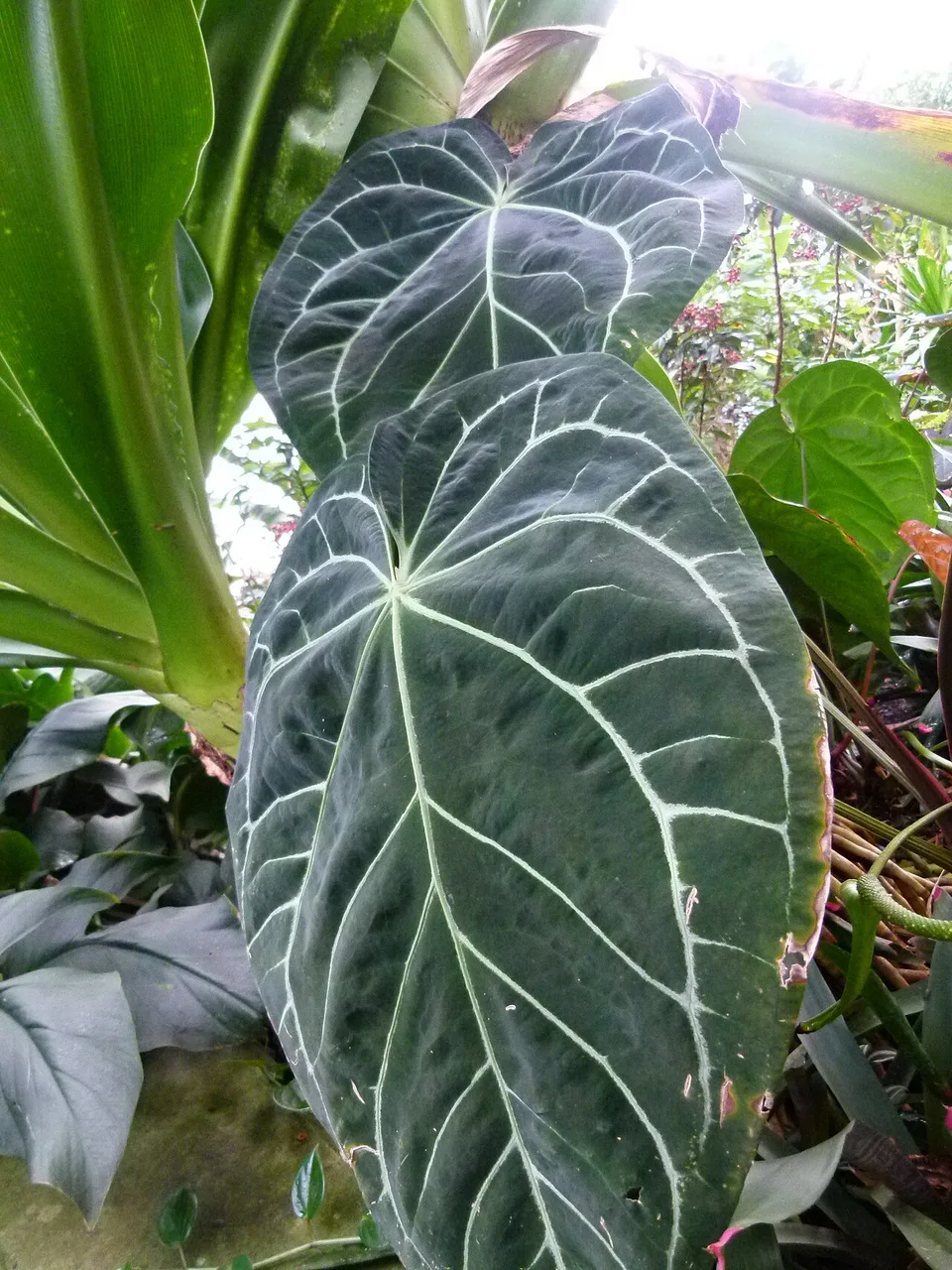
Silver-white veins cross a leaf so dark it is almost black. The Anthurium crystallinum in the photograph is one of the anthuriums that can hold attention through foliage rather than flowers. Its deep colour, heart-shaped outline and fine lines branching from the midrib are striking, but one photograph is not enough to hurry every similar plant toward the same name.
Connect the white veins to the outline of a species
Kew’s Plants of the World Online accepts Anthurium crystallinum as a distinct species. Its native range extends from Panama to Colombia, and it is recorded as an epiphytic subshrub of the wet tropical biome. A habit that uses other plants for support, together with broad leaves adapted to receiving light in a humid forest, remains legible in the plant we see in a pot.
The name was first published in 1873, and Kew’s record retains two later names as synonyms. More than a century of revision sits behind the label in a nursery: it carries a history of observation and classification rather than serving as decoration. That history also makes it important to distinguish the changing boundaries of a name from the leaf directly in front of us.
In the photograph, lateral veins divide from a pale midrib and stand against the dark green blade. Two basal lobes open around a deep sinus leading to the petiole. Yet leaf width, the angle of those lobes, the weight of the veins and the degree of gloss can shift with the age of the plant and with each leaf’s development. The identity is read through a combination across the plant, not through one mark.
A newly opened leaf does not have the same colour or firmness as an older one. Its soft surface hardens over time and the colour and texture settle. Looking along several leaves on the same plant is more revealing than isolating either the oldest or newest blade, because their sequence shows how that individual has been forming its shape.
Individual variation sits between species and hybrid names
Foliage anthuriums are discussed through hybrid names as well as wild species. Kew records an artificial cross between A. crystallinum and A. veitchii, the latter known for long, corrugated leaves. A taxonomic record can establish the parent combination, but it does not dictate the exact width or venation of every individual plant.
Seed-grown siblings do not become visually identical simply because they share the same parents. A vegetatively propagated plant, by contrast, more closely carries the traits of the original individual. Alongside what is printed on the label, it matters whether the plant was raised from seed or propagated and which leaf best represents its current form.
A name is a way of sharing differences; it is not a substitute for looking. Describing the brightness of the veins, thickness of the blade, angle of the lobes and rise of the petiole makes plants with similar labels visible as separate individuals. A collection grows not only through the number of names but through the ability to remember these differences.
Place plants with the same name side by side
Where several plants can be compared, do not let the largest leaf decide everything. Follow the outlines of old and new leaves, the position of the growth point and the condition of the roots as one sequence. Ask whether the plant is a species or hybrid, seed-grown or propagated, what substrate and light it has known, and whether it was recently repotted. Such information helps prevent an abrupt change at home and outlasts any claim of rarity.
On 18 October, Anthurium Festival 2026 Tokyo will bring acu’s forest, urban jungle, Barian Engei, and sugar and pine to soko station 146 in Shin-Kiba. General entry is listed from noon to 17:00, with two paid early sessions from 11:00, each limited to 20 people on the official booking pages. The value is not the scale of the event but the chance to place plants from one genus beside one another in the same room.
A leaf cannot be explained by parentage alone. Its angle to the light, age since opening, humidity history and root condition all settle into its colour and outline. When the white veins catch the eye, it is worth resisting the urge to close them inside a name and instead following the sequence of leaves the plant has made.