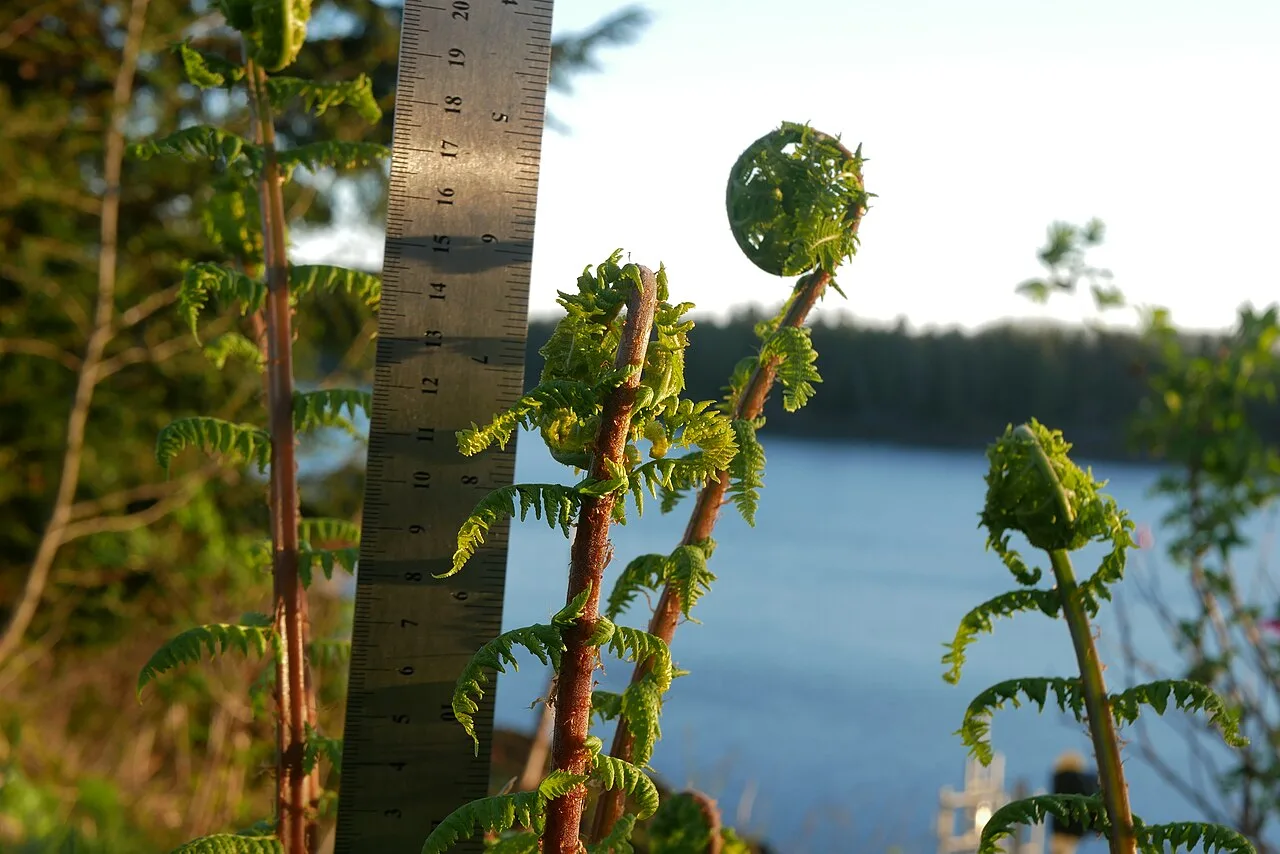
A young fern rising from the soil keeps its tip tucked inside a small coil. In this photograph of lady fern, pale green croziers push through brown scales and begin to open from the outside. Each is not a flower bud but an entire leaf still in the process of becoming visible.
Protecting the growing tip inside a coil
In most ferns, a new leaf emerges with its tip rolled inward. The form is known as a crozier or fiddlehead, and its development is called circinate vernation. The Field Museum explains that the soft growing tip, or meristem, remains at the centre while growth and unfolding produce the expanding frond.
The coil does not extend all at once like a spring pulled straight. Sections closer to the stalk develop first while the tip stays curled longest. Expanded tissue can begin receiving light as the parts still being formed remain enclosed, so one young frond contains both opened and developing regions.
On the largest crozier in the photograph, small divisions are already appearing along the outer side of the axis, with tighter curls continuing near the tip. Not only the main axis but the parts that will look like branches are folded within it. The rounded end is a compressed arrangement of one complex leaf.
Fern species do not all produce coils of the same size or density, but the sequence offers a useful feature to observe across many living ferns. Following a new frond over several days shows that the tip is not simply travelling upward; successive parts of the leaf are lengthening and opening.
One leaf rises from a rhizome
The coiled structure is harder to understand if an open fern frond is mistaken for a branch. The visible frond is one leaf, produced directly from a stem that usually runs underground or close to the surface. In many species the fronds can die back while the rhizome persists and sends up new leaves.
The stalk at the base is the stipe and the main axis through the blade is the rachis. The first divisions along it are pinnae; divisions within them are pinnules. Inside a fiddlehead, these parts are present at short intervals and have not yet taken up the space they occupy in the mature leaf.
Unfurling therefore changes more than the leaf’s area. The rachis lengthens, spaces open between pinnae and the pinnules take on their own orientation. Only then does the familiar divided blade appear. Much of the mature pattern was already folded into the compact young frond.
North Cascades National Park describes fern leaves as opening from base to tip and growing from horizontal underground stems. Many woodland species favour moisture and low light, but ferns cannot all be reduced to one set of conditions. Recognising the relationship between frond and rhizome is a better first step toward understanding where a potted plant will produce its next growth.
The next generation appears under the leaf
Once a frond has opened, its underside reveals another part of the fern’s structure. In many species, the capsules that produce spores gather into groups called sori. They may form round dots, narrow lines or broad areas, making a second pattern beneath the visible surface of the leaf.
The American Fern Society notes that sori can be circular, arranged in rows or spread across most of the underside. They are absent from the youngest coils and develop as suitable fronds mature. This is why a regular pattern of brown marks should be distinguished from damaged tissue before it is treated as disease.
A spore is not a seed. The University of California Botanical Garden explains that a germinating spore becomes a small gametophyte; when water allows fertilisation, an embryo develops into the fern with roots, stem and fronds that we recognise. The large leafy plant is therefore only one form within the life cycle.
The young coil, the open frond and the sori beneath it are not separate ornaments. They belong to a sequence in which a rhizome produces a leaf, the coil protects its growing tip, the blade expands and a mature frond prepares spores. Watching one fiddlehead across several days lets the fern’s structure unfold along with the leaf.