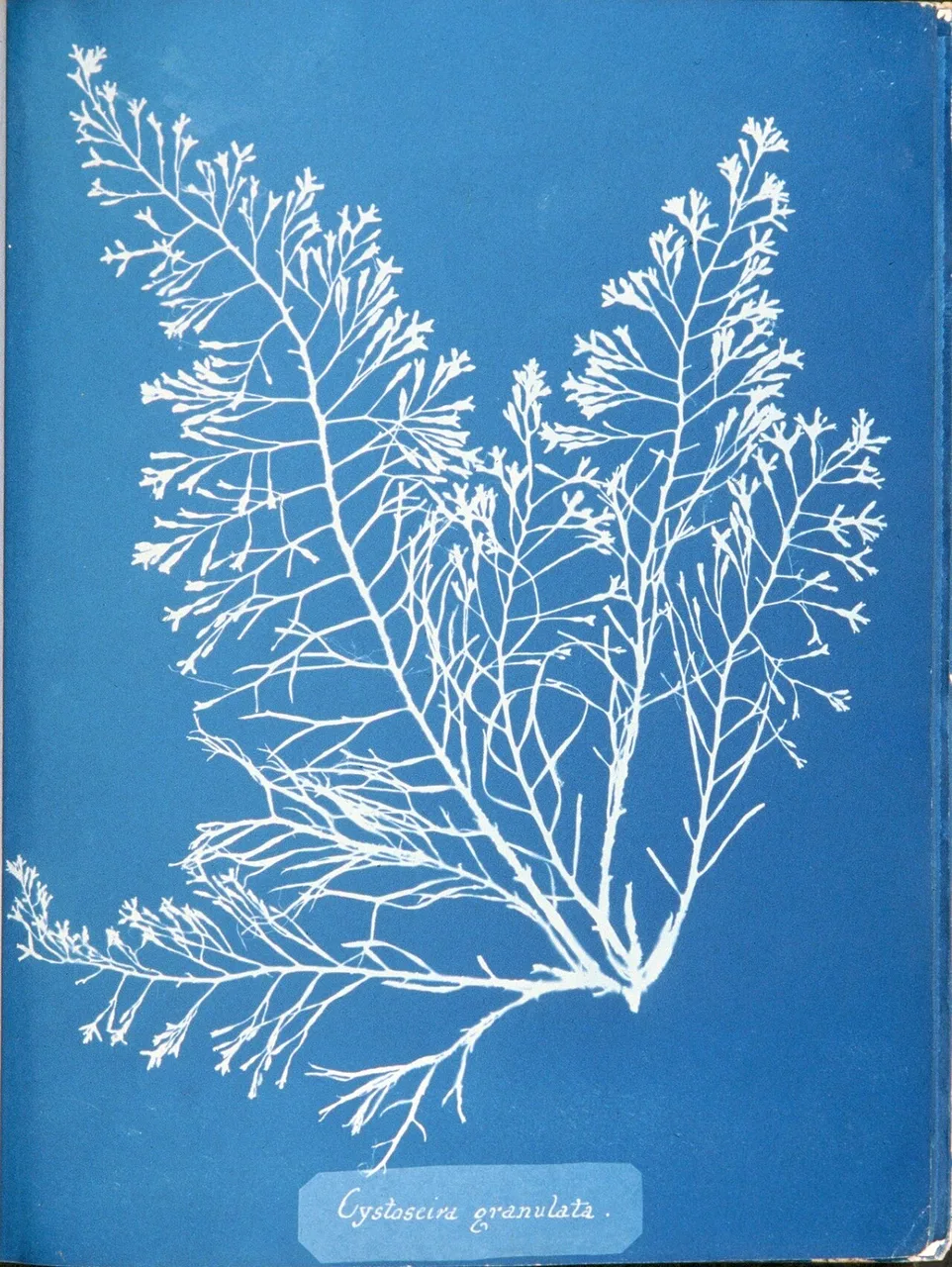
White seaweed branches across a field of deep blue. Anna Atkins placed wet specimens directly on light-sensitive paper and exposed them to sunlight. No lens or camera was required. The plant’s contact with the page preserved its form in a nineteenth-century botanical volume.
Placing seaweed on paper
A cyanotype is made by arranging an object on paper coated with iron salts, exposing it to ultraviolet light and washing it with water. The exposed ground turns Prussian blue while the areas covered by seaweed remain white. Fine tufts and overlapping branches also leave different densities of blue.
In Cystoseira granulata, a firm central axis divides into finer branches that loosen toward their tips. It is the trace of a specimen, yet it suggests the plant moving under water. The blue around it is not merely a background; it behaves like open water in which the structure can be read.
Making a botanical book with photographs
The Metropolitan Museum of Art dates Atkins’s Photographs of British Algae: Cyanotype Impressions to 1843–53, when it appeared in fascicles. Regarded as the first book to be photographically printed and illustrated, it presented algae page by page at close to the scale of the original specimens.
Atkins followed the nomenclature in William Harvey’s unillustrated Manual of British Algae of 1841 and wrote the labels by hand. Name, specimen and image met on a single sheet, joining botanical record-keeping to a new photographic process.
One exposure at a time
John Herschel invented the cyanotype process in 1842. Atkins adopted it as a way to register fragile algae without redrawing them. Direct contact with the paper could preserve cuts in a blade and the spacing between the narrowest branches.
This was not a printing process that ended after one plate had been prepared. With no negative, every sheet required the specimen to be arranged again and exposed to sunlight. Kew estimates that more than 300 individual prints were needed for the roughly ten sets now known. Passing clouds could alter the result.
Taxonomic lines and composed space
If accuracy alone had been the goal, each specimen could have been placed evenly at the centre. Atkins instead attended to crossings, tapering tips and differences in density. The diagnostic structure remains visible, but the eye is also led through the page.
The Met notes that she used specimens she collected herself as well as algae received from other amateur scientists. Collecting, naming and image-making overlapped; the volume did not emerge from one observer’s work alone.
What the blue preserved
Cyanotype later became a practical method for copying drawings and gave us the blueprint. In Atkins’s pages, however, blue records more than convenient reproduction. Light passing through a thin plant body, branches touching paper and chemistry washed away with water remain as a single act of looking.
The Cystoseira granulata image was made between 1843 and 1853 and is now available in the public domain. Following its shifts in blue reveals where the seaweed divided and where it admitted light before its historical name comes into view.
A cultivated plant can also be seen anew by attending to veins, openings and overlaps as shadow. Atkins’s blue pages preserved more than a list of uncommon specimens. They preserved time spent placing a plant quietly on paper and looking at its structure before reaching for its name.