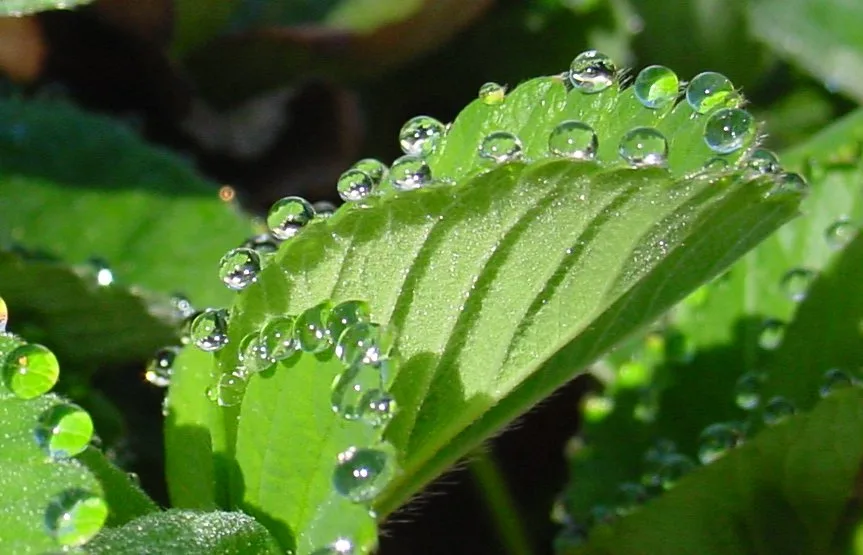
Clear beads can gather at the tips and margins of leaves by morning. On an indoor Monstera, Alocasia or pothos, a repeating pattern may be guttation: liquid pushed from inside the plant. Before treating the droplets as disease, note where they formed, whether they feel sticky and how wet the pot remains.
Begin with the pattern along the margin
Guttation emerges through hydathodes at leaf tips and margins. Overnight, droplets may line up where veins end. That regular position differs from condensation spread across a broad leaf surface or water that has fallen from above.
If one leaf is ambiguous, compare the rest of the plant. Several leaves wet at their tips or teeth in the morning, then dry later in the day, point to a process more structured than moisture simply settling from the air.
Root pressure rises while the night is still
Stomata close at night and transpiration slows. If roots continue taking up water from moist growing medium, root pressure can push water upward and out through hydathodes. High humidity, warm soil and cooler air can make the effect more likely.
This is not perspiration used to cool a body. It is another route for water when transpiration is low. A droplet alone does not prove root rot or excessive fertiliser.
Do not let one droplet set the watering schedule
There is no need to add water simply because guttation appeared overnight. Check below the surface with a finger or slim wooden stick, lift the pot, look for water in the saucer and make sure the drainage holes are open. The droplet is a clue to conditions, not a command to water.
If the medium stays wet for days and yellow leaves, soft petioles or an odour from the base appear as well, investigate persistent saturation and root condition separately. Light, temperature, airflow, pot size and the medium all affect how quickly water is used.
Check texture and leaf undersides before wiping
Sticky, irregular drops away from the leaf edge can be honeydew, especially when insects are visible beneath leaves or along petioles. Aphids, scale insects and mealybugs excrete sugary liquid, sometimes followed by dark sooty mould.
A pale ring may remain after a guttation droplet dries. Dissolved minerals and other compounds can be left behind, so wipe gently with a soft damp cloth. A mark by itself is not enough to diagnose fertiliser burn; compare it with feeding history, the growing medium and visible leaf damage.
Keep three short notes: time, position, moisture
To see whether the pattern repeats, record when the droplets appeared, where they sat on the leaf and how moist the medium felt. Add the previous watering, room temperature or humidifier use. Those few details help separate a change in the plant from a change in the room.
A bead along the leaf edge is not necessarily an alarm. It is the movement of water from root to leaf made visible by the night. Check its position before wiping it away and the next watering decision can remain unhurried.