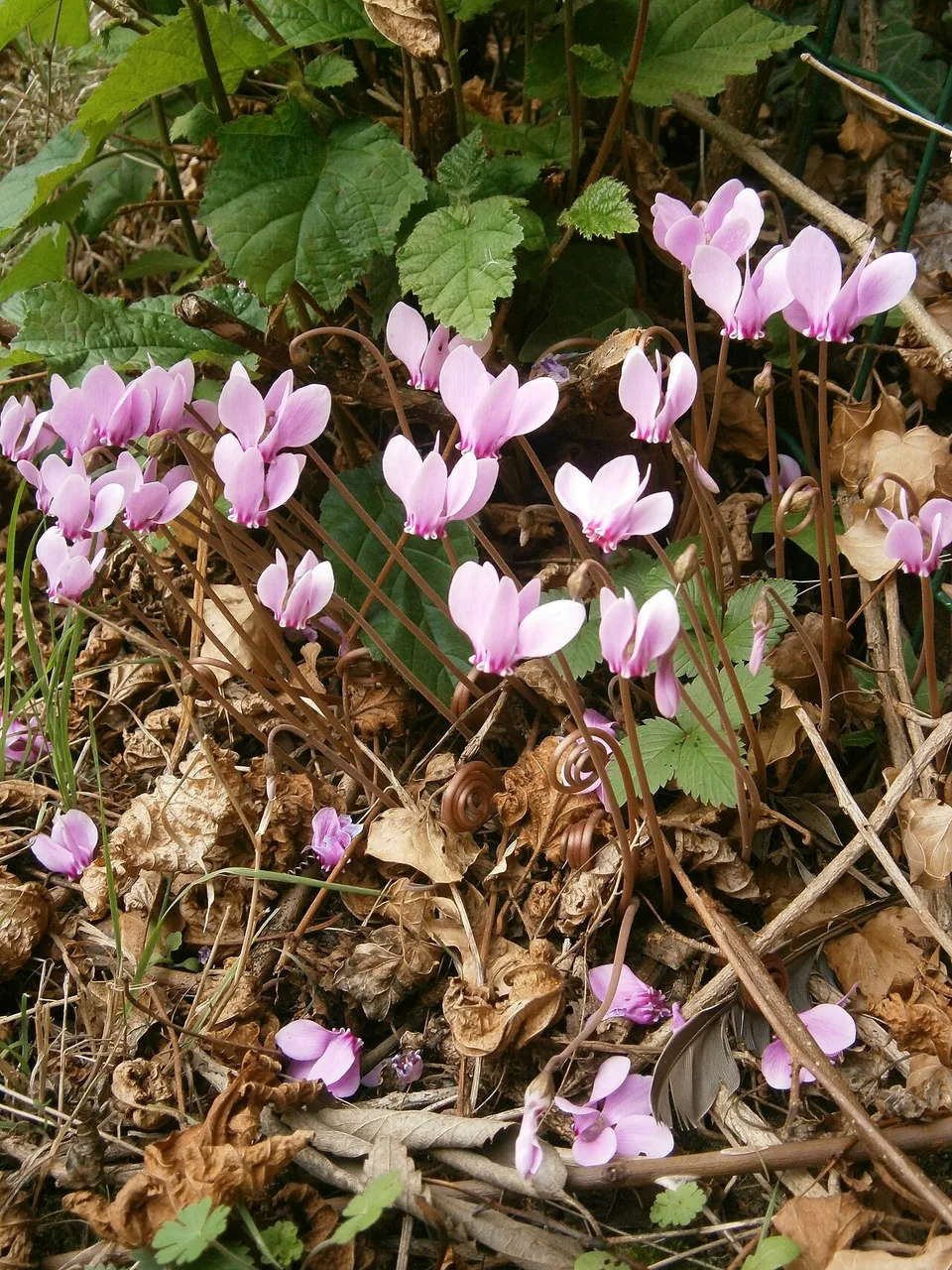
The first growth to rise from the pot is often not a leaf but a slender flower stem. A pink, reflexed bloom appears, followed at soil level by foliage traced with silver. Cyclamen hederifolium, one of the species cyclamens, makes the sequence of returning from summer dormancy into autumn visible.
Flowers rise before the leaves
Cyclamen hederifolium is a tuberous perennial in the Primulaceae. Kew treats it as a temperate plant native from France to Türkiye. The Royal Horticultural Society describes pink flowers opening before or with the leaves on a plant that remains around 10 centimetres tall.
It is not simply a miniature version of the florist’s cyclamen sold for winter rooms. The name here refers to plants identified as Cyclamen hederifolium. If a plant has no label, do not assign the species from flower colour or leaf shape alone; ask the seller for the botanical name.
Every leaf pattern is its own record
The leaves are not limited to the angular ivy shape suggested by the name. The Cyclamen Society records forms ranging from broad hearts to spearheads, patterned in pale green, silver or grey on dark green. Choosing by flower alone misses the second character that may unfold weeks later.
Make three photographs: the first flower, the first fully expanded leaf and the whole pot. Include the date and botanical label. Next year, the order of emergence, the returning leaf pattern and the spread of the same plant can be compared. When looking at shared images, the label and leaf outline are more useful than colour corrected by a screen.
Read new growth, not the calendar
The disappearance of growth in summer does not by itself mean the plant has died. It rests in an underground tuber and returns as autumn rain arrives. The Cyclamen Society places flowering in the wild from August to October and notes that its timing depends on the start of the autumn rains.
Avoid a fixed rule such as watering a set number of times each week from October. When a new flower stem or leaf stalk is visible and the surface mix has dried, water until excess drains from the base. Empty the saucer, then wait for surface dryness and a lighter pot. Do not keep adding water to a still-dormant pot because of the date alone.
Bright partial shade is the starting point. The RHS recommends humus-rich, well-drained soil and avoiding excessive summer moisture. In a container, include coarse material that helps drainage rather than using a dense fine mix alone. UK hardiness ratings do not describe Japan’s humid heat or long rainy spells, so they should not decide the position by themselves.
Move the pot out of persistent autumn rain
Autumn is an active season, but prolonged saturation removes air from the root zone. Once flowers and leaves begin moving, use a place such as a bright eave where rainfall can be moderated and air can pass. The aim is not to keep the plant bone dry, but to provide both moisture for new roots and time for surplus water to leave.
If crowded flowers or leaves develop grey mould, the crown softens or an odour appears, do not add more water and wait. Separate damaged material with clean tools and check airflow and the potting mix. The RHS also lists mice, squirrels and vine weevil among possible problems for hardy cyclamen.
Do not plant the tuber too deeply
The RHS gives a planting depth of about 5 centimetres. Change depth during dormancy rather than digging around emerging flower stems and roots. Before repotting, photograph the current depth and orientation of the tuber; the reference helps prevent losing track of its position.
Wash after handling
Cyclamen tubers are not food. The RHS advises gloves and protective equipment when handling them and keeping them from pets. Wash hands and tools after repotting, and do not leave the pot where children or animals can dig it up. If ingestion or illness is suspected, give the plant name to a medical professional or veterinarian.
Collect the flower and the leaf separately
The value of one plant is not exhausted by its flower count. Record the first bloom, the first leaf that follows and the pattern spreading into winter. Place the season’s first watering within that sequence, and care becomes connected to the plant’s movement rather than a table of frequencies.
What silver line will appear after the pink flower? An autumn with Cyclamen hederifolium includes not only the moment of bloom, but also the wait for the next leaf.