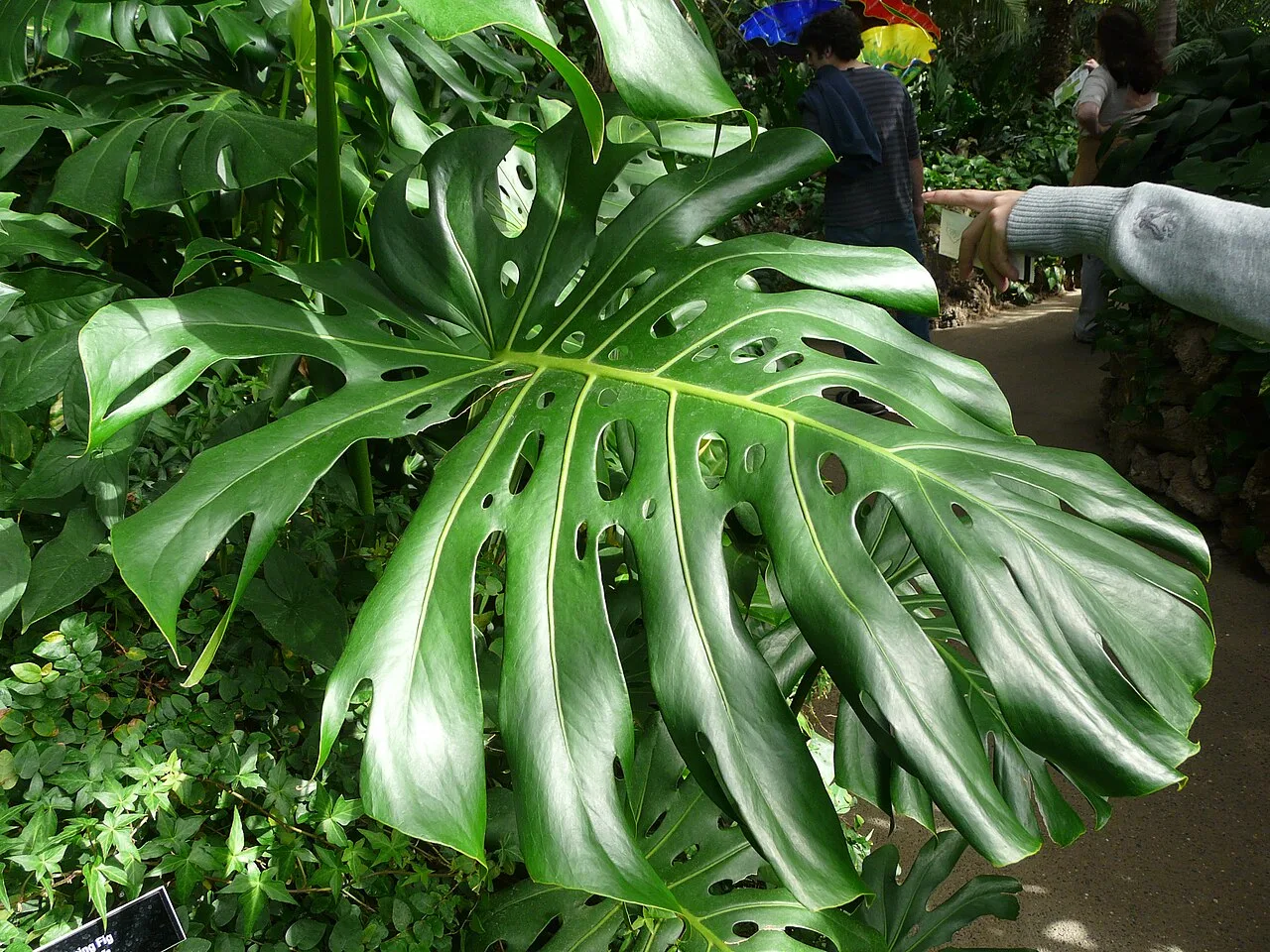
A fully opened Monstera leaf will not gain new fenestrations simply because you keep watching it. Splits and holes are formed while the leaf is still developing and tightly rolled, then revealed as it unfurls. Looking to the next leaf, rather than waiting on the current one, makes maturity and changing growing conditions easier to read.
A leaf’s outline is set before it opens
Monstera holes are part of the leaf’s architecture, not damage. Classical morphological research describes tiny perforations forming while the young leaf is rolled. As the blade expands, those openings widen; some reach the margin and appear as deep splits.
Once a leaf has finished unfurling and hardened, it does not develop new, normal fenestrations. A tear at the tip or edge, a missing section with browning, or an insect feeding mark should be read separately from the plant’s natural pattern.
A young plant’s round, unperforated leaves are not a failure. Monstera changes leaf form as it matures. Larger adult leaves are more likely to carry holes and splits, so the progression appears across successive new leaves rather than midway through one old leaf.
Compare four details on each new leaf
Record leaf size, splits entering from the margin, enclosed holes within the blade, and the distance between nodes. Photograph each new leaf from the same angle and place the images side by side. That sequence shows how the plant is maturing.
Monstera deliciosa is a liana native from Mexico to Guatemala in the wet tropics. It climbs supports such as trees and produces aerial roots. Indoors, stable upward growth on a support can help the plant reach the size at which larger leaves are produced.
A support will not add holes to an existing leaf. Position it so the stem can rise without being forced into a sharp bend and so nodes and aerial roots can meet the surface. Tie the stem loosely, not the petiole, and leave room for thickening.
Do not make light the only answer
Useful light supports the growth that produces the next leaf, but light alone does not determine a fenestration count. Maturity, leaf size, climbing habit and root health overlap. Read the trend across new leaves instead of reducing a solid leaf to one missing input.
Increase exposure gradually when moving the plant to a brighter position. Large leaves can scorch after a sudden shift into direct sun. Shorten the distance to the window in stages and watch for bleaching or dry brown patches.
Watering is not a technique for making holes. Use a freely draining mix and water thoroughly after the top 5–7 centimetres has dried. Empty the saucer, and in cooler conditions reassess how slowly the root zone is drying.
Separate fenestrations from damage
Natural fenestrations have an established outline when the leaf opens and appear in relation to the vein pattern. Irregular tears that develop later, abraded edges, or expanding brown tissue point instead to handling damage, dry conditions, pests or disease.
Leaves and stems contain needle-shaped calcium oxalate crystals that can irritate the mouth if chewed. Keep the plant beyond the reach of cats, dogs and small children, and wear gloves when pruning or training exposes sap.
Do not wait for the current leaf to change. Wait for the next one. Record its opening date, position, attachment to the support, size and fenestration count. Leaf by leaf, the plant will show how it changes form as it climbs, at its own pace.