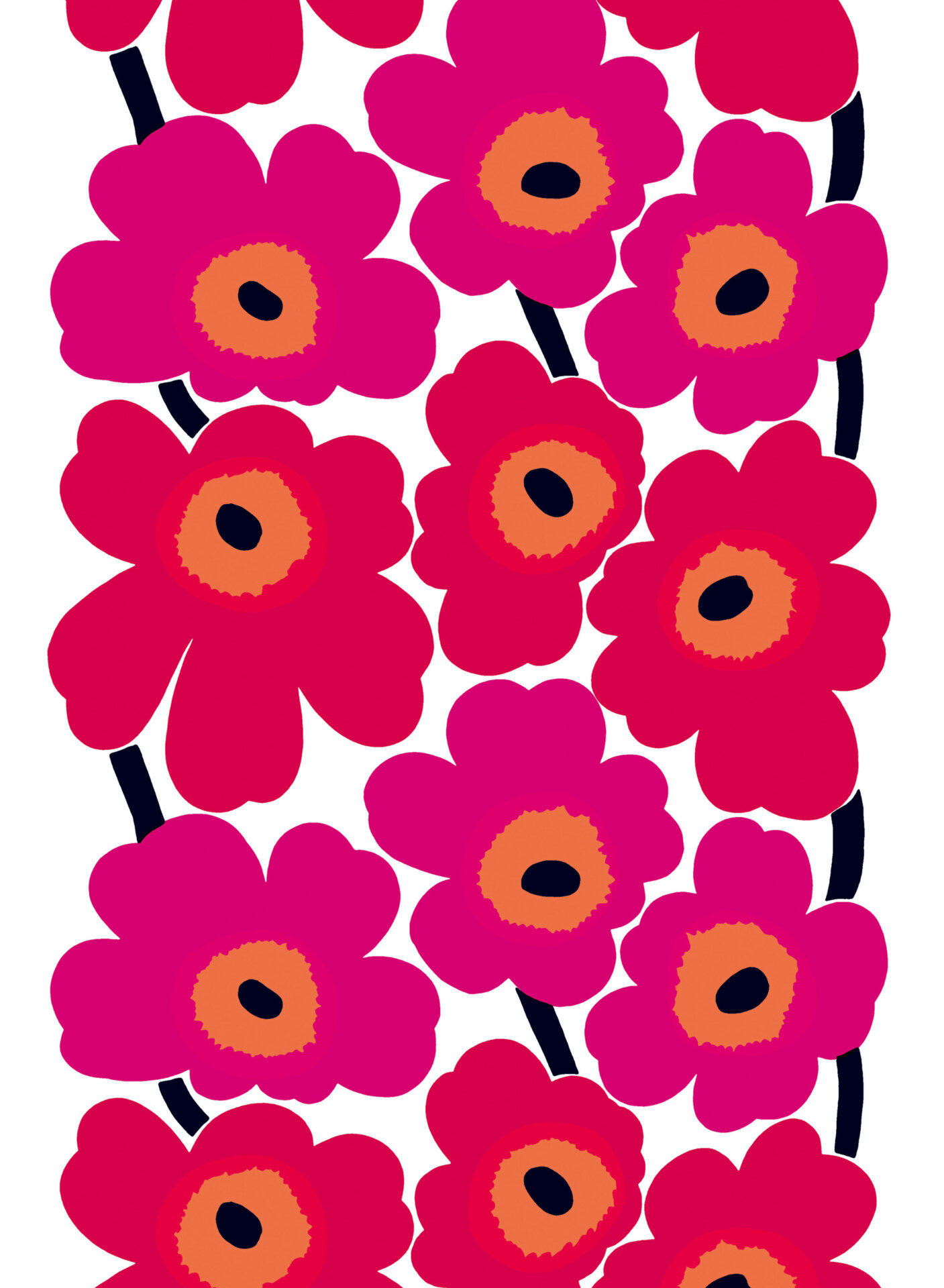
White petals around a black centre press outward across green cloth. Maija Isola’s 1964 Unikko does not record a poppy in botanical detail; it turns one flower into a bold form made for repetition. At Marimekko: Art of Printmaking, opening October 3, that flower begins to move across fabric and dress.
Turning one flower into a repeat
The motif in Unikko is a poppy. Irregular petals open around a round centre, while stems, leaves and fine veins fall away. By holding on to the frontal flower alone, the design changes a plant from an illustration into a unit of print.
In the official press image, white petals, black centres and a green ground are sharply divided. The same flower continues at shifting angles and intervals. Petals are cropped at the edge of the cloth, implying the next bloom beyond the frame.
Repetition does more than make the flowers uniform. Large blooms alternate with open ground, so distance changes what the eye receives. Up close, the wavering outline stands out; farther away, the rhythm of flowers takes over.
When the flower moves onto a dress
The Tokyo exhibition brings together more than sixty dresses from early and recent decades, alongside fabrics and material that reveals how they were made. A flower repeated on flat cloth changes once it is cut, joined and carried over the curves of a shoulder or waist.
The exhibition also looks behind Marimekko’s catalogue of more than 3,500 print designs. A moving-image installation about the Helsinki print factory follows the process through which colour and form settle onto fabric.
With Unikko, follow the interruptions in the pattern rather than stopping at the name of the flower. Notice how much of a bloom remains at a hem, or how a centre and its petals shift around a seam. Those transitions are where a plant form meets the movement of clothing.
Placing the flower inside an Art Deco residence
The museum’s main building is the former residence of Prince Asaka, shaped by French Art Deco decoration of the 1930s. Patterns already live in its walls, lights and doors; bold prints from the later twentieth century enter that setting.
There is no need to isolate the floral print from its surroundings. Curves simplified from a plant, the geometry of the building and the outline of a dress can share one field of view. Pattern becomes more than surface decoration: it helps set the scale of a room and a body.
Photography is not permitted for most works in the exhibition. The visit therefore offers time to judge the scale of the flower, the boundary between colours and the weave of the actual cloth. Learning the form from the official image first can free the eye to notice thickness and volume in the gallery.
Choose a time before you go
The exhibition runs from October 3 to December 20 in the museum’s main and new buildings. Hours are 10:00 to 18:00, with last admission thirty minutes before closing and Mondays generally closed. General admission is ¥1,400. Entry uses timed reservations, so tickets should be purchased before visiting.
Begin with one Unikko bloom, then widen the view to the repeat, the cloth, the dress and the building. The poppy does not stop being a plant when it leaves natural scale. The exhibition lets us walk the line between the features that preserve the flower and the choices that turn it into pattern.