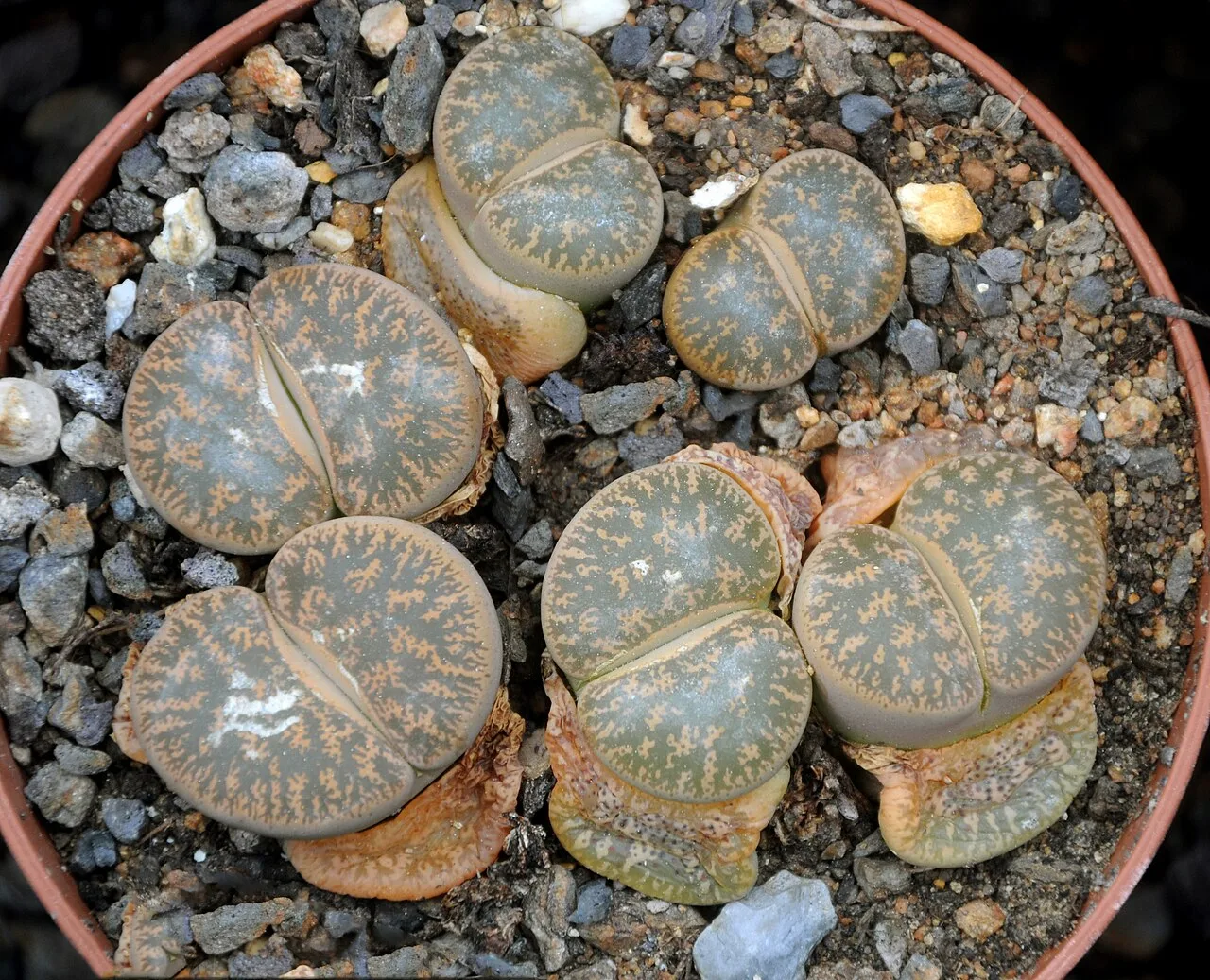
Lithops lesliei sinks so low among grit that almost everything visible above the surface is one pair of leaves. As a dry summer ends, cooler autumn conditions alter the firmness of those leaves and the cleft between them; a flower may follow. The signal to resume watering is not a date. It appears in the leaves, the pot and the temperature together.
The stone-like surface is the tip of a leaf
Lithops lesliei is a perennial succulent in the ice-plant family. Kew records its native range from southeastern Botswana to South Africa’s Free State. In desert and dry shrubland, its low body merges visually with stones at the surface.
Most of the plant remains below ground, while the flat tips of the leaves stay visible. Translucent windows in that surface admit light to the interior. The pattern is not decoration alone; it forms part of a structure that keeps exposed tissue small while receiving light in an arid landscape.
Two leaves face each other across a central cleft. In autumn or early winter, a white or yellow-toned flower may rise from that opening. Plants sharing one pot do not necessarily regain firmness or flower together, so a cluster is better observed head by head than treated as one unit.
Do not rush the move out of summer dryness
Botanic-garden guidance describes spring and autumn as the normal growing seasons for Lithops, with summer and winter kept dry. That does not mean watering a cultivated plant simply because September has arrived. Residual heat, night temperature, growing medium and airflow all shift the end of dormancy.
First look for light wrinkling along the sides, confirm that the growing medium has dried to the bottom, and lift the pot to judge whether it is genuinely light. If hot nights persist and the leaves remain firm, wait. Avoiding a calendar-only decision reduces the risk of the first autumn watering arriving too early.
When conditions are ready, water in the morning so the whole root zone is wetted, then let excess run freely from the drainage hole and empty the saucer. Restore airflow and wait for the medium to dry again. Small daily sips erase the dry interval and can leave the underground body vulnerable to rot.
A flower does not mean more water
A bud in the cleft can help confirm active growth, but it is not a request for water every day. Read it alongside leaf firmness, pot weight and drying speed. If moisture from the previous watering remains, the next one can wait.
Keep the plant in strong light and a freely draining medium. A plant moved directly from summer shade into intense sun can scorch, so increase exposure in stages. Air movement matters not only at the surface but also because it restores a clear drying interval inside the pot.
Indoors, distinguish cool nights near the glass from daytime heat trapped at the sill. Outdoors, protect the pot from prolonged rain and sudden cold. After changing its position, do not inherit the old watering interval unchanged; measure how long the pot now takes to dry.
In winter, new leaves use the old pair
During winter, a new pair develops through the cleft while water and nutrients move out of the old leaves. Adding water while the old pair is thinning can disrupt that transfer. Keep the plant dry while the new leaves are absorbing the old ones.
Autumn watering is not a fixed count. Record the paired leaves, pot weight, depth of dryness and night temperature in the same order each time, and the restart of growth in that particular pot becomes visible. The stone-like body does not hide change; it narrows the places where change must be seen.