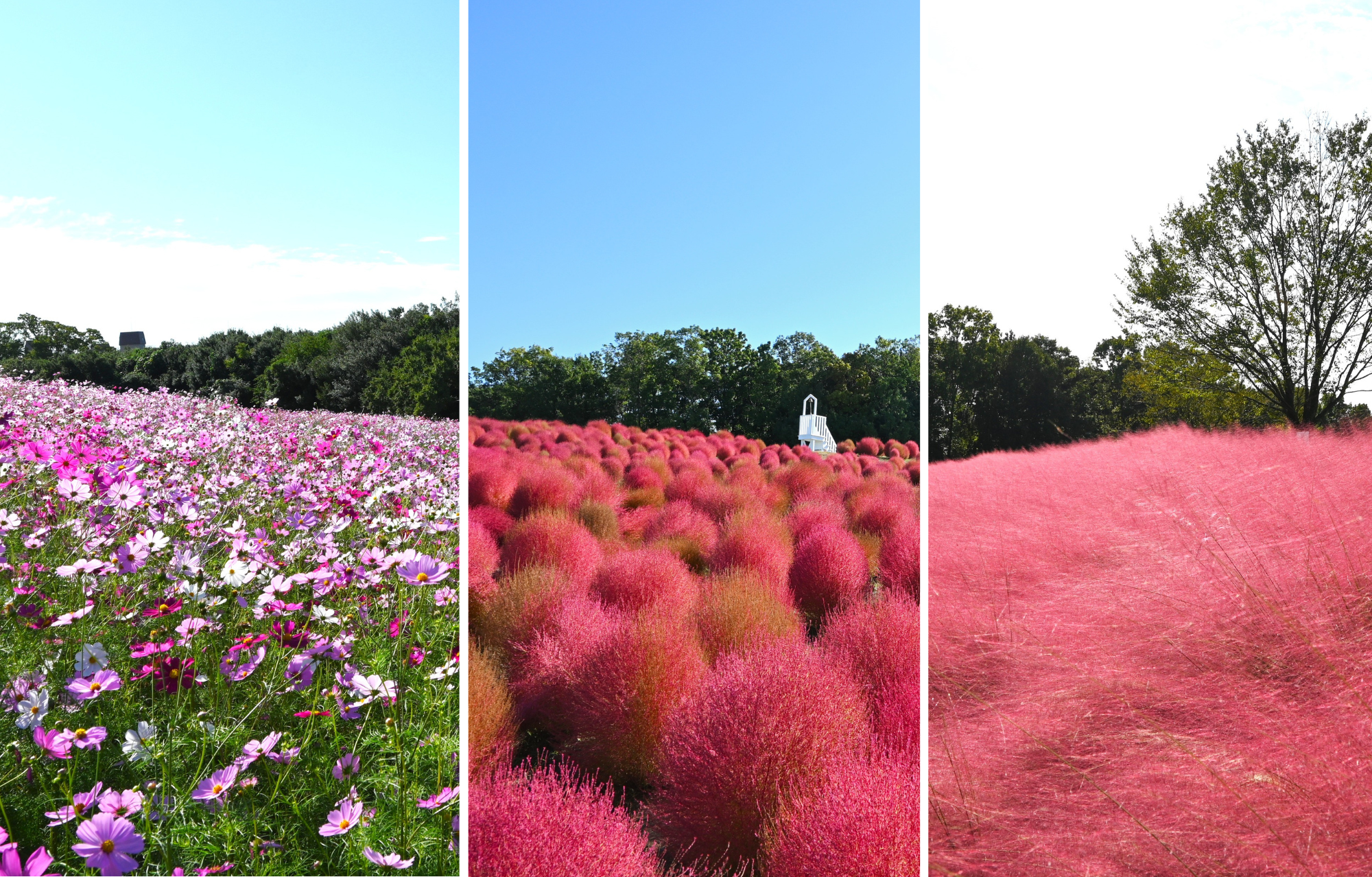
Thin petals, densely branched ovals and flower panicles that loosen like smoke will share Flower Hill at Expo ’70 Commemorative Park from 3 October. The planting brings together 150,000 cosmos, 3,600 kochia and drifts of pink muhly grass. Beyond the broad fields of colour, the walk reveals how three distinct plant forms receive light and wind.
Flowers, rounded shrubs and fine panicles
The cosmos planting centres on mixed pink and white Sensation forms, a white selection and yellow-flowered cosmos. Their blooms sit apart on slender stems. From a distance they merge into layers of colour; close up, sky appears between individual flowers, and only the surface of the field leans when a breeze passes.
Kochia builds volume from a dense mesh of fine stems and leaves, giving each plant an oval outline. The official notice highlights the autumn colour of 3,600 plants, but temperature and timing govern that change. Rather than expecting uniform red on opening day, look for differences among plants as green shifts towards crimson.
Pink muhly grass makes another kind of surface: overlapping, threadlike panicles create a pale haze. Small red buckwheat flowers add a fourth note. Across the hill, cosmos reads as scattered points, kochia as rounded mass and grass panicles as accumulated lines.
Use the planting map to shape the walk
The official event notice includes a 2026 planting map. Instead of trying to capture the whole hill at once, move first through the plane of cosmos flowers, then the ranks of kochia and finally the fine panicles of muhly grass. The sequence keeps their different structures legible.
Angled morning light can pass through layered petals, while low light can define the edge of kochia and the fineness of grass panicles. Weather and flowering conditions change daily, however. Rather than prescribing one perfect hour, choose where to pause according to the day’s wind and cloud.
Keep paths open when photographing and do not occupy one place for long with a tripod or other fixed equipment. Visitors must stay out of the muhly grass and use the marked photography area. Leaving flowers and branches untouched, and taking no plants from the park, preserves the same forms for the next person.
Peak season is not a single date
The festival runs from 3 to 30 October. Separate official updates cover cosmos, kochia, pink muhly grass and red buckwheat. Checking them before travelling avoids compressing flower count, autumn colour and mature panicles into one vague promise of “full bloom.”
After rain, petals and panicles hold water; in strong wind, slender cosmos stems move more visibly. The lightness of a dry, clear day is only one version of the hill. Each plant group answers weather differently, allowing the same ground to look newly arranged.
Flower Hill from 3 October
The event runs every day from 3 to 30 October. Hours are 9:30 a.m. to 5 p.m., with final admission at 4:30 p.m., in Flower Hill and other parts of the Natural and Cultural Gardens. Festival viewing is free, but the shared admission charge for the gardens still applies.
Mölkky sessions and a small market are planned for the opening weekend, followed on selected dates by portrait sessions, music and workshops. A quiet plant-focused visit and a day with added programmes will feel different, so check the official event notice and choose the date that matches the intended pace.
The figure of 150,000 describes more than the scale of a distant view. Move closer to the space between individual flowers, the rounded weight of 3,600 kochia and the gaps left by fine grass panicles, and Flower Hill becomes three plant surfaces rather than one autumn colour field. An October visit can begin by reading those differences from the path.