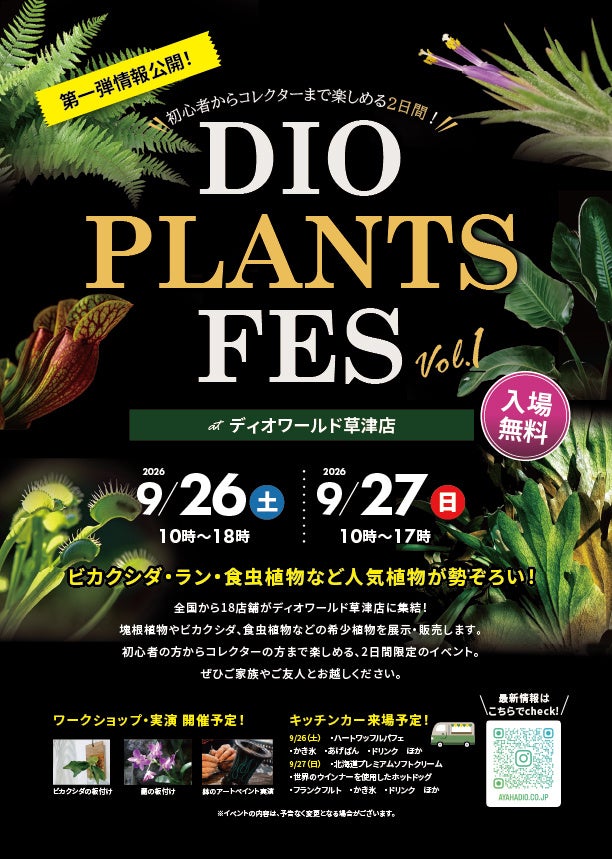
Staghorn ferns, caudiciforms, carnivorous plants, orchids, aroids and bonsai share one floor in Kusatsu on 27 September. DIO PLANTS FES is scheduled to bring together 18 specialist shops and remains open until 5 p.m. Instead of choosing in haste, ask how a plant’s leaves connect to its roots, how it is being kept now and how it was propagated. The aim is to carry its striking form into daily life with its needs intact.
Compare six plant groups in one place
The announced range includes epiphytic staghorn ferns, water-storing caudiciforms, carnivorous plants, orchids whose flowers depend on healthy roots, aroids with widely varied foliage, and bonsai shaped through branch and container. They may all be described as unusual plants, but their points of interest and environmental needs do not overlap.
On the first circuit, look at silhouettes before price tags. Do you want a plant mounted on a wall, placed by a window or read as a small sculpture above its pot? Choosing one role in the room makes differences among the 18 scheduled shops easier to see.
Ask for the name and growing history first
For a promising specimen, ask for its scientific or cultivar name, whether it was seed-grown or vegetatively propagated, and where it was raised. Similar foliage can hide different species and propagation histories, which affect growth rate and mature size. Ask permission before photographing a label.
Then ask about its current position and watering. Replace the vague phrase “bright place” with details: indoors or outside, hours of direct sun, and how long the pot was allowed to dry before watering. A specific recent routine can be compared with conditions at home.
As autumn moves towards winter, minimum temperature and dormancy also matter. Do not assume that a new plant needs immediate repotting. Confirm the medium, visible roots at the drainage holes, timing of the next watering and a place for cold nights. Fewer abrupt changes help preserve the healthy form seen at the event.
Read a one-off plant together with its pot
With caudiciforms and bonsai, look beyond the preferred front. Check whether the plant sits firmly in the pot and whether the base has unexplained wounds or soft areas. Do not pull it out for inspection; ask when it was last worked on and when repotting would be appropriate.
For carnivorous plants, a tray of water is not a complete care guide: ask about water quality, medium, light and winter treatment for that species. With orchids, read root colour and air around the pot; with aroids, inspect the newest leaf and nodes; with staghorn ferns, look at shield fronds and how the mount dries. The questions should change with the plant.
Choose an order for the floor
Begin with two shops in the plant group that interests you most and note their growing conditions. Move to another group only after that comparison; it reduces decisions based on the first dramatic specimen. Workshops and food trucks are also planned, so avoid carrying a purchase around longer than necessary.
The venue is Dio World Kusatsu, 1-23-1 Nishishibukawa, Kusatsu, Shiga. The event is announced for 10 a.m. to 5 p.m. on 27 September, with free admission, about a three-minute walk from the west exit of JR Kusatsu Station. Check the official notice before leaving in case hours or exhibitors change.
An exhibitor list and venue notice do not guarantee a particular specimen. If the species you wanted is unavailable, resist replacing it simply to leave with something. Asking about a future arrival or a plant still being raised can be the more useful result of meeting specialist growers.
Rarity alone does not choose the plant to take home. When its name, propagation history, current routine and the light and temperature available at home can all be described, its form has a place to continue. The walk among 18 scheduled shops becomes the first entry in that plant’s care record.