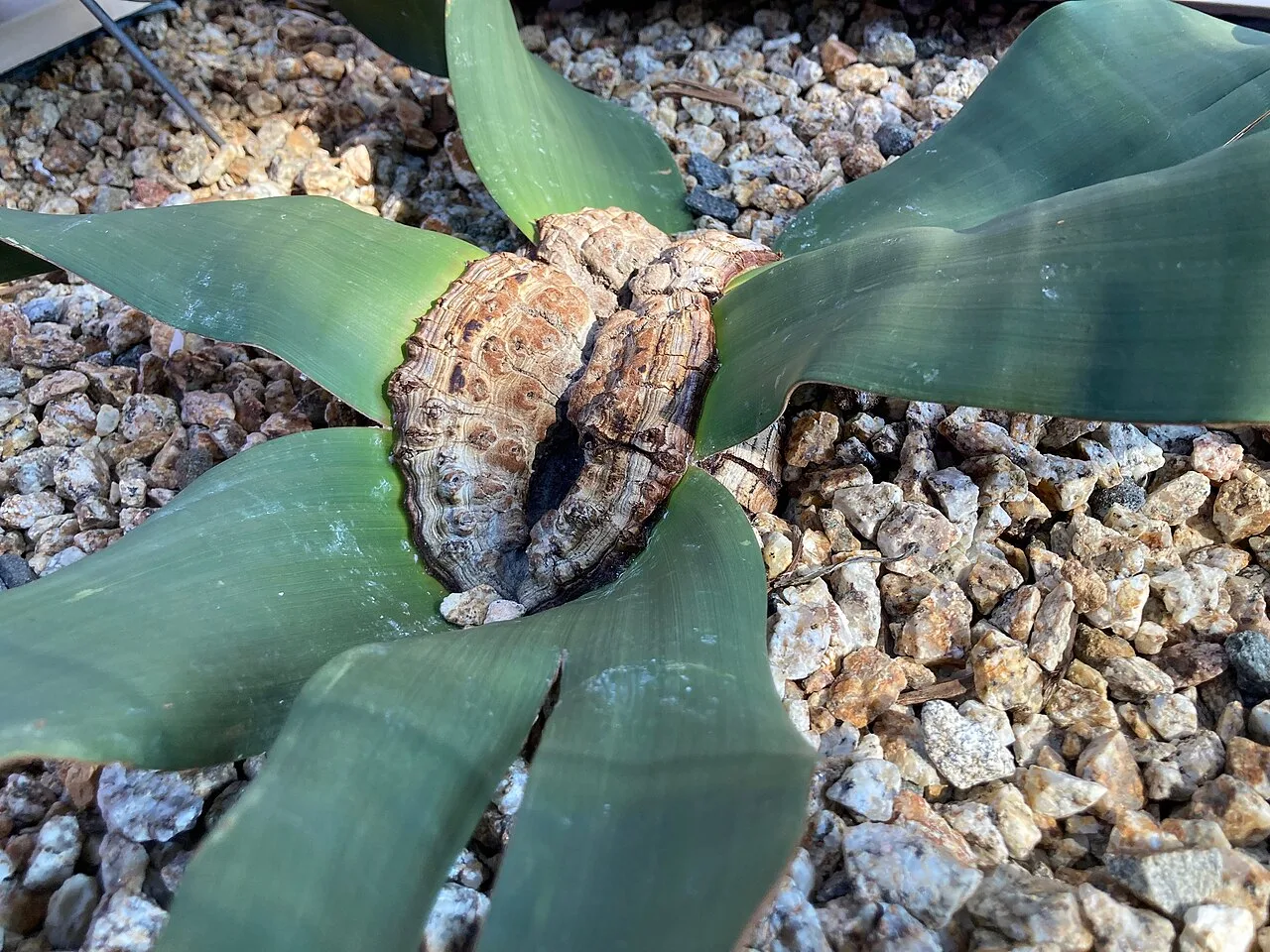
The plant appears to carry many leaves around a short woody stem. In fact, Welwitschia mirabilis produces only two true leaves in its lifetime. Their bases keep growing while wind, sand and time split the ends into ribbons. In the photographed specimen, broad blades run along the ground and overlap around the stem. Separating the growing base from the frayed tips makes the plant easier to read.
Length increases, not leaf number
After germination, the two true leaves continue to grow from their bases at the top of the stem. Growth continues even as the ends wear away. The narrow strips are not a succession of new leaves; they are longitudinal sections of the same two blades.
Kew notes that the leaves can reach 8 to 14 metres in long-grown plants. Leaves lying on the ground also bend, dry and disappear from the tips. In cultivation, the fresh green growth at the base tells more than a record length.
Male and female cones rise from a low stem
Welwitschia is a gymnosperm and bears cones rather than flowers with petals. Male and female cones occur on separate plants. Mature male plants carry slender pollen cones, while female plants form larger seed cones.
The low woody structure between the leaves is the stem. Branched cone-bearing shoots emerge around its rim. The leaves dominate the silhouette, but the position of stem and cones helps reveal a plant’s stage of maturity.
The species grows in arid country extending from Namibia into southern Angola. Coastal fog is part of its story, but roots also travel into the ground. Two exposed leaves and a hidden root system sustain the same long-lived plant.
Look at the growth point, not a guessed age
Frayed leaves alone cannot reveal an individual’s age. Damage varies with conditions and long strips are gradually lost. Stem size, cones and cultivation records add context, but a precise age requires a documented history.
On a cultivated plant, the central area that produces the two leaves needs protection. Cutting a split blade back to its base in pursuit of a tidier outline can bring a tool too close to living growth. Fraying is not automatically a defect; it is also the visible consequence of continuous extension.
SANBI recommends a deep container for the root and a sandy, freely draining medium. Before repotting a new specimen, ask about root depth, drainage and its previous routine, then choose a position that allows continuity rather than an abrupt reset.
Provenance belongs to the plant’s form
When considering a cultivated specimen, ask when and where it was raised from seed and what origin the seller can document. An aged, wild-looking appearance is not evidence of quality. A traceable cultivated history is a better beginning for years of observation.
The photographed plant was recorded at the University of California Botanical Garden. Its spreading blades, low stem and cone-bearing shoots can be compared in one frame. Following a frayed tip back towards the centre reveals how each leaf remains continuous.
Welwitschia is not strange because it has many leaves. It is strange because it keeps making the same two from their bases, losing their ends while preserving the history of one plant. Stop counting the strips and look for their point of origin: the apparent tangle becomes a coherent structure.