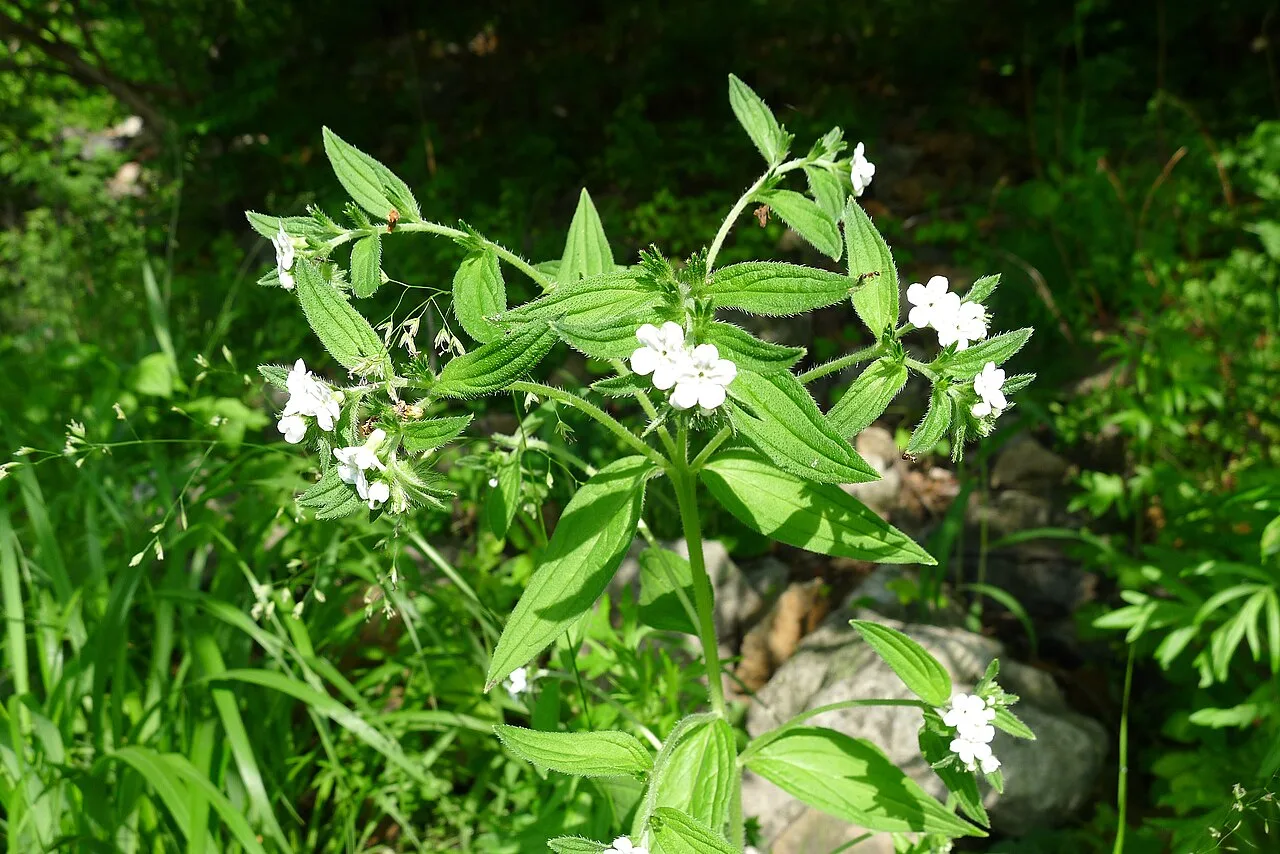
The small flowers are white. The plant is called murasaki because its roots hold a reddish-purple colour beneath the soil. In Kami, Miyagi, those roots are cultivated and their colour is carried into silk.
White flowers, red roots
The accepted botanical name is Lithospermum erythrorhizon. Kew Science records it as a perennial in the borage family, native from eastern Siberia to Japan.
Above ground, slender stems carry leaves and small groups of white flowers. The clue to its Japanese name lies below. Kami calls the root shikon and records its long use as both a dye material and a medicinal plant.
Colour moves from root to silk
Shikon is described alongside safflower and indigo as one of Japan's representative plant colourants. Kami's account also notes that purple made from the root once signalled high court rank.
The white of the flower, the red-purple of the root and the violet of dyed cloth are not identical. Colour changes according to the part of the plant and the material that receives it.
A textile workshop in Kami uses locally grown shikon for silk wrapping cloths, pocket squares and shawls. Cultivation and dyeing meet before the colour of a root can arrive close to the body.
Cultivated below Mount Yakurai
The plant is grown in settlements below Mount Yakurai, a symbol of Kami. The town describes this area as the inner reach of the Osaki Kodo Globally Important Agricultural Heritage System.
Wild populations have declined in Japan, where the plant is listed as endangered. Cultivation gives the root a working future while keeping the living species in view.
In the selected photograph, small white flowers rise above narrow leaves without announcing the strong colour below. The contrast between a quiet shoot and a colour-bearing root makes the plant memorable.
Follow the colour in three stages
Begin with the white flower. Then consider the reddish-purple root, and finally look at the violet that settles into silk.
The flower alone leaves the name unexplained. The root alone removes the plant from its living form. Flower, root and cloth together show how colour moves from one part of a species into culture.
Kami's murasaki flowers in white, stores colour below ground and passes it into silk through human hands. Its purple is not a single bloom but the meeting of cultivation time and dye work.