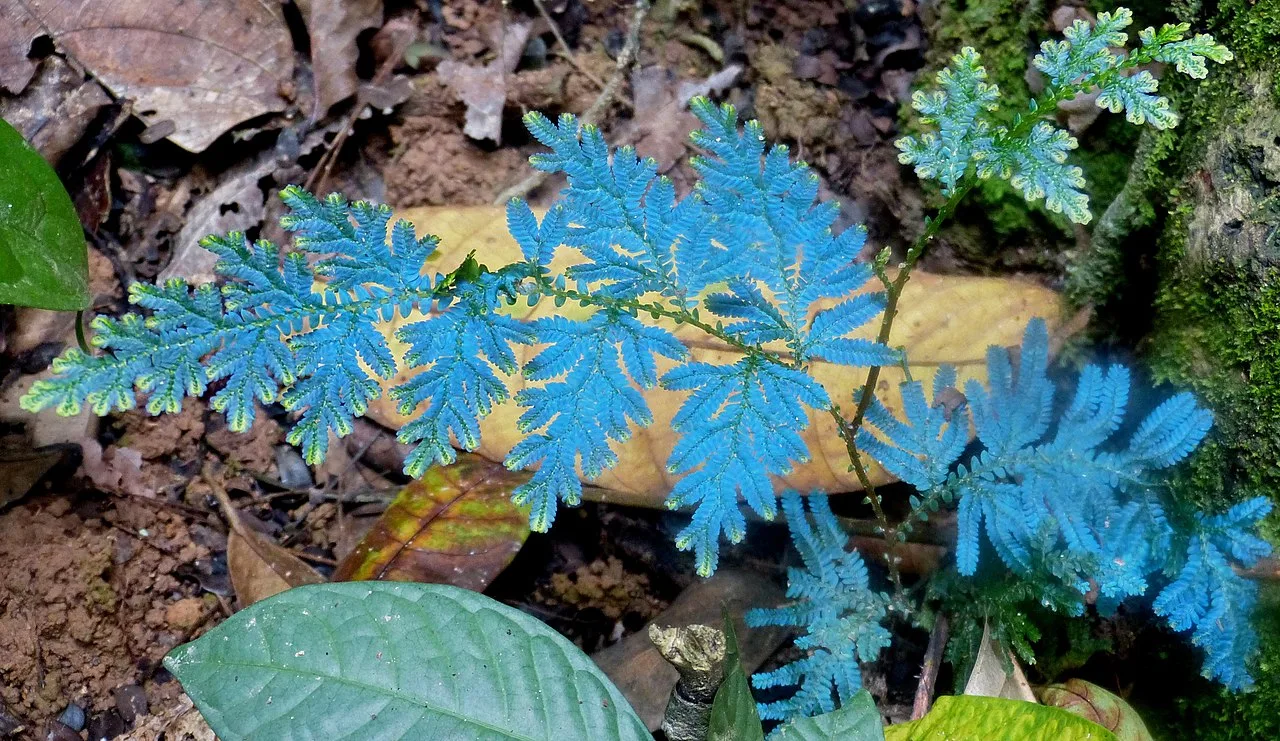
Seen at an angle, blue light travels across the green layers of tiny leaves. Selaginella willdenowii does not hold one flat colour; its appearance shifts whenever the direction of light and the viewer changes.
Blue begins at the leaf surface
Singapore’s National Parks Board describes the species as metallic blue-green, with green and pink tones appearing from different angles. A photograph captures only one moment of a plant that can look different without changing leaves.
Royal Botanic Gardens, Kew explains that microscopically thin transparent layers in Selaginella leaves reflect rays that our eyes read as blue. This is structural colour: the leaf’s architecture returns light in addition to the colour supplied by pigments.
A collection includes the viewing angle
A branch that looks blue from the front may settle back into deep green when the pot turns. Rather than expecting uniform blue, watch how light moves across the plant in the morning and evening, and from the window side to the room side.
Leaves only a few millimetres long sit in two rows along scrambling stems, which may climb through nearby vegetation. Looking at the branching and overlap, not just a cropped blue patch, reveals how the whole plant meets the light.
Kew’s Plants of the World Online accepts Selaginella willdenowii as the species name and places its native range from south-eastern Bangladesh to southern China and western and central Malesia, in the wet tropical biome. Although fern-like, it is a lycophyte rather than a true fern.
Do not chase blue with harsh light
In nature the plant occurs on tropical forest floors. NParks recommends semi-shade to full shade and ample moisture. Moving a plant abruptly into harsh light to intensify the blue runs against that habitat.
After any change of position, watch more than colour: dry leaf tips, the firmness of stems and the pace at which the mix dries all matter. The ecological function of iridescence should not be reduced to one explanation; visible reflection and the plant’s growing conditions are separate questions.
Keep moisture steady and air moving
A preference for shade does not mean sealing the plant in a dark, still container. Keep the growing medium evenly moist while choosing a place where air can move through the foliage. Read the mix and new growth instead of using leaf colour alone as a moisture gauge.
In a dry room, support humidity around the pot without letting water remain stagnant for long periods. Change one condition at a time and check the tips and growing medium every few days, so the pursuit of blue does not exhaust the plant.
The blue of one pot never stays in one place
Collecting Selaginella willdenowii is about more than owning a blue plant. Thin leaf layers, the angle of light and overlapping branches make a colour that belongs to a particular moment. Each turn of the pot moves the blue, carrying the shifting light of a tropical forest floor into the room.