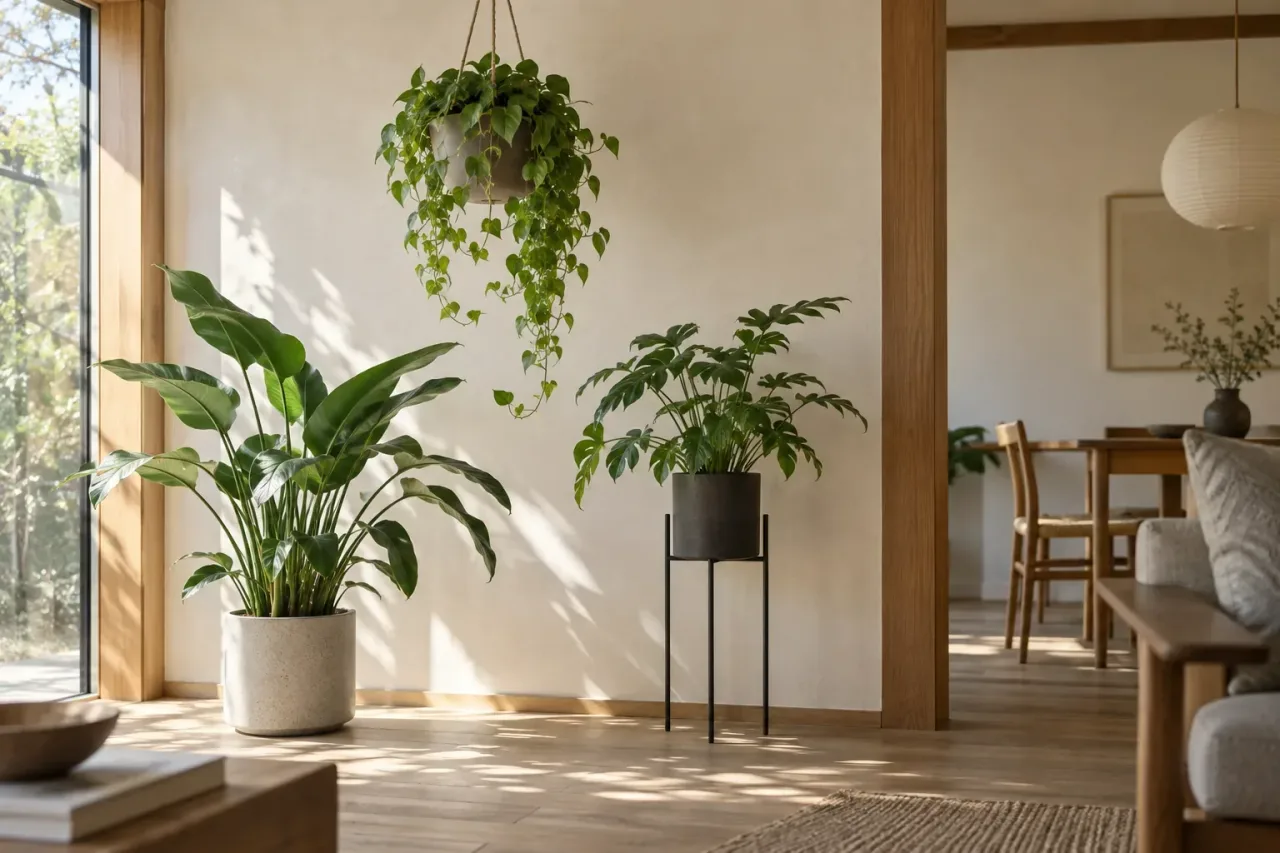
A plant’s position should not be decided only by an empty patch of floor or shelf. The structure of a pot, the height of a stand, and the choice to hang a plant can alter its access to light, its relationship to a room, and the ease of daily care.
This article contains advertising links. Products are selected according to RareDex editorial standards; neither a purchase nor a commission affects the assessment.
Do not let leftover furniture space make the decision
Window light, the direction leaves spread, the distance water must be carried, and the weight a person can safely lift all come before appearance. The same plant sits with a lower center of gravity on the floor, meets furniture at eye level on a stand, or reaches brighter space without occupying the floor when suspended.
These three objects are not competitors. One defines the pot itself, one adds height, and one moves a plant into the air. Separating those jobs makes it easier to see what a particular room and plant actually require.
Move it into the air — KINTO PLANT POT 201
KINTO’s PLANT POT 201 174mm pairs a pot measuring 174 millimeters in diameter and 118 millimeters high with a stainless-steel hanger adjustable from 520 to 1,200 millimeters. The pot weighs about 410 grams. The beige version combines polypropylene with wheat fiber, and a removable inner pot creates a two-part watering system. Maximum load is 3 kilograms.
Its purpose is to free the floor and bring trailing leaves or vines closer to eye level. KINTO’s aim of balancing usability with presence appears in the slender wire, adjustable length, and removable inner pot. The 3-kilogram limit, however, must include the plant, wet substrate, and water—not just the empty vessel. Confirm the strength of the attachment point and keep the planter clear of doors and walking paths.
Let the pot define the place — amabro ART STONE L
The amabro ART STONE L measures 320 millimeters in diameter and 290 millimeters high, and weighs about 1,650 grams. Made from stone powder and polypropylene, it accommodates plants in the approximate 10- to 11-go range. A reservoir at the base allows roots to draw on stored water.
A large pot occupies an area closer to a piece of furniture than a small accessory. Its stone-like surface and comparatively manageable weight suit an approach in which the container becomes part of the room rather than something to conceal. That choice also reflects amabro’s practice of recasting familiar forms through an art-and-design perspective for contemporary life.
A reservoir does not make watering automatic. Drying time still changes with the plant, substrate, root mass, and season. Because the bottom plug is not watertight, a saucer is necessary indoors. Before moving the pot, account for the combined weight of the plant and wet substrate.
Build height and layers — amabro TWO TIER PLANTER STAND
The TWO TIER PLANTER STAND is a powder-coated iron stand measuring 264 millimeters in diameter and 315 millimeters high, with a maximum load of 10 kilograms. A pot sits on the upper tier while a mister or small tools can occupy the lower tray, and the frame folds for storage. ART STONE L is designed to fit on the upper tier without a separate saucer.
Raising a floor plant by about 30 centimeters brings foliage closer to the height of surrounding furniture and changes access for cleaning. Keeping tools below can gather watering and maintenance in one place. The upper pot may also reduce the light reaching the lower tier. Leaf spread, growth direction, a level floor, and total load all need checking first.
Measure the plant before choosing the object
Room size is only one measure. Record the plant’s weight with its pot, its widest leaf span, distance from the window, a place for drainage after watering, and a comfortable working height. For a hanging planter, the fixing point matters; for a stand, the center of gravity; for a reservoir pot, the substrate and roots.
Before bringing home another object, measure the plant from the front and side: height from the base of the pot to the leaf tips, widest leaf span, total weight when watered, distance from the window, and the route to the place where watering and drainage happen. Those figures show more clearly than the room’s first impression whether the plant can be cared for comfortably on the floor, on a stand, or overhead.