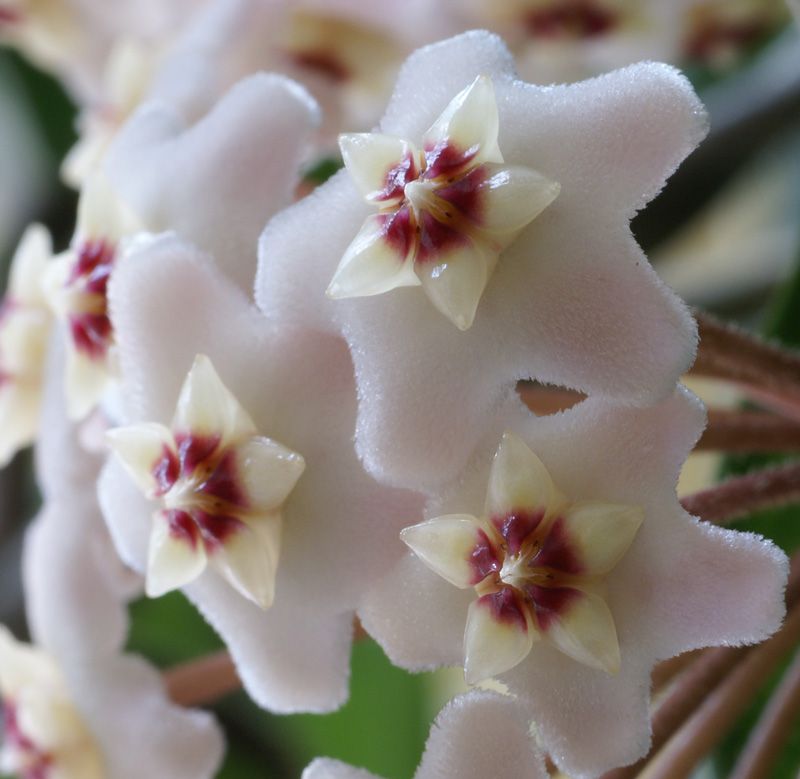
After the star-shaped flowers of Hoya carnosa fall, a short projection remains on the vine. That stem-like spur can become the place where the next cluster returns.
A short spur remains behind the flower cluster
Hoya carnosa is an evergreen vine and an epiphyte, a plant whose roots naturally rest against trees and other supports. Its thick leaves store water, while a rounded cluster of wax-like star flowers forms at the end of a peduncle.
When the flowers drop, the short peduncle stays where the cluster met the vine. A new shoot lengthens through a sequence of nodes, but the peduncle remains in one position and gathers the marks of earlier flowers at its tip.
Do not remove the old peduncle
NC State Extension advises against pruning old flower spurs. The same peduncle may produce flowers repeatedly over several years. Even if it looks brown after flowering, preserve the short, firm spur that branches from the vine.
Let the spent corollas fall, and avoid pulling the peduncle or cutting back into the vine. If a new shoot and an old spur look similar, do not judge by length alone. Follow the shoot’s sequence of nodes toward leaves, and look for clustered flower scars at the tip of the shorter spur.
Read the light before asking for flowers
Hoya carnosa prefers bright indirect light. A plant may keep its leaves in a dim position without flowering, while strong direct sun can scorch them. A bright window filtered by a sheer curtain offers a useful starting point, provided heat does not build in the leaves.
Plants commonly flower after reaching maturity, and NC State Extension gives two to three years as a broad guide. Age alone does not set a flowering date. Recording old peduncles, shoot growth, leaf spacing and seasonal light makes the changes in one plant easier to follow.
Leave air around the roots before adding water
As an epiphyte, Hoya carnosa suits a loose substrate that holds air better than a dense mix that stays wet. NC State Extension recommends an organic-rich but fast-draining medium and a container with drainage holes.
Do not choose the next watering by weekday. Check whether the pot has become light and whether the mix has begun to dry below the surface. Thick leaves do not mean the plant needs no water. Allow a drying interval, then water thoroughly and empty any water left in the saucer.
Repot and prune away from buds and flowers
Consider repotting when roots have filled the container and the mix begins to dry unusually quickly. Avoid disturbing a plant in bud or flower, and do not jump to an oversized pot. NC State Extension suggests increasing the diameter by no more than about two inches.
While waiting for the next cluster, the useful work is not to manipulate the spur. Remember its position, note the light reaching the vine and track how quickly the pot dries. When small buds gather on that same peduncle, time from the previous bloom takes visible form.