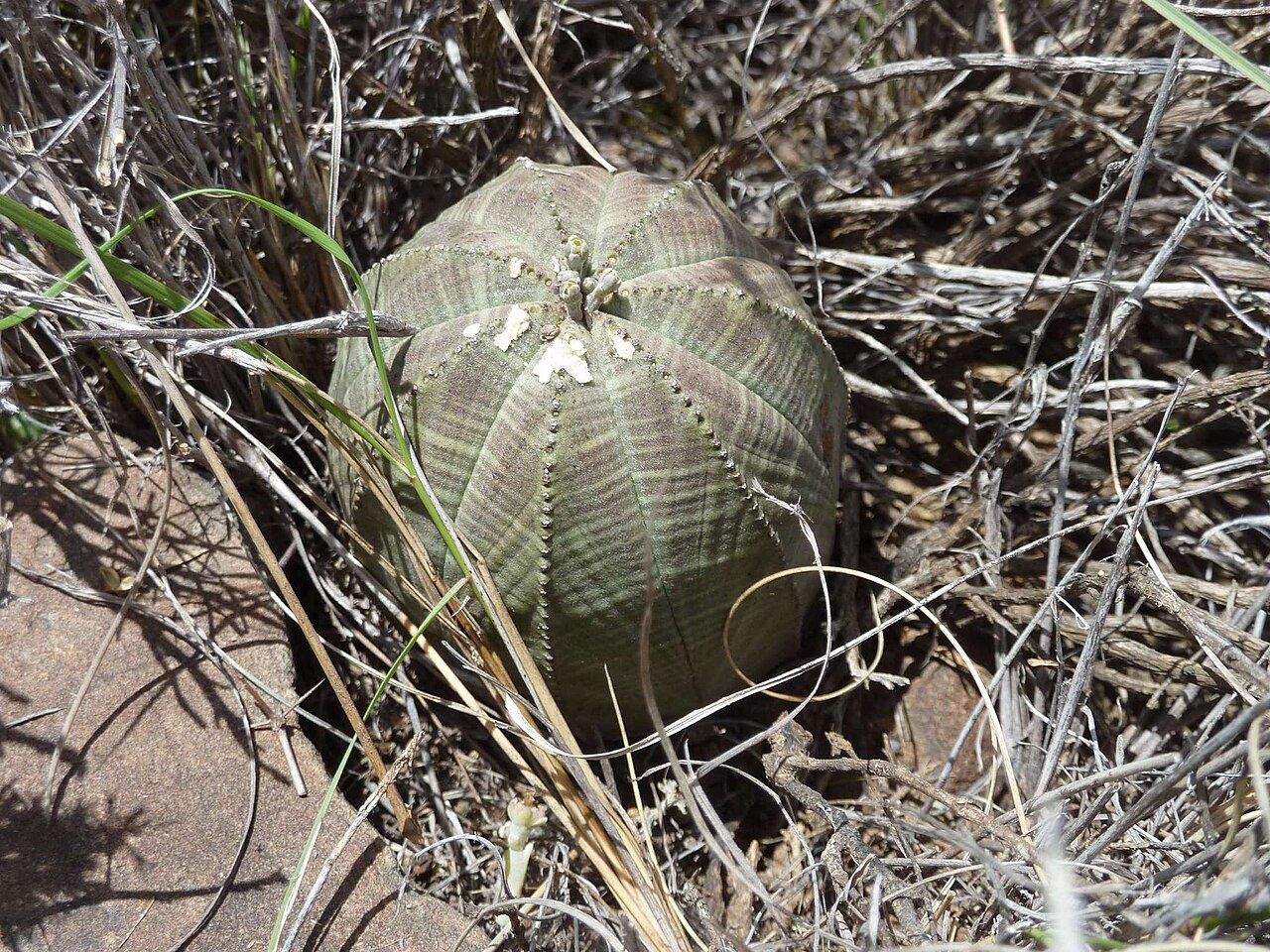
Vertical ribs and fine horizontal bands cross the rounded stem of Euphorbia obesa. When tiny cyathia gather at the crown, a closer look reveals a second distinction: male and female plants carry different structures.
Roundness does not remain unchanged
Euphorbia obesa is a succulent native to the Cape Provinces of South Africa. Kew accepts the species and places it primarily in desert or dry shrubland. Without leaves or spines shaping its outline, the green stem itself meets light and stores water.
Young plants are close to spherical, but older specimens become taller than they are wide. The Ruth Bancroft Garden also notes that strong light can bring brown or purplish tones and that narrow horizontal bands cross the stem. A taller plant is not necessarily another species; read the ribs, bands and crown together.
The flower-like cup is a cyathium
The small cup-shaped structures at the crown are cyathia. Glands line the rim, while highly reduced flowers sit within. There are no broad petals. The geometry of the whole stem and the mechanics of flowers only millimetres wide meet at the same centre.
Male and female flowers occur on separate plants. A male cyathium holds several tiny pollen-bearing flowers, while a female cyathium holds one flower rising from its centre. Do not rely on colour alone; look for pollen-bearing anthers or a divided stigma under magnification.
A capsule swells at the female crown
After pollination, the female flower develops into a round capsule that releases its seeds by splitting open at maturity. It may reach about seven millimetres across. If a small round structure enlarges after flowering, trace its position back to the cyathium before treating it as damage.
There is no need to injure the stem to inspect flowers or fruit. Members of Euphorbia release milky latex when damaged, and that latex can harm skin and eyes. Wear gloves after breakage or during repotting, keep contaminated hands away from the face, and handle the plant beyond the reach of children and animals.
Do not turn habitat rainfall into a watering calendar
The garden profile describes roughly 350 millimetres of annual rain in the species’ habitat, peaking from late summer into early autumn, with dry winters. Those figures cannot be copied directly into a Japanese pot. Container material, substrate, root mass and temperature all change how long one watering remains.
Choose the next watering by combining several observations: whether the pot has become light, whether the substrate has dried within, and whether the stem has suddenly lost firmness. In a cool winter position where moisture lingers, drying time matters more than a fixed interval.
Ask what seed-grown and hybrid mean before buying
Plants sold as obesa, symmetrica and hybrids can stand close together in the market. Kew recognises two subspecies within E. obesa. A sales label alone does not establish a wild-type plant; ask for the scientific name, whether it was raised from seed or propagated vegetatively, whether the parentage is known, and whether the photograph shows the exact plant.
The interest of E. obesa is not the preservation of a perfect sphere. Horizontal bands accumulate between the ribs, the crown reveals whether a plant is male or female, and a female capsule may eventually release seed. After seeing the rounded outline, move your attention to the few millimetres at the crown and read the plant’s passage through time.