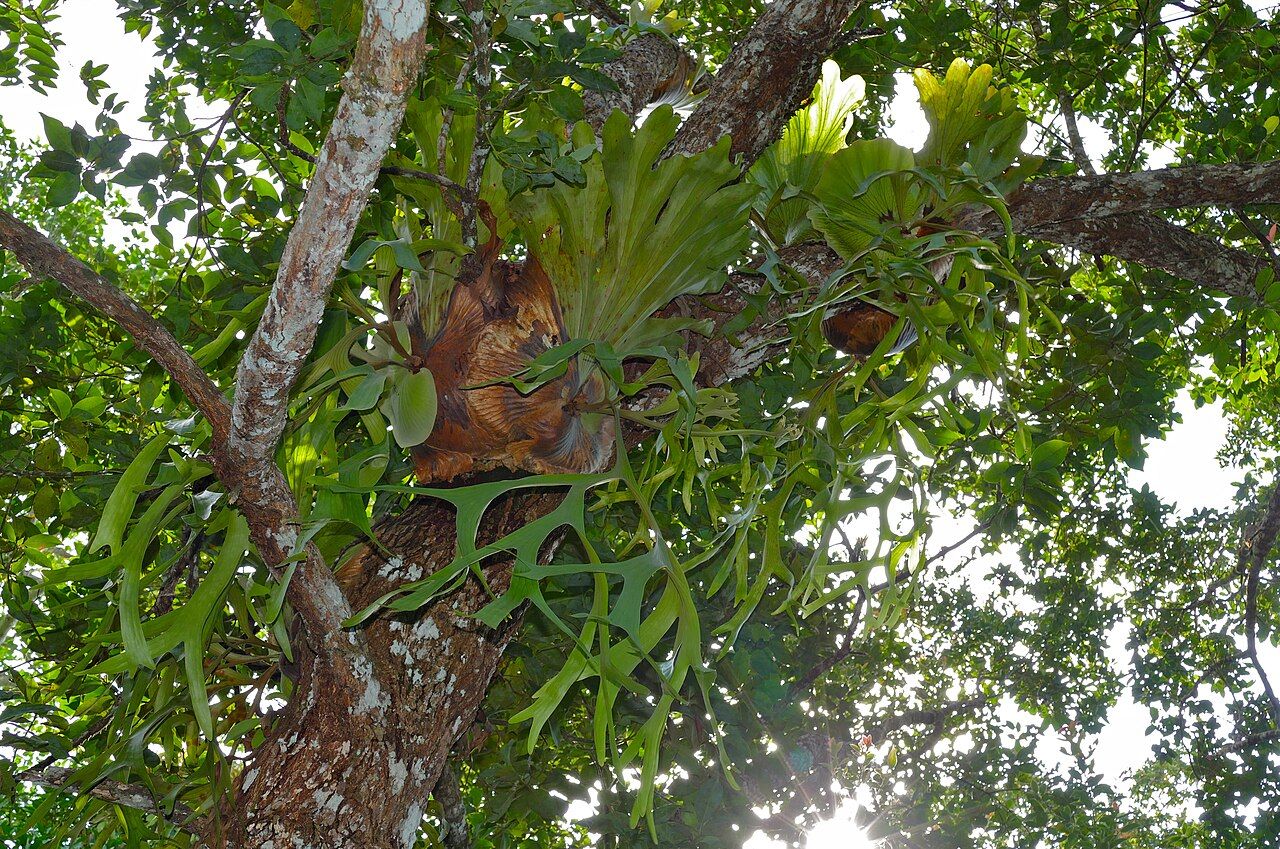
The nest fronds of Platycerium ridleyi do not simply lie flat against a trunk. They overlap in deep ridges, leaving an enclosed space within. Outside that shell, the fertile fronds alone divide and rise.
Two kinds of frond, two different jobs
Platycerium ridleyi is an epiphytic fern native from peninsular Thailand through Peninsular Malaysia, Sumatra and Borneo. Kew places it chiefly in the wet tropical biome. Its body begins from a different position than a plant rooted in potting soil.
The species makes two kinds of frond. Singapore’s National Parks Board describes corrugated, infertile nest fronds that overlap into an enclosed chamber, and stiff fertile fronds that fork repeatedly as they rise. A flat pairing of shield and antler does not capture this depth.
A room forms inside the nest fronds
Raised veins alternate with recessed surfaces across each nest frond. As one frond overlaps another, they build a thick shell around the rhizome. In the wild, ants sometimes use that space as a nest.
The photograph shows the species on a tree in Sarawak, Malaysia, in 2015. It is not a model for an indoor board mount. It reveals how the nest fronds clasp the trunk while the fertile fronds extend around them.
Fertile fronds rise instead of falling
The National Parks Board distinguishes this species by its ascending fertile fronds. They are leathery and forked, with spore-bearing lobes near the lower part of the branching frond. A side view often reveals the height more clearly than a frontal portrait.
On a young plant, neither the ribs of the nest fronds nor the branching of the fertile fronds has reached its mature form. Rather than judging a juvenile only against photographs of adult specimens, follow each new frond and the role it begins to take.
Move beyond “tropical means wetter”
One grower asked why both nest and fertile fronds declined after the plant moved into a very humid cabinet: was the mount too wet, or had mounting disturbed the roots? Do not reduce that question to a single humidity number. Check separately whether the back of the mount dries and whether air reaches the spaces between the fronds.
The enclosed form of the nest fronds does not mean that more retained water is always better. Drying changes with the room, the mount and the root mass. Instead of adding water after a fixed number of days, note where moisture remains and how firm the newest frond feels.
Separate form from provenance before buying
A specialist cultivation account notes that propagated plants now circulate while wild-collected plants still enter trade. Before choosing labels such as wide, narrow or dwarf, ask the seller for the species name, propagation method and the condition of the roots after import.
Ridley’s staghorn is more than an antler silhouette. The nest fronds around the trunk, the chamber inside them and the fertile fronds dividing upward form one structure. After seeing the front, move to the side and look for the depth held between the leaves.