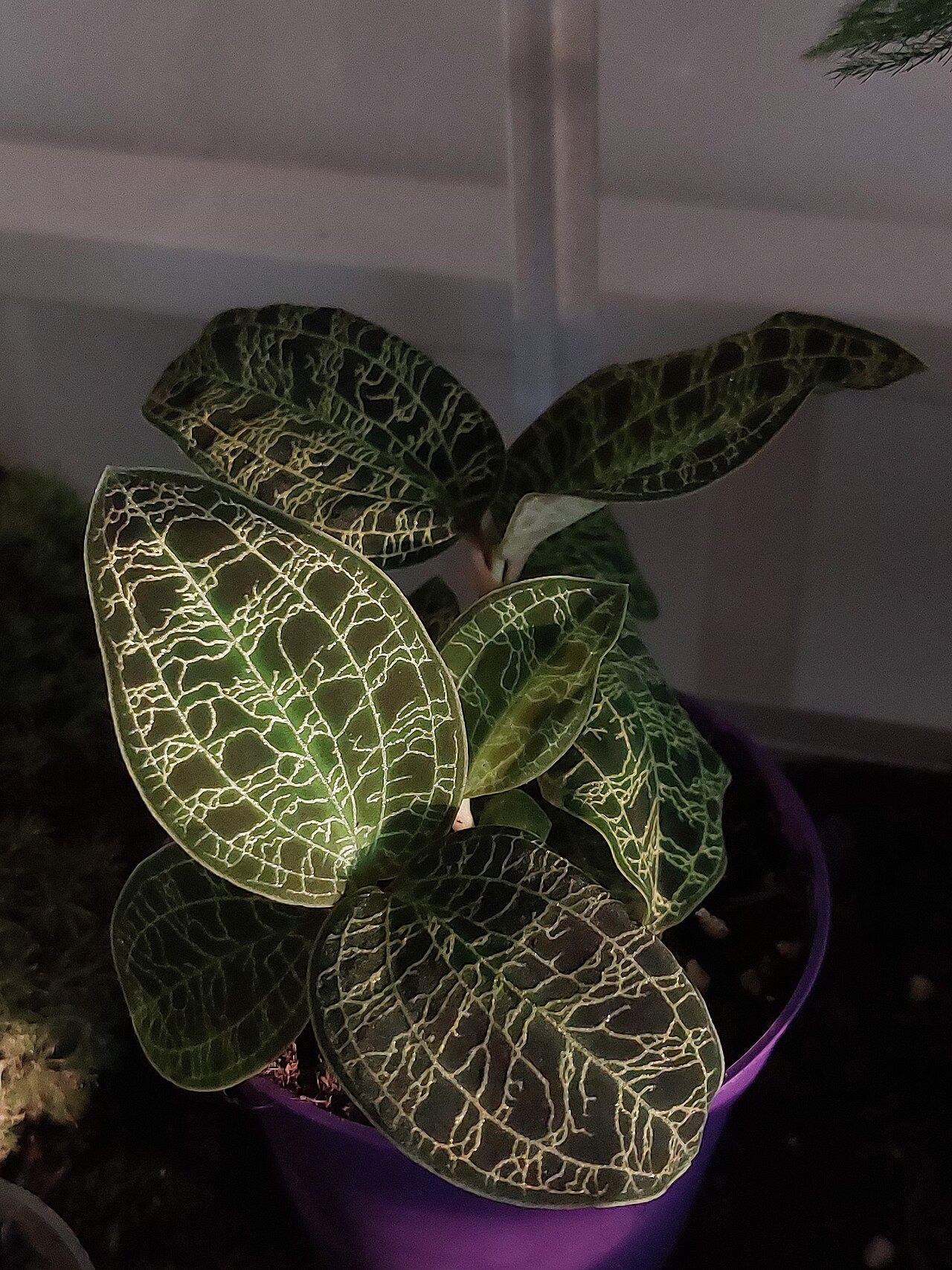
Fine gold lines cross a field of deep green. Shift the light slightly and the veins of Macodes petola rise like embroidery. Keeping that leaf in view is less about watering on a fixed weekday than learning how water moves—and lingers—inside its pot.
The veins are ornament and record
Macodes petola is an accepted species of Macodes in the orchid family, according to GBIF. In cultivation it is known as a jewel orchid, collected chiefly for the network of veins across its dark leaves rather than for a show of flowers.
The same leaf changes with its angle, the light and the firmness of its surface. Take one photograph a week, in the same place and at the same time. It becomes a quiet fixed point for comparing the pace of a new leaf and the posture of an older one.
Water by the rate of drying, not the day
The American Orchid Society separates the amount of water from its frequency and asks growers to watch how quickly the medium dries. Humidity, light and airflow alter that rate, even in the same pot. A seven-day rule can hide those changes.
Record three things in one line: the weight of the pot just after watering, the colour of the medium seen through the side, and whether condensation remains the next morning. When the next decision feels uncertain, return to that record instead of relying on touch alone.
Humidity and air are not separate numbers
Higher humidity slows water loss from leaves and lets the medium stay wet longer. Add weak air movement and moisture can remain around both roots and foliage. An enclosed case is a way to hold humidity; closing it is not the goal in itself.
If condensation persists and the medium looks unchanged, do not hurry to add more water. Reconsider the lid or vents and look for a slow exchange of air without directing a strong stream at the leaf. High humidity and stagnant air are not the same condition.
Look below the mist, toward the roots
The AOS notes that misting raises room humidity only briefly and that most water enters an orchid through its roots. Before spraying more often, inspect the medium touching the roots, the way water remains there and the ventilation of the container.
When a plant arrives, ask not only what the medium is called, but when it was last watered, which enclosure it occupied, its day and night conditions, and how it was propagated. Understand the present relationship between roots and environment before rushing to repot.
Change one thing at a time
When a leaf relaxes, changing water, humidity, light and airflow together erases the clue. Check moisture and pot weight first, ventilation next, then placement. Write the date of each change beside the weekly photograph.
The veins of Macodes petola can look as if night light has been stitched into a leaf. Caring for that glow begins not with elaborate equipment, but with seeing small differences in the same order. Leaving the calendar behind turns watering into a longer conversation with one leaf.