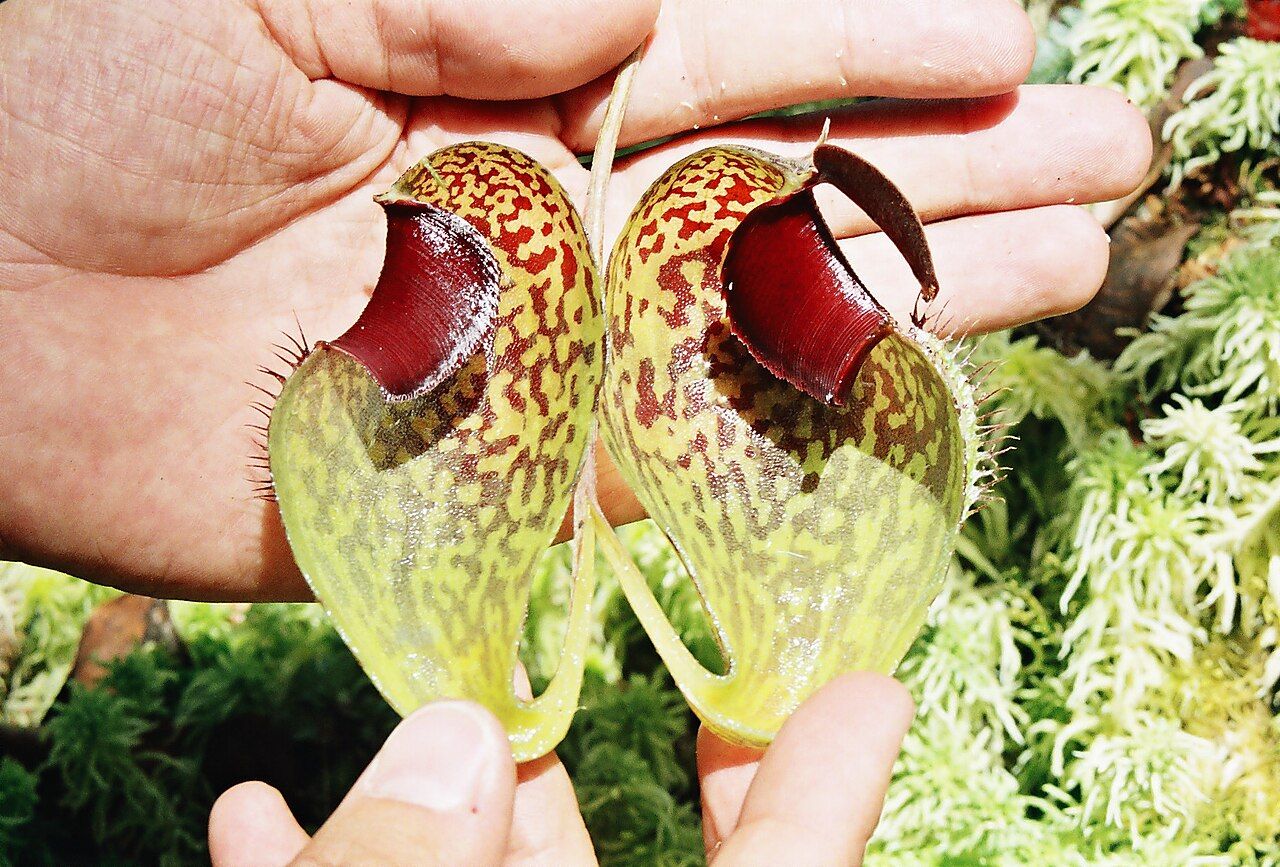
A pale pitcher marked in purple-red spots, with an opening that faces forward like a small window. At the end of a tendril, the upper pitcher of Nepenthes aristolochioides has the outline of a tiny suspended lantern.
The opening becomes the face of the pitcher
Many tropical pitcher plants invite a view down into the mouth. In this species, the opening stands at a nearly vertical angle, exposing its pale interior from the front. Purple-red spotting and the rounded body make that orientation even more striking.
Its name is Nepenthes aristolochioides, formally described by Jebb and Cheek in 1997. The epithet points to a resemblance to the genus Aristolochia. Learning the name turns an eccentric “rare pitcher” into a starting point for comparison across Nepenthes.
August in Sumatra reaches Yatsugatake in October
Hiro’s Pitcher Plants visited the Lake Tujuh area of Sumatra in August 2026. Its announcement records N. gymnamphora, N. singalana and N. aristolochioides in dense and cloud forest reached beyond a lake at about 2,000 metres.
The photographs and video will be shown in “A Journey through Sumatra: In Search of Nepenthes” from 13:30 on 3 October. Look beyond the pitcher: how high does the vine climb, which plants stand beside it, and where does light reach? The edges of the frame can return a cultivated plant to its forest context.
The greenhouse offers another surface for comparison
The venue is the HIPS farm on the southern foot of Yatsugatake. The greenhouse opens from 10:00 to 16:00 on 3 and 4 October, including cultivated plants and parent stock that are difficult to take to ordinary sales events.
The announcement confirms that N. aristolochioides appears in the screening footage; it does not promise a live display or sale of the species. If related species or hybrids are present, compare the mouth, lid, spotting and tendril attachment one feature at a time.
Ask about provenance before choosing a plant
Before bringing a Nepenthes home, ask about the names on its label, propagation, current day and night conditions, winter minimums, growing medium and watering. Pitchers that resemble one another in photographs may belong to species and hybrids with different requirements.
Plant availability will change on the day. Describe the night-time temperature range and humidity you can maintain, then ask which plant fits those conditions. Choosing by the pitcher alone can shorten the time before you see the next one.
Place the forest beyond the window
The open house runs on 3 and 4 October at Hiro’s Pitcher Plants, 4856 Nishiide, Oizumi, Hokuto, Yamanashi. The Sumatra screening begins at 13:30 on 3 October. Greenhouse viewing, plant sales and cultivation questions are scheduled from 10:00 to 16:00 on both days.
Find the sideways opening in a photograph, return the pitcher to the forest through field footage, then listen to the people who grow these plants under glass. The small window of N. aristolochioides opens onto more than rarity.