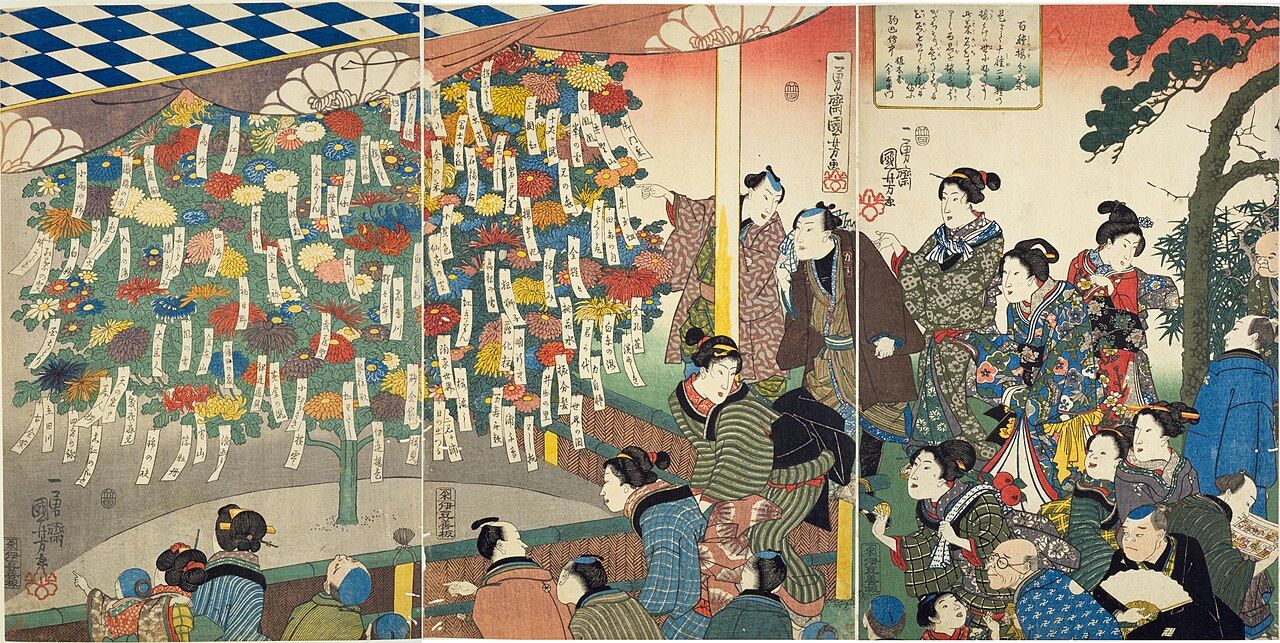
Red, white, yellow and purple. Chrysanthemums of different forms spread from a single trunk, each bloom carrying a slender label. Utagawa Kuniyoshi’s 1845 triptych Hyakushu Tsugiwakegiku also gathers the spectators’ eyes into the scene.
The labels appear before the flowers
The branch is crowded not only with layered, radiating and differently colored petals. Narrow labels turn the distinctions between blooms into words, moving the viewer between the whole tree and each flower. The pleasure of identifying and collecting cultivars becomes the structure of the image.
The National Diet Library places the print in the first chapter of its exhibition “Gardening Adventures: From the Front Yard to the World.” Its subject is not plants alone, but the passion with which people improved cultivars, searched for unfamiliar species and preserved their names and forms in print.
Edo-period pots multiplied through records
Chapter One, “Gardening in Edo: From Lords to Townspeople,” also includes Kadan Kōmoku from 1681 and Ko-omoto Nayose from 1832. A record that gathers the forms and names of Rohdea cultivars shows how attention to leaf pattern and shape extended beyond the pot and into documentation.
Keeping a plant label today, along with the date of acquisition or repotting, sits on the same line. A name is not merely a badge of rarity; it is a route back to reliable information about a particular plant. Time with these older gardening records can change how we document our own shelves.
Plants crossed mountains and remained in plates
Chapter Two moves into the age of Western plant hunting. It includes Illustrations of Himalayan Plants by Joseph Dalton Hooker and others from 1855, and an 1852 volume of Curtis’s Botanical Magazine. Plants once unfamiliar to their readers survived as records of color and form through transport, drawing and print.
Chapter Three continues with the Journal of the Horticultural Society of Japan from 1890, Senshō Zusetsu, a cactus volume from 1913, and illustrations of Japanese camellias from the 1940s. From chrysanthemums and Rohdea to cacti and camellias, the subjects changed while the methods of noticing and sharing difference kept evolving.
The pages change between the two halves
In Tokyo, more than 200 selected items are divided between two exhibition periods, with about 150 shown in each. The second rotation begins on 19 October. Paper objects cannot all remain open at once, so the choice of pages becomes part of the exhibition’s editorial voice.
The Tokyo exhibition runs from 2 to 31 October in the first-floor Exhibition Room of the National Diet Library’s New Building. It is open from 10:00 to 19:00, closing at 17:00 on Saturdays. It is closed on Sundays, public holidays and 21 October. Admission is free, including for visitors under 18 and those without a library registration card.
Take one difference home
Begin with the abundance of Kuniyoshi’s branch, then follow the labels one flower at a time. Put a difference in color or form into words and record the name that holds your attention. That small action connects an Edo-period spectacle with the living practice of collecting plants today.