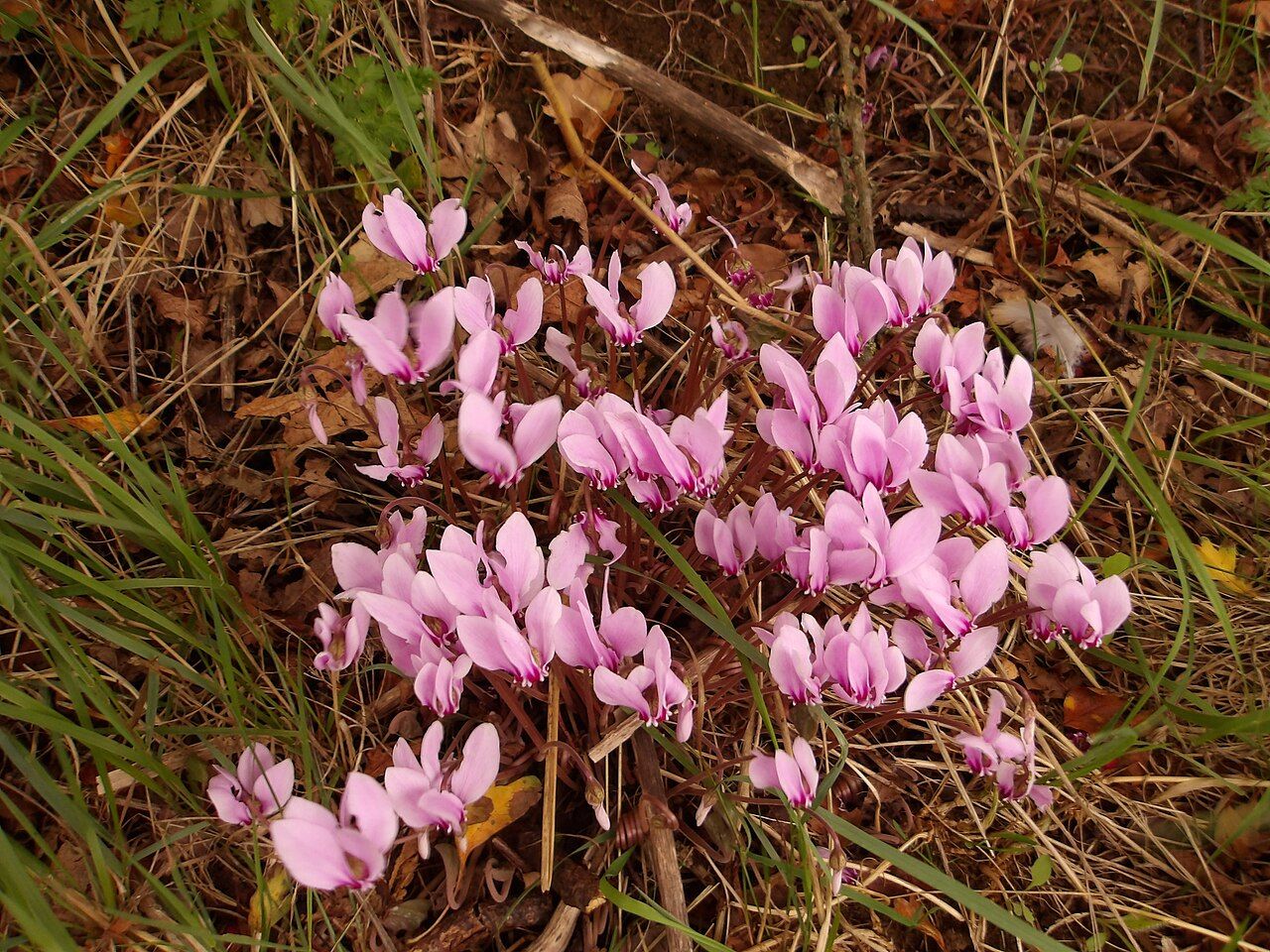
Flowers rise through fallen leaves before the foliage has fully appeared. Photographed on a roadside bank in southern England on 18 September, Cyclamen hederifolium carried pale pink blooms on fine stems. Beyond the familiar florist’s cyclamen is a species that begins its year outdoors in autumn.
Flowers first, leaves later
Cyclamen hederifolium is a tuberous perennial in the primrose family. Kew’s Plants of the World Online records a native range from France to Türkiye. Originating in woodland, scrub and rocky places, it flowers in the low light of autumn.
Blooming runs from late summer into autumn. Five swept-back petals may be white, pink or purple. Because the flower stems emerge before the foliage has spread, colour can seem to hover just above the ground. Only a few leaves are visible among the flowers in the photograph taken on 18 September.
Ivy-shaped leaves carry the garden into winter
The leaves that follow give the species its name: their outline recalls ivy. Grey-green and silver patterns vary from leaf to leaf and remain after the flowers have passed. At roughly 10 to 15 centimetres tall, the plant places a low layer of pattern beneath larger foliage.
Beneath a deciduous tree, the plant’s year is especially easy to read. Light reaches the ground from autumn to spring, while summer foliage shades the soil. Keeping fallen leaves and marbled cyclamen foliage in the same view allows the order of the seasons to shape the garden.
Dormant in summer, never waterlogged
When the leaves disappear in late spring, the underground tuber enters summer dormancy. North Carolina State University’s plant guide warns that poorly drained soil is a particular problem during this resting period. In shade, the first question is not whether to add water but whether rain can drain away.
Humus-rich, free-draining soil and partial shade form a useful starting point. The species can tolerate dry shade, but climate and snow cover vary widely. Overseas hardiness figures should not be applied to every Japanese garden without checking local nursery guidance and the conditions of the planting site.
After flowering, the stem coils down
Once a flower finishes, its stalk coils towards the ground and carries the developing capsule close to the soil. The seeds mature around summer, and undisturbed plants can spread into colonies. Their varied heights, flower tones and leaf markings keep a group from becoming a perfectly flat block of colour.
A small flower still needs a considered place
The plant, including its tuber and leaves, contains saponins and can cause illness if eaten by people or animals. Keep it beyond the reach of children, dogs and cats, and do not leave lifted tubers or cut foliage where they can be swallowed. It is not a food or home remedy; gloves are sensible for anyone with sensitive skin.
The autumn of Cyclamen hederifolium does not end with its flowers. Leaves continue into winter, coiling stems return seed to the ground, and the tuber sleeps through the dry summer. One bloom among fallen leaves holds the whole year in a compact sequence.