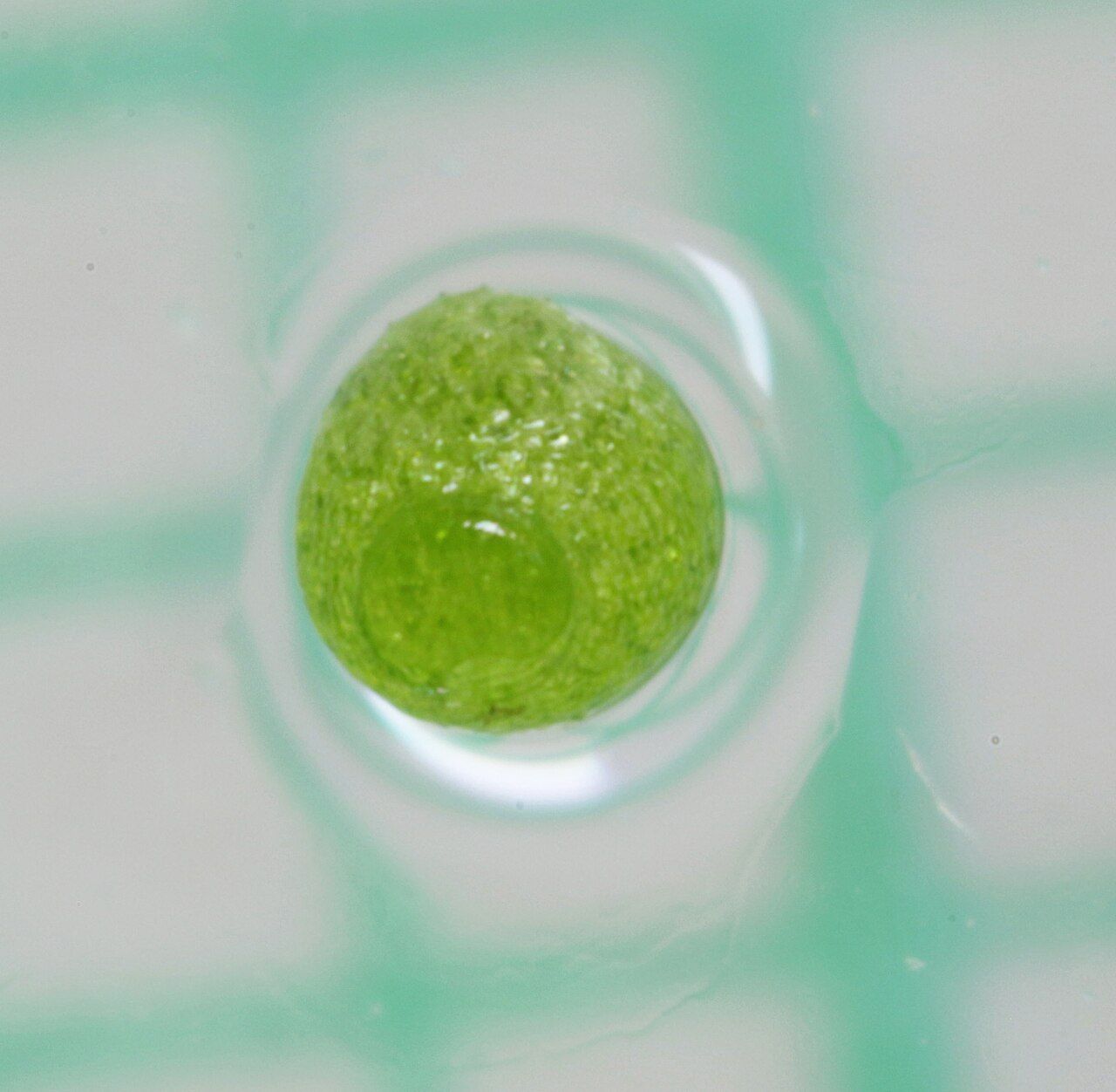
The green speck floating on water is less than a millimetre across. It is still a flowering plant. At the 150th meeting of the Japanese Society of Breeding, opening in Fukui on 17 September, a presentation pairs flower induction in Wolffia globosa with image phenotyping.
Keeping sight of a 0.4-millimetre plant
The talk is scheduled for 10:45 a.m. on 17 September. Kento Kuwata and Minori Takahara of Nagaoka University of Technology will present work on flower-induction methods and image phenotyping for breeding Wolffia globosa. The public programme gives the title and presenters, but not numerical results or methodological details.
An assessment by the European Food Safety Authority describes the species as an ovoid frond 0.4–0.8 millimetres long. Rather than a plant divided visibly into leaves and stem, its tiny green frond is the plant body. In the photograph, the underside of a single cultivated specimen appears as a round green surface in the centre of a water droplet.
The photograph was taken in 2015 and does not show material from the conference presentation. It does not show a flower either. Its role is to enlarge a plant that looks like a dot on the water and make its scale and form visible.
Budding usually comes before flowering
Wolffia globosa produces a new frond from a pouch at the base of the plant body. EFSA explains that water lentils reproduce mainly through this asexual budding, while sexual reproduction through flowering occurs occasionally.
The Japan International Research Center for Agricultural Sciences records the species floating on sunny, still streams and ponds, often among other small aquatic plants. It is also sold in markets in Thailand and Laos and used in cooking. The same plant takes on different roles on open water, at the table and in a laboratory.
Breeding begins by bringing flowers together
Plants that multiply by budding can be compared and propagated without waiting for flowers. Crossing different parents and examining their offspring, however, depends on being able to bring flowering into a known window and observe it. That is why flower induction stands first in the presentation title.
Image phenotyping records differences in form and growth from photographs. For fronds smaller than a millimetre, it can help researchers follow change against the same criteria instead of relying only on visual inspection. The public programme does not reveal which traits the team measured or how much of the process was automated.
Other talks at the meeting connect visible traits with genetic information, including rice root angles, melon firmness and vacuolar pH in Phalaenopsis. Wolffia globosa stands apart because the subject being measured is itself no larger than a speck on the water.
Pause before the smallest flower appears
The 150th meeting runs on 17 and 18 September at the Eiheiji campus of the University of Fukui Prefecture. One short session on the opening morning is devoted to inducing an elusive flower and following an easily lost plant body through images.
The green speck in the droplet can make another plant without flowering. That is precisely why a path towards breeding begins with recording when it flowers and preserving the differences between one tiny frond and the next.