Even within one plant, roots do not encounter the same soil conditions. A Nagoya University team has identified CERI, a co-receptor required when Arabidopsis thaliana sends news of local nitrogen shortage from its roots to its leaves. The finding adds a new molecular junction to the way distant roots compensate for one another.
Nitrogen shortage travels from root to leaf
Nitrate is unevenly distributed in soil. When nitrogen becomes scarce around part of the root system, those roots produce CEP, a short peptide made of 15 amino acids. CEP moves upward through the xylem, the tissue that carries water, and reaches the shoot.
In the leaves, the receptor CEPR1 receives CEP. The shoot then sends a second signal, CEPD, back toward the roots, promoting uptake where nitrate remains available. A plant balances nitrogen through communication between roots and leaves, rather than through each root acting alone.
CERI works beside CEPR1
Researchers had not known which molecule helped CEPR1 pass the message into the cell after recognising CEP. The team searched for a membrane protein that interacted with CEPR1 only when CEP was present and named it CERI, short for CEP RECEPTOR INTERACTOR.
After joining CERI, CEPR1 phosphorylates the part of CERI inside the cell, activating the downstream pathway. Arabidopsis plants lacking CERI lost systemic nitrogen-demand signalling. CERI is therefore not a stand-alone sensor of low nitrogen; it is a co-receptor that helps a CEP-bound receptor relay the message.
Fourteen co-receptors are thought to participate in plant peptide-hormone signalling, and the functions of 11 had already been described. CERI was one of the remaining three with no known role. Its identification helps fill a gap in both nitrogen signalling and the wider co-receptor family.
A small rosette coordinates a whole plant
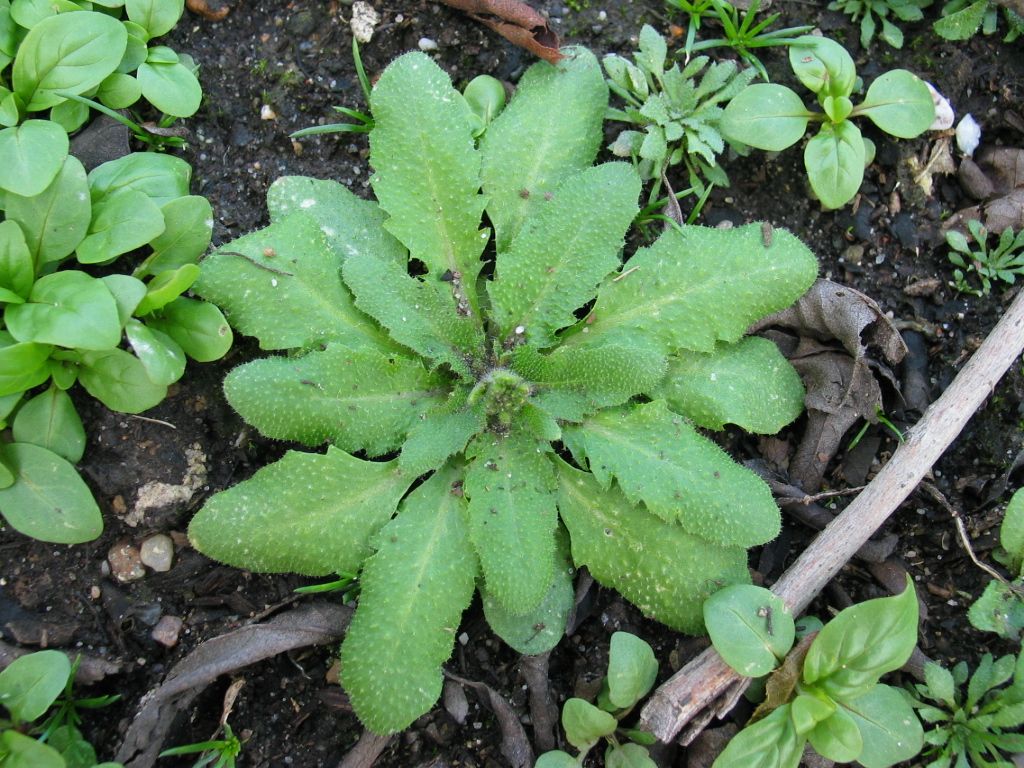
Arabidopsis thaliana is a small member of the mustard family that forms a rosette of leaves and is widely used as a model plant. The photograph shows a reference rosette with a flowering stem beginning to emerge; it is not one of the experimental plants. Beneath such a cluster of leaves, many fine roots can reach different patches of soil.
Work reported in 2014 showed that nitrogen-starved roots send CEP and that receptors in the shoot receive it. The 2026 study places CERI immediately after that reception step. A specific connection at the cell membrane has now been added to the root-to-shoot-to-root route mapped 12 years earlier.
Not yet a finished way to cut fertiliser
The researchers see potential for breeding crops that require less nitrogen fertiliser. The present result, however, defines a molecular pathway in Arabidopsis; it does not demonstrate reduced fertiliser use in a particular crop or field. Each crop would need its own tests before the finding could become an agricultural practice.
It is not a direct guide for changing fertiliser in a houseplant pot either. Leaf colour and growth can respond to water, root damage, light and temperature as well as nutrients, so this study alone is not a reason to raise or lower a plant’s nitrogen supply.
What the team has found is one part of the system that lets a stationary plant coordinate distant roots as one body. CEP rises from a nitrogen-poor patch, CEPR1 and CERI receive it in the leaves, and the response leads toward another root. Two-way messages run from root to leaf and back again inside a modest rosette.