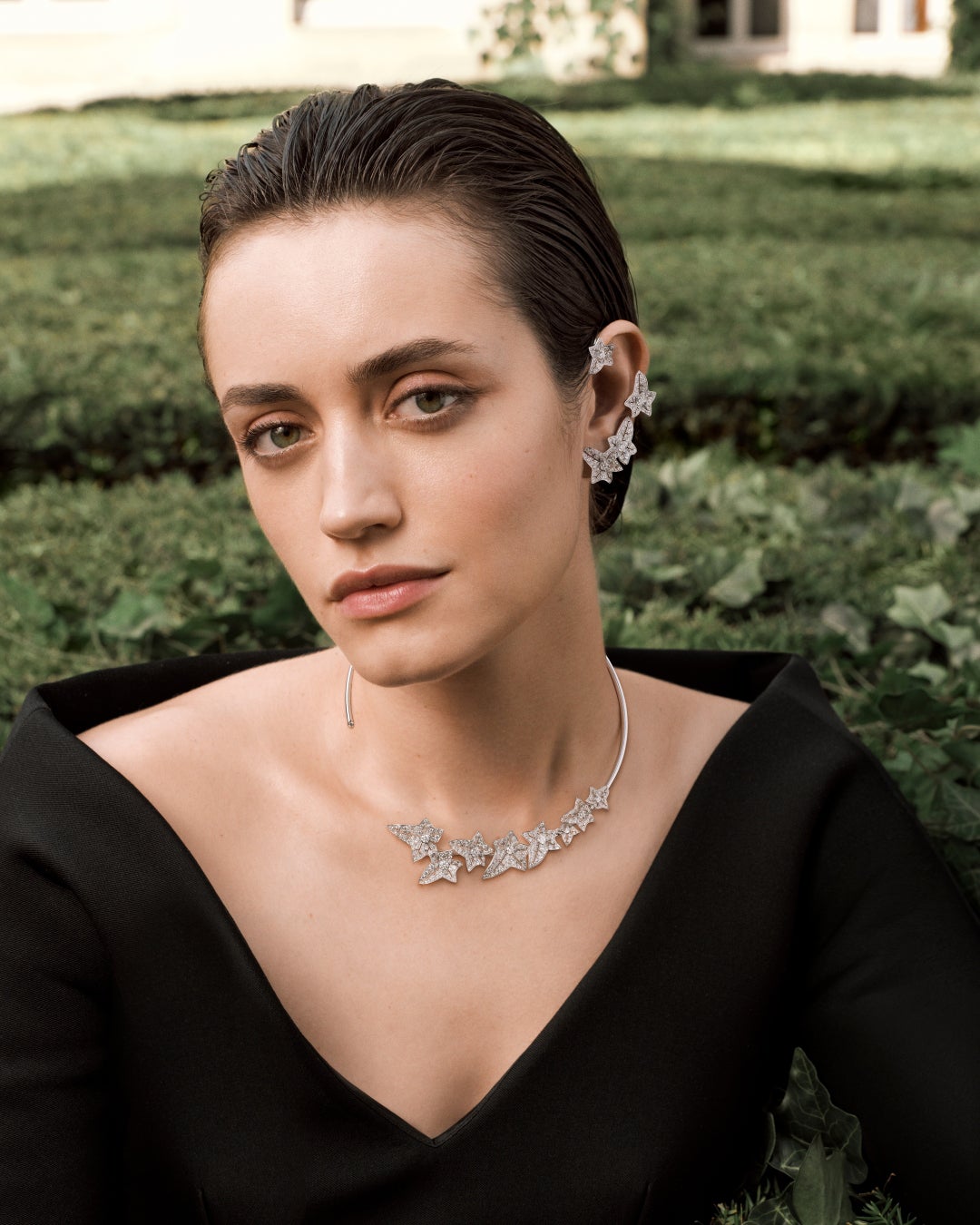
An ivy stem crosses between fingers, climbs along the rim of an ear and reaches around the neck. On September 9, 2026, Boucheron announced nine new pieces in Lierre de Paris. White gold and diamonds do not turn the plant into a tidy bouquet; they follow leaves and stems searching for their next support.
Nine pieces from one climbing line
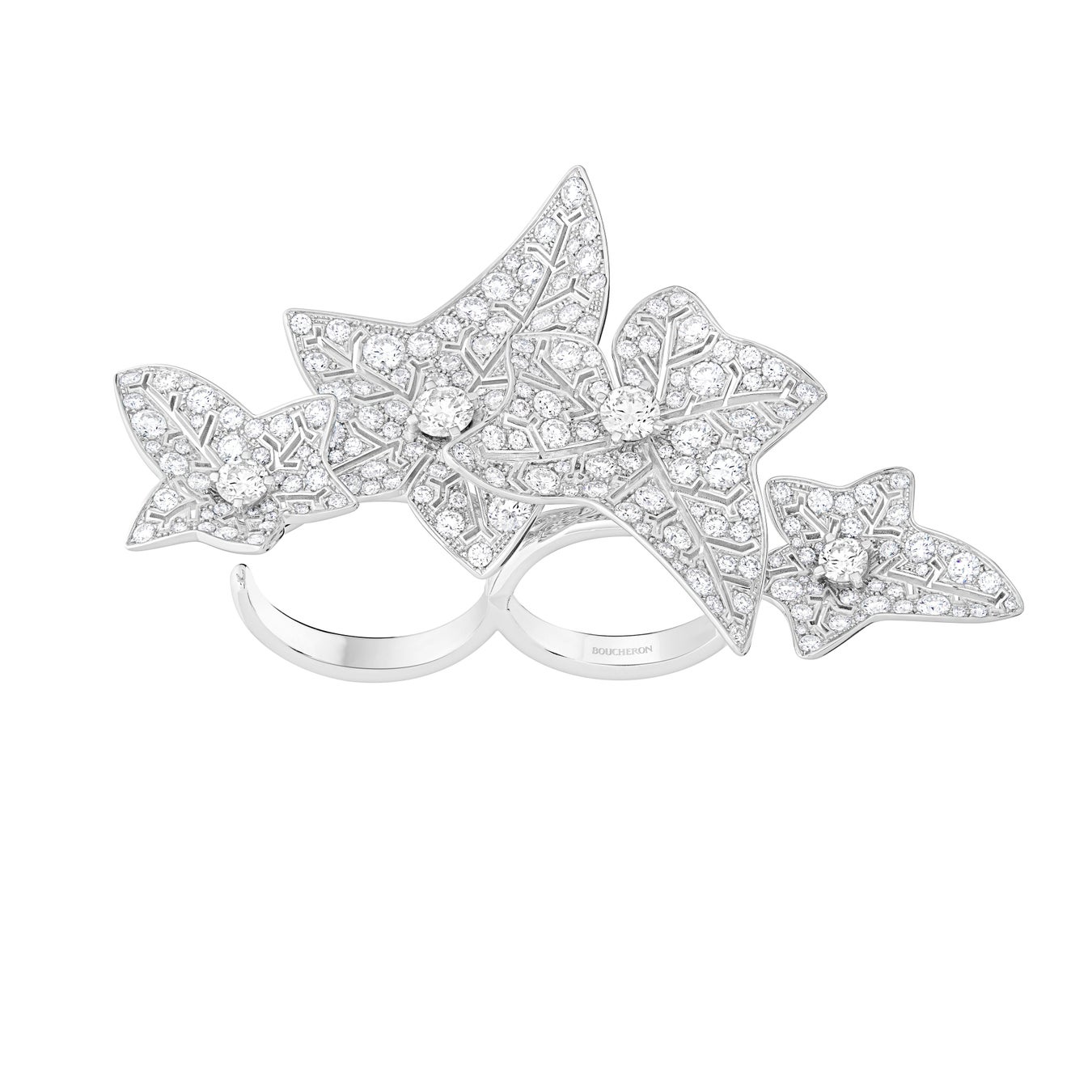
The additions comprise three rings, a pendant, a clasp-free choker necklace, two kinds of earrings and two brooches. The two-finger ring carries leaves across adjacent fingers, while the asymmetrical ear clips follow one ear’s outline. A pin construction also allows the brooches to be worn in the hair.
Diamonds cover the face of each leaf, while openwork beneath lets light pass through. Veins, overlapping leaves and softly rounded tips shape a jewel meant to be seen from the side and back as well as the front. Even when the leaf surfaces are filled with stones, the direction of the stem remains clear.
A climbing mechanism becomes a line of jewellery
In its juvenile stage, English ivy (Hedera helix) produces adventitious roots and begins to climb when it meets a vertical support. It is invasive in parts of North America and requires careful siting, yet its movement from one point of contact to the next helps explain the curves behind Lierre de Paris.
Boucheron names its motif as lierre, or ivy, rather than a particular species. Lobed leaves, veins and curving stems retain a recognisably botanical character within the jewellery.
On a ring, the stem does not simply circle one finger; it reaches toward the next. The necklace follows the neck without a clasp, and the earrings resist perfect symmetry. Ivy’s climbing habit becomes a different route for each part of the body.
An ivy lineage beginning in 1870
Ivy first appeared in Boucheron jewellery in 1870. In 1879, founder Frédéric Boucheron chose lierre for the first design of the clasp-free Question Mark necklace, which the workshop realised as high jewellery in 1881.
By the 1920s, gold traced the vine all the way to its tips. Ivy returned in the Maison’s 2012 high-jewellery collection and in the 2025 and 2026 Histoire de Style collections. In 2026, it also expanded into an XXL work that appeared to grow across the body.
Across the nine pieces, that high-jewellery idea extends into rings, pendants and earrings. Leaf direction and the bends of each stem vary with where the jewel sits, giving the same motif different expressions.
Shape distinguishes the nine pieces
Japanese planned prices, including tax, range from ¥1,716,000 for the small ring to ¥16,236,000 for the pendant earrings. Beyond that range, each piece differs in contact: leaves gathered on a finger, a stem crossing the neck, or a brooch that can move into the hair.
Veins become openwork, a stem becomes a clasp-free line, and leaves remain asymmetrical as they follow the ear. Ivy is more than a decorative reference here: its way of climbing determines where each jewel travels across the body.