The opposite of a manicured flower bed has become a sequence of nine paintings: dead trees, spreading scrub, and water returning to wetlands. “A Year in the Wild,” a solo exhibition by artist Rebecca Howard after visits to rewilding projects across England, opened at Knepp Wilding in southern England on September 12, 2026. It receives the shapes made by plants not as a finished garden, but as a landscape still changing.
Untidiness becomes the subject
Howard’s official description says the exhibition follows nine independent rewilding projects in Britain. The sites range from saltmarsh to a Cornish temperate rainforest with ancient oak woodland. Rather than repeat one ideal meadow, the paintings show trees, scrub, water edges, and grassland forming different combinations in each place.
The Guardian reports that Howard spent two years visiting the sites and about a month on each of nine large canvases. Her subjects include fungi on dying trees, newly formed wetlands, and beaver pools holding brown water. Deadwood and mud—features often removed from polished landscape pictures—return to the canvas as evidence of a landscape in motion.
Plants are not background here. Whether a dead trunk remains, a young tree reaches light, or scrub spreads across an opening changes the density of the picture and the path of the eye. Animals and water also shape the scenes, but their effects become visible through trees, grassland, and wetland vegetation.
A Knepp meadow as the photographic entry
Knepp, the exhibition venue, is a roughly 3,500-acre landscape where rewilding began in 2000. Its official account describes free-roaming cattle, ponies, pigs, and deer shaping dynamic scrubland, wild meadows, wetland, and wood pasture. The approach does not mean the absence of care; it avoids fixing vegetation into one permanent finished state.
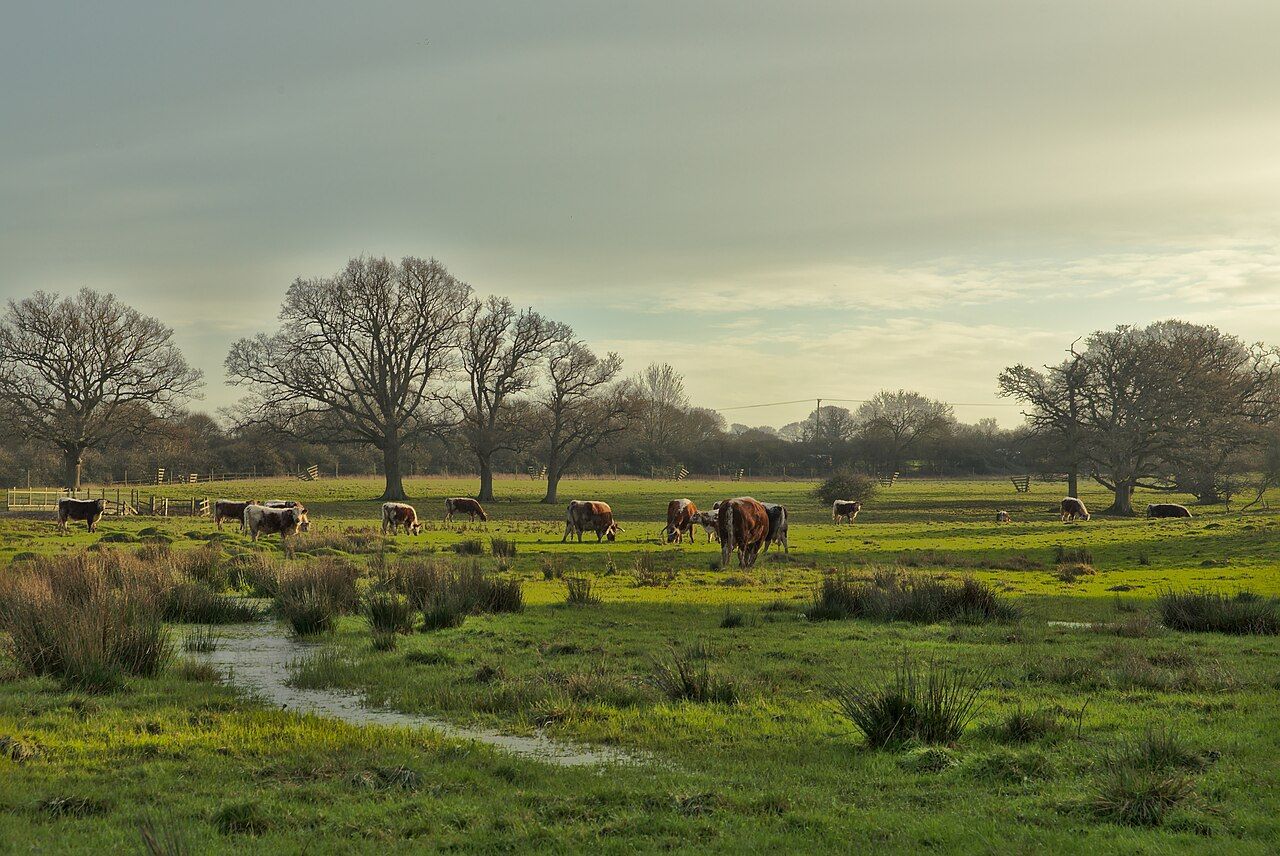
The photograph was taken at Knepp in 2016 and shows longhorn cattle in wet grassland. It is not an artwork from the exhibition or a view of the installation. Grass, pools of water, scattered trees, and animals share the frame, offering context for a landscape that does not resolve into a single lawn or forest.
The photograph and the paintings need not be treated as the same kind of image. A photograph records one moment of vegetation; a painting holds forms found across a place through the artist’s own duration. They share a refusal to push fallen wood or scrub outside the frame simply because it appears untidy.
Nine places without one template
Alongside Knepp, the official description names sites including Cabilla in Cornwall and Moor Barton in Devon. Saltmarsh and inland woodland are not judged by one visual measure. The series instead distinguishes what is recovering in each place and which layers of vegetation have become visible.
The exhibition resists reducing rewilding to one attractive look. Tall trees are not the only sign of richness: saplings, scrub, herbaceous growth, wetland margins, and decaying wood occupy different moments. Even without identifying every species, separating canopy, thicket, water edge, and deadwood makes landscape change more specific.
This is not a prescription to stop caring for a garden. Domestic gardens and potted plants involve safety, pests, neighbors, and the needs of particular plants. The transferable gesture is smaller: before tidying, notice what is living, what is decaying, and which shoots or leaves appear along that boundary.
A landscape still changing through October
“A Year in the Wild” runs at the Knepp Wilding Shop through October 18. Howard’s official page says the exhibition and Wildland are free to visit. Sales of artworks, cards, and limited-edition prints support Rewilding Britain in part. Visitors should check Knepp’s official site for current opening information.
When a dead tree remains in a painting, the landscape moves further from an image of completion. In return, space for the next tree, low ground where water gathers, and scrub linking the woodland edge become visible. Howard’s nine paintings widen the idea of beauty by placing plant time before order and after decay inside the same view.