Daylight may still feel strong, but the first edge of autumn appears in the overnight low. For houseplants that spent summer on a balcony or in a garden, the calendar alone is not enough. Each plant's cold tolerance, the condition of leaves and stems, and the light and humidity inside determine the order of the move. The route begins before a pot crosses the doorway and ends only when it settles into a suitable indoor place.
Return the temperature to the plant name
University of Minnesota Extension gives a broad cue for bringing outdoor houseplants back inside before night temperatures fall below about 50°F, or 10°C. That figure is not a universal safe line. The Royal Horticultural Society gives examples by group: Cymbidium, Clivia, and Alocasia need nights consistently above 10–12°C; Spathiphyllum, Philodendron, Sansevieria, and rex begonias above 13°C; and Calathea and Maranta above 15°C.
Phalaenopsis is listed separately as unsuitable for minimum temperatures below 18°C. Instead of moving every pot by one number, identify the plant and check the minimum suitable for its species or cultivar. In Japan too, the useful signal is not simply that September has arrived, but the local forecast for the next several nights. Move the most cold-sensitive plants first. If tolerance is uncertain, keep the plant on the warmer side until reliable guidance is found.
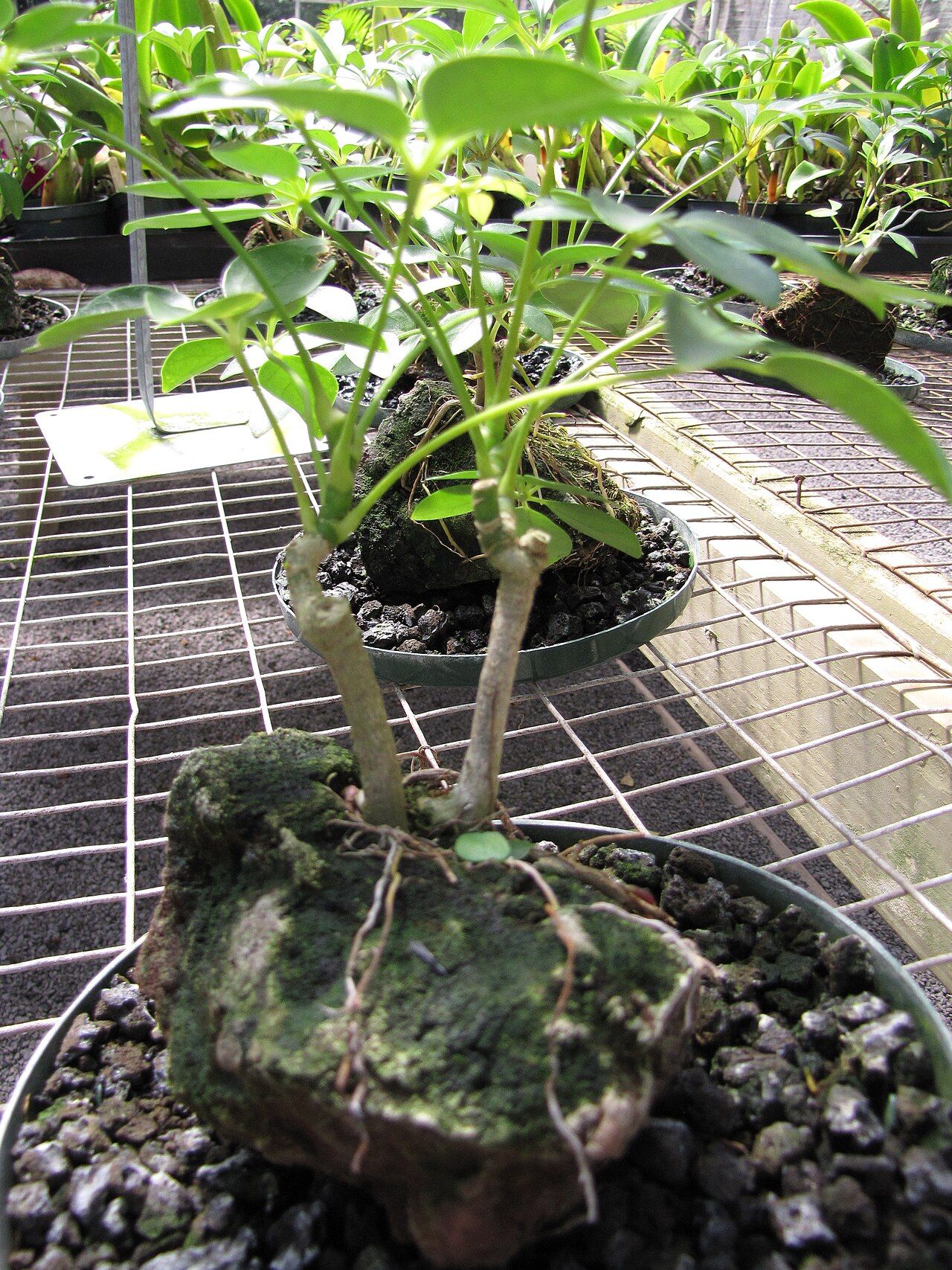
The photograph shows a potted plant recorded in Hawaii as Schefflera arboricola. Plants of the World Online at the Royal Botanic Gardens, Kew now treats that name as a synonym of Heptapleurum arboricola, the accepted name. A change in accepted name does not suddenly change the plant's care, but both names may help when searching for reliable temperature guidance.
Look under the leaves before the doorway
Before carrying a pot indoors, inspect the upper and lower leaf surfaces, petiole bases, stem joints, pot rim, and soil surface. University of Minnesota Extension notes that fungus gnats, aphids, spider mites, mealybugs, and scale may arrive indoors with plants, and recommends checking before the move.
Pause if you find movement, deposits, color changes, stickiness, or anything that was not present before the plant went outside.
If something looks wrong, do not place the returning pot among the indoor group. The same guidance recommends keeping returning plants in a separate area away from established plants. Choose a bright separation area before the move, and clean saucers and outer pots.
When symptoms are widespread, roots or soil are involved, or the right response for the identified plant is unclear, consult a local horticultural service or specialist nursery. Rejoin the collection only after inspection and any necessary care leave no unresolved signs. A one-line, dated record of each inspected area makes it possible to compare the same pot again the next day.
Do not apply one preventive treatment to every pot. Use a product only when the target pest and plant are identified, and follow the label and indoor-use directions for products authorized where you live. In a home with cats or children, location, drying time, and possible contact also matter. A pot-by-pot decision based on observation is safer than treating unaffected plants simply for uniformity.
Do not close off outdoor light at once
Outdoor and indoor conditions differ sharply in light, air movement, and humidity, even near a window. The RHS advises starting in a cool room where possible and allowing two or three weeks for readjustment. Moving a pot from bright outdoor shade directly into a dark corner with heated air replaces one stress with another. Check window distance, brightness, and airflow before carrying the plant inside.
Yellowing or leaf drop can follow an environmental change, but it should not automatically be dismissed as acclimation. Insects under leaves, soil that remains wet, a dark soft stem base, or spreading spots can point elsewhere. A short note of the move date, position, overnight low, soil drying, and where leaves fell makes it easier to see whether a change is temporary or continuing.
Do not carry the outdoor watering schedule indoors unchanged. With less air movement and lower light, the same pot may dry at a different rate. Check more than the surface: notice the pot's weight and moisture deeper in the mix, and do not leave water standing in the saucer. As growth slows, read the change in drying time instead of fixing a weekly interval in advance.
Choose the return day one pot at a time
First confirm the plant name and its minimum temperature. Then check the coming nights. Inspect leaves, stems, pot, and soil, and prepare a place away from established plants. Finally, create a gradual route from outdoor brightness to the indoor position. There is no need to move every pot on one date. Begin with plants that are cold-sensitive, show no unresolved symptoms, and already have a suitable place indoors.
Plants that spent summer outside carry leaves formed in stronger light and time exposed to rain and air. The autumn move is not an abrupt switch but an effort to narrow the difference between environments. Four simple records—overnight temperature, leaf condition, light, and soil drying—turn the doorway from a hard seasonal boundary into a quiet passage toward the next place.