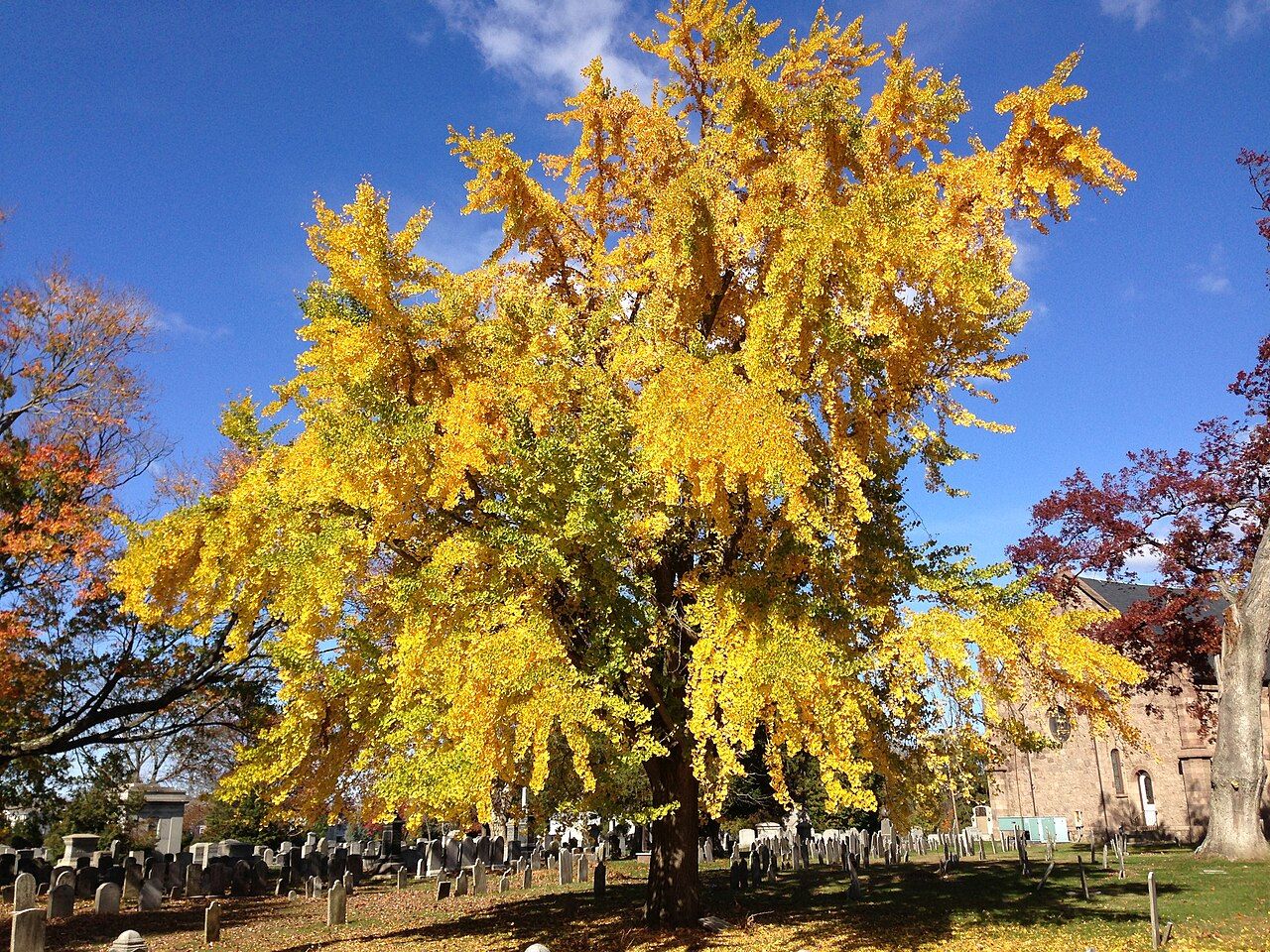
In early September, the walls of Lucca in Italy became a place for comparing plants one specimen at a time. The horticultural festival Murabilia held its 25th edition from 4 to 6 September 2026 and chose Ginkgo biloba, whose fan-shaped leaves turn gold, as its anniversary emblem. The event has ended, but its use of the number 25 to make plant diversity visible offers a method for observing a plant at home.
Gold begins with one leaf
The 2026 theme was Gold. A branch of autumn Ginkgo biloba drawn by botanical illustrator Alessandro Infuso carried the image of the 25th edition. Fan-shaped leaves moving from green to yellow tied the celebratory color to a seasonal change in a real plant rather than borrowed decoration. Leaf outline and placement along the branch, not color alone, became part of the anniversary's visual memory.
The photograph used here is not Murabilia's official artwork. It is a reference photograph of Ginkgo biloba taken in New Jersey in 2014. It does not recreate the venue or its displays; it offers only a view of the yellow crown and fan-shaped leaves. Keeping the event artwork separate from this licensed photograph avoids substituting the official illustration and returns attention to the plant itself.
The organizer associated Ginkgo biloba with memory, longevity, and renewal. These are anniversary interpretations rather than botanical properties turned directly into slogans. Even so, the decision brings together an observable fact—leaves of a familiar shape changing color with the season—and the passage of 25 editions. The botanical illustration preserved a recognizable outline while also carrying the event's sense of time.
Differences emerge when 25 are placed together
The anniversary number also shaped the displays. According to the official program, rosemary, ornamental brambles with botanical passionflowers, and oaks each appeared in small exhibitions showing 25 variations. The sequence continued with grapes, cereals and pome fruits, groundcover plants, buddleias, autumn asters, Sicilian aromatic plants, waterlilies, tomatoes, and colocasias.
The value of this arrangement lies in refusing to turn 25 into a ranking. Plants called by the same name can differ in leaf width, margin, internode length, stem posture, and growth habit. A single specimen may register only as rosemary; several side by side make variation visible. The display favors attention to diversity among species and cultivars over a contest in rarity.
The same method does not require taking leaves or moving plants. In a nursery or botanical garden, find three plants from the same genus and compare only one feature, such as leaf direction, branching position, or the way a plant covers the ground. Naming similarities and differences one at a time can make the outline of the next specimen easier to remember than learning labels first.
The listed groups span woody plants, herbaceous plants, aquatic plants, food crops, and plants valued for fragrance. They should not be measured by one standard across the whole event. Differences make sense first within each compact display: oaks are not ranked against waterlilies, while each set of 25 can reveal the features its members share. Limiting the field of comparison keeps diversity from becoming a miscellaneous inventory.
A route from the walls to the botanical garden
Murabilia extended across the San Regolo and La Libertà bastions on Lucca's walls and into the Lucca Botanical Garden. The organizer listed more than 200 exhibitors, most of them nurseries, offering unusual plants, new introductions, and old and new cultivars. It was not only a market but a place to compare plant names and the different histories through which plants have been grown.
The Botanical Garden opened under the same ticket and offered guided visits. An official article highlighted the flowering frangipani collection and an orchid exhibition in the small greenhouse. Walking from the compact displays on the walls to a garden that maintains living collections shifts the scale: plants selected in pots can be considered alongside plants maturing within an environment. Buying comparisons and long-term observation meet along one route.
A way of seeing after the festival
This route does not make finding one rare pot the only goal. A name first seen on a label can be sought again in a mature specimen in the Botanical Garden, where leaf size and branching may appear at another scale. A form noticed in the garden can then be reconsidered in a compact display. Moving between exhibition and growing environment replaces a memory of product names or rarity with a more specific observation of the plant.
The 25th Murabilia closed on 6 September. Yet its method—using a Ginkgo biloba leaf as an anniversary sign and arranging plant groups in sets of 25—can travel beyond the dates. Color can lead to leaf shape; a name can lead to differences among specimens. The festival's most useful afterimage returns celebration to plants by refusing to reduce one plant to a symbol and looking instead for the breadth held inside a shared name.