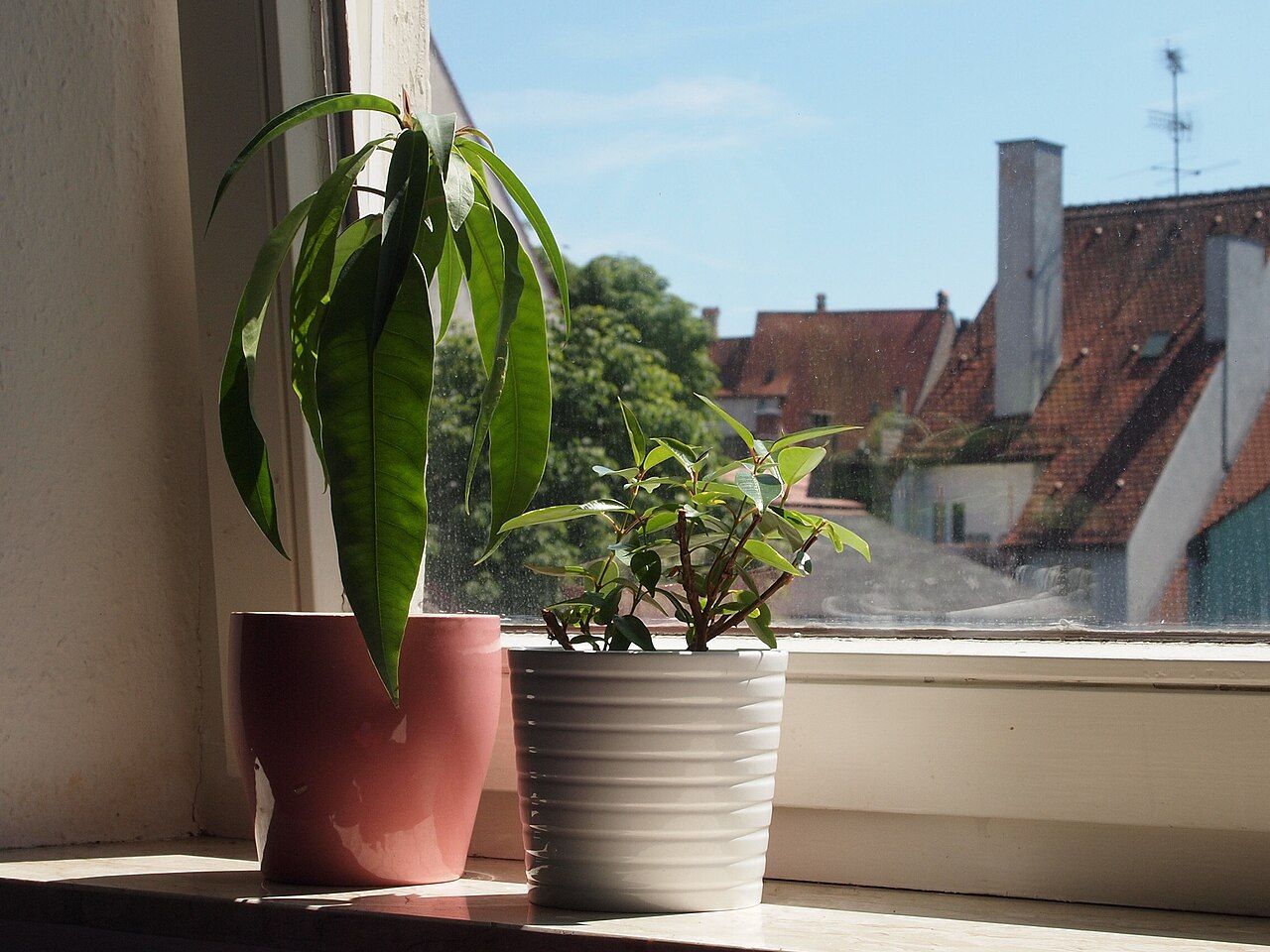
Hearing that watering should be reduced at summer’s end can make us want to change the schedule as soon as the month turns. Yet the speed at which a pot dries depends not only on the plant’s type and size, but also on light, temperature, humidity, airflow, growing medium, and pot material. The Royal Horticultural Society and U.S. university Extension programs likewise advise checking the medium and pot before watering rather than following a fixed weekday.
Compare Changes in the Same Pot, Not the Date September 1
What matters is not a one-time reading from different pots placed side by side. It is repeated observation of the same pot, in the same place, at the same time of day. Shorter days and lower room temperatures may slow drying, but the scale of change also varies with window light, air-conditioning, and pot size. A calendar can signal when to begin observing; it cannot itself signal when to water.
For the first week, do not decide the watering frequency in advance. Record the date, time, soil reading, temperature and humidity, and pot weight in a single line. Note whether leaves that dip slightly by day recover at night, or remain slack the morning after the medium dries; this connects the numbers to the plant’s condition. Choose a record short enough to maintain under consistent conditions rather than one designed for precision.
When water is needed, wet the entire root ball thoroughly and allow excess water to drain from the bottom. Do not leave water standing in the saucer. Instead of adding a little every day, check how dry the medium is and distinguish between times to water and times to wait. Because cacti and succulents require a different drying pattern from tropical foliage plants, do not make one universal standard from the three measurements alone.
Do Not Judge Soil Moisture by One Color in One Place
Shinwa Rules’ Soil Moisture Checker M 79019 indicates a moisture range with red, green, and blue LEDs when inserted into soil. Battery-powered, it is useful for quickly checking changes between dry and moist conditions rather than reading a numerical value. Its instructions, however, say to confirm the moisture appropriate for the crop and to measure several points in a pot. The color is not the correct answer for a particular plant; it marks the moisture band at that location.
The rim may be dry while moisture remains in the center. Avoid the immediate base of the stem, insert the probe gently where it will not damage roots, and compare several locations. Do not force it into hard soil; remove soil from the tip after use before storing it. The color gains meaning only when combined with observations such as touching the surface, checking leaf firmness, and lifting the pot.
A Thermo-Hygrometer Records the Air Near the Pot
Tanita’s TT-585 Digital Thermo-Hygrometer displays temperature, humidity, and time, as well as previous highs and lows. It can reveal how hot and dry the room became while no one was home, not only the reading seen in the morning. When recording it near a pot, keep it away from direct sun, humidifier airflow, and splashing water. It is also important not to treat a range labeled comfortable for people as a plant’s ideal temperature or humidity.
Temperature and humidity do not command watering; they provide context for the difference from the previous day. If humidity is high, light is weak, and the pot has lost little weight, there may be no need to rush in with water based on the surface alone. Conversely, even after a run of hot, dry days, it is possible to wait if moisture remains inside the medium. If the pot is moved, begin recording from that day as a new set of conditions.
Pot Weight Records the Difference Since Watering
A&D’s UH-3201-W Digital Home Scale is a household scale with a maximum capacity of 3 kg. For a small pot, record its weight after watering and allowing it to drain fully, then compare the change on subsequent days. If using a cachepot or saucer, weigh the same combination each time. The point is not to compare the weight of different pots, but to watch water leave one pot over time.
The unit is not dustproof or waterproof. Do not place a wet pot directly on it; use a clean, dry, thin tray between them, and work on a level, stable surface. Do not use it for pots over 3 kg or pots whose large base makes them unstable. Weight loss alone does not determine whether water is needed or how dry a particular plant should become. Combine it with soil moisture and changes in the room, then return to the needs of that plant.
If the three tools disagree, that does not necessarily mean one is broken. The surface can be dry while water remains at the center of the pot, and the room can be dry while the pot remains heavy. Do not rush. Keep the location and time of measurement consistent and look at the next day’s difference. The day to water less is not set by the calendar; it emerges gradually from the record of watching the same pot.