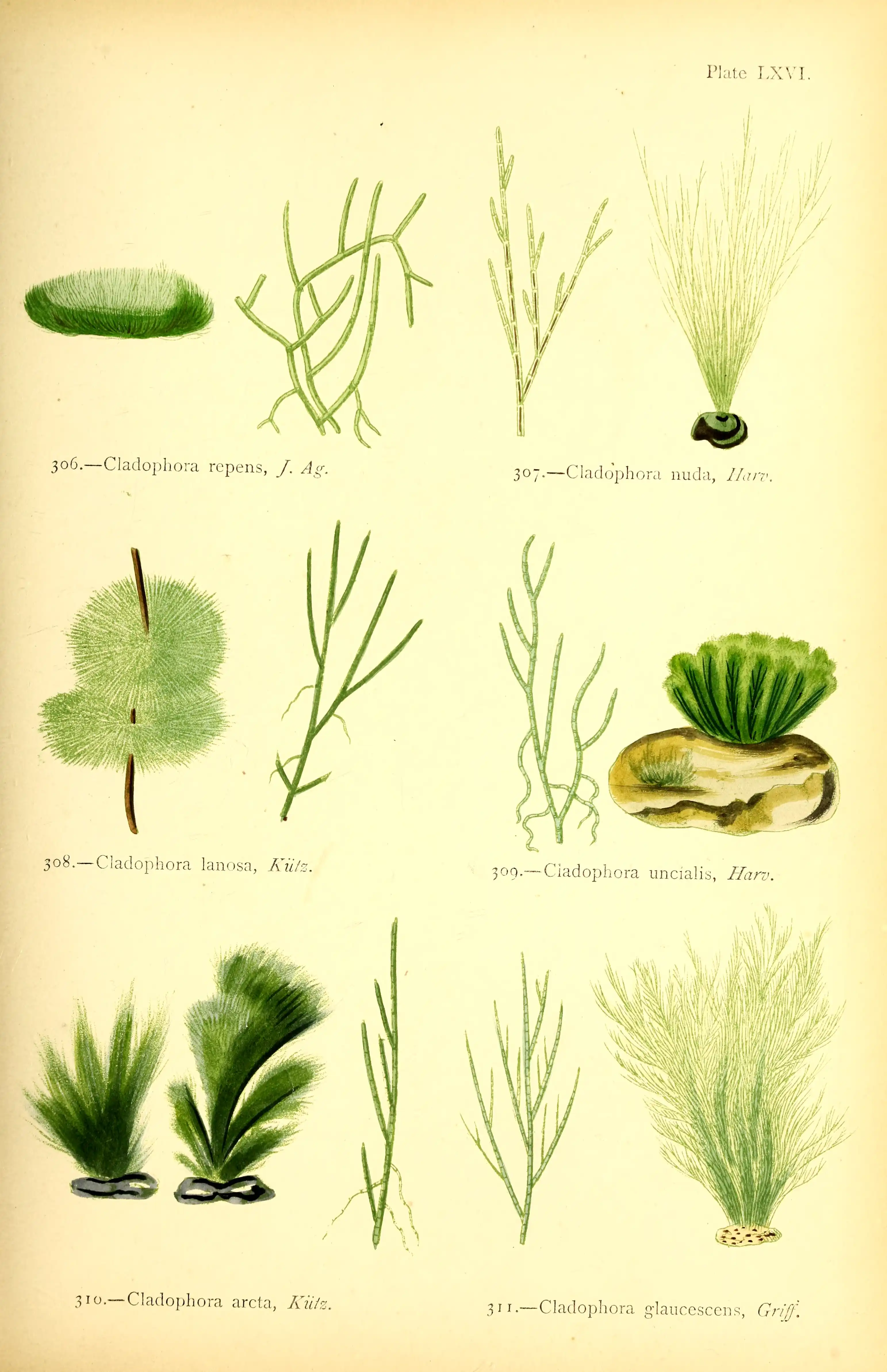
The opening plate is not one of Merrifield’s watercolors shown in the exhibition. It is a page depicting six species of Cladophora from the 1872 edition of British Sea-Weeds by Margaret Gatty, another woman of the same period who studied seaweed. We begin here without confusing the work of two makers because the plate conveys how looking at seaweed in 19th-century Britain crossed science, art, and women’s education.
A Woman Who Thought of Clothing as Something to Move In
Mary Philadelphia Merrifield was born in 1804. She studied painting techniques and color and published Dress as a Fine Art in 1854. According to Cambridge University Botanic Garden, the book supported practical clothing that interfered less with women’s movement. She looked beyond dress as decoration to consider how a body could move. That perspective became the exhibition’s point of departure.
About a decade later, Merrifield compiled a natural history of the Brighton area and wrote its chapter on seaweed. Her interest deepened into phycology, and the Botanic Garden reports that she made nearly 1,000 seaweed watercolors. Most are now held by the Cambridge University Herbarium. From the lines of dress to the branching forms of seaweed: the subject changed, but the practice of observing form, separating color, and recording by hand remained continuous.
Seaweed Remains Between Record and Picture
Brighton’s Booth Museum of Natural History holds seaweed specimens left by Victorian collectors, including Merrifield. Its seaweed collection contains 832 specimens representing more than 270 species. Detailed labels recording place and date of collection can also help compare past and present shorelines. A page with delicate thalli spread across paper was both a composition for viewing and a record carrying forward what was seen, where.
Merrifield continued studying seaweed late in life and contributed a review of phycological research to Nature in 1883. The exhibition does not tell a simple success story of a hobby becoming science. It asks how women continued their work between domestic roles and the desire to create—a question brought into the same space by herbarium watercolors and contemporary artists.
Aquatic Plants Become the Room’s Framework
The Struggle for Light was created by The Glasshouse Artists, a community arts group led by Annabel Lee, in collaboration with the University Herbarium and the Botanic Garden learning team. Official images show a room resembling a Victorian parlor, layered with sculpture, lighting, sound, and text; at its center stands a large transparent tank filled with aquatic plants.
Evoking a glasshouse waterway, the tank is said to represent Merrifield, her descendants, and the women artists who followed as they sought room to create. Here plants do not decorate history. Their living forms reaching upward through water become the structure supporting the exhibition’s argument. Along with botanical patterns hidden in wallpaper and textiles, visitors discover clothing, domestic space, and botanical art in sequence within one room.
Opening the Plate on the Final Day
The exhibition was in the Syndicate Room at Cambridge University Botanic Garden from 10:00 a.m. to 6:00 p.m. local time on August 30 and was included with regular admission. At 6:00 p.m. in Japan, the doors were just opening locally, leaving time to see it within that same day. Anyone traveling from afar should first confirm the day’s opening status on the Botanic Garden’s official site.
Even without reaching the gallery, a page from a botanical volume can be viewed at hand. Gatty’s green seaweed plate places six forms side by side, differing in filament thickness, branching, and attachment to rock even within the same genus. The names shown follow the 1872 text and do not guarantee current classification or identification. Still, the gaze that separated one similar green form from another leads the imagination toward Merrifield’s nearly 1,000 watercolors.
A plant can be preserved in more ways than a specimen or photograph. Trace its lines, place its colors, add the date and place. Those small choices turn a private observation into a record that others can follow later. In one image of a familiar plant, not only its name but the direction of its leaves and the location of its pot can preserve that day’s way of seeing. What remains for the future is not only the correct answer, but the gaze that chose where to look.