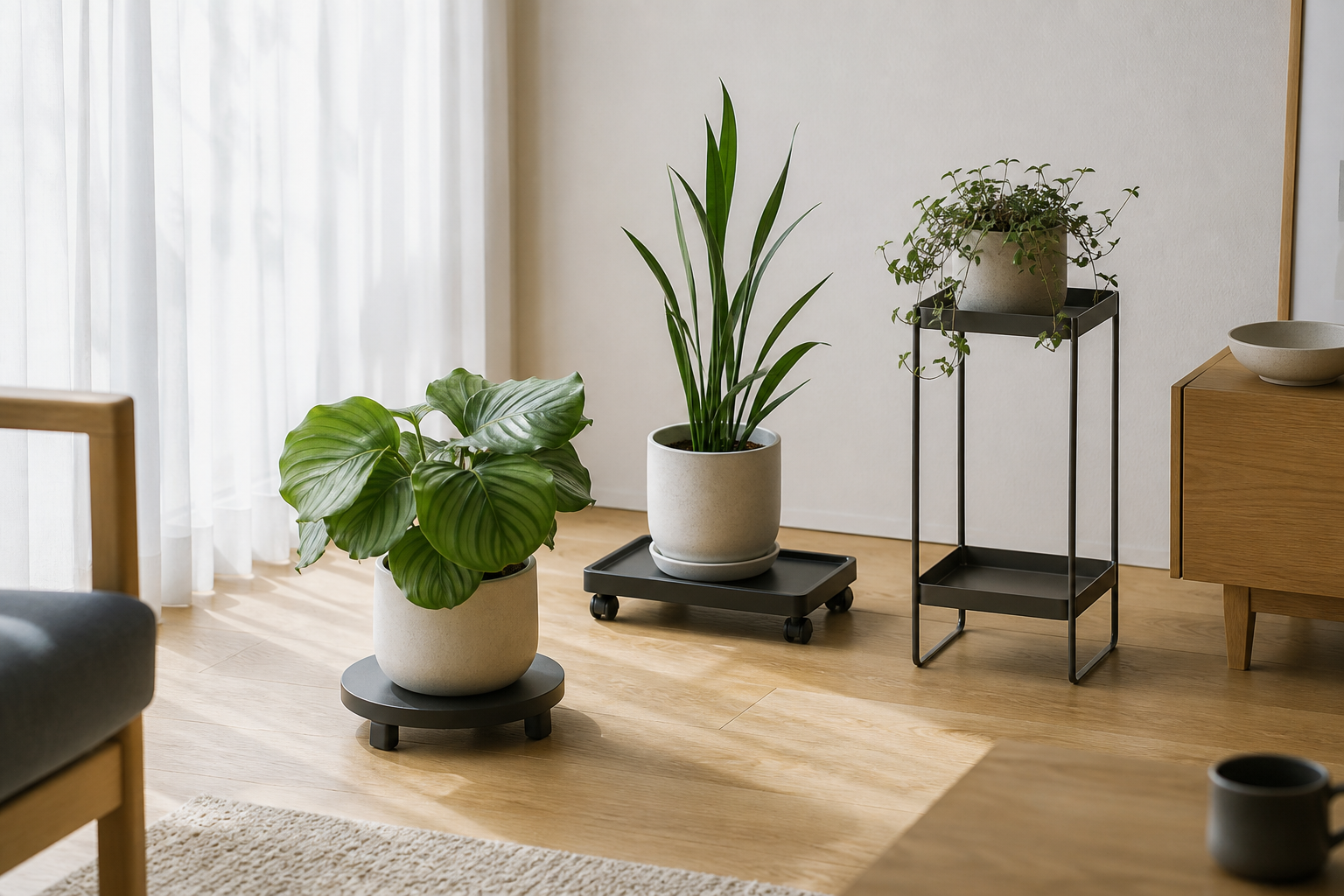
When choosing something to hold a plant, attention readily goes to the pot’s color and material while height above the floor becomes an afterthought. Yet a difference of a few centimeters changes whether a vacuum can approach, a saucer can be checked, or leaves overlap furniture. A large pot can remain part of the floor-level view while smaller leaves rise toward eye level; one device need not solve both needs.
First Measure the Pot’s Diameter and Its Weight When Wet
Compare a dolly or stand’s load limit not with the empty pot, but with the combined weight of plant, growing medium, pot, saucer, and water retained immediately after watering. Check in advance that the pot base does not overhang the support and that its center of gravity remains centered. The more mobile the device, the more important stability under load becomes.
A pot with drainage holes must shed excess water fully to preserve air needed by the roots. The Royal Horticultural Society advises allowing pots to drain after watering and emptying water from saucers. A dolly or stand does not replace a saucer. It becomes a complete setting only when paired with a way to keep water off the floor and casters.
3.2 cm Keeps a Large Pot in the Floor-Level View
Yamazaki Home’s Tower Slim Round Dolly L measures 37 cm in diameter and 3.2 cm high, with a static load capacity of 40 kg. Its round outline keeps the dolly visually quiet and the pot close to the floor. It suits a large-leaved plant meant to rise from a low point, or a tall pot that should not gain further height.
Low height does not eliminate the need to check pot size. Look beyond diameter to the shape of the surface touching the support and the direction in which foliage extends. Because the casters are hard to see, it is also easy to forget that the platform can move underfoot. Keep it slightly outside frequently traveled paths, and after moving it confirm that the floor is level and the pot stable.
6.5 cm Creates Room to Pull the Pot Out
Yamazaki Home’s Tower Dolly measures 28 cm wide, 45 cm deep, and 6.5 cm high, with a static load capacity of 100 kg. Its supporting surface is 27 cm by 40.5 cm, making it suitable not only for round pots but for elongated cachepots whose bases fit within that area. The manufacturer also lists houseplants among its intended uses.
Raised slightly more than 3.2 cm, the platform becomes easier to notice. In return, it makes it easier to pull a pot forward from a wall or beside furniture and inspect the saucer and floor. Even with ample load capacity, stability is a separate question if the base extends beyond the platform. Measure both long and short sides, and check that leaves or cords will not catch in the direction of movement.
70 cm Brings Small Leaves Closer to Eye Level
The Tower Two-Tier Planter Stand with Casters measures 25 cm wide, 26.5 cm deep, and 70 cm high. Its upper tier is rated for 2 kg and the lower for 5 kg, and it is intended for indoor use. A small pot hidden by furniture at floor level can rise toward seated eye level, while watering tools or another lightweight pot can be separated onto the lower tier.
As height increases, pot weight and projecting foliage demand greater care. Do not put a large pot on the upper tier, and avoid combinations with an off-center load even within stated limits. Do not place it where children or pets pass, near steps, or on a sloping floor. Do not move it quickly while loaded. Empty saucer water, check the surroundings, and roll it slowly.
Choosing Height Means Choosing the Path of Care
The three heights need not be ranked. At 3.2 cm, a pot retains its visual weight on the floor. At 6.5 cm, it gains room to be pulled out for care. At 70 cm, a small plant joins the room at furniture height. Do not let the platform alone determine distance from the window or light level; first prioritize a position suited to the plant, then choose a height that makes continued care easier.
Moving one pot can reveal a water mark on the floor or leaves leaning toward the window. A movable platform is not only for frequent rearranging; it can create occasions to look beneath the pot. In a late-summer room, the arrangement worth choosing is not the one that appears composed in a photograph, but the one that allows watering, cleaning, and observation to continue without strain.