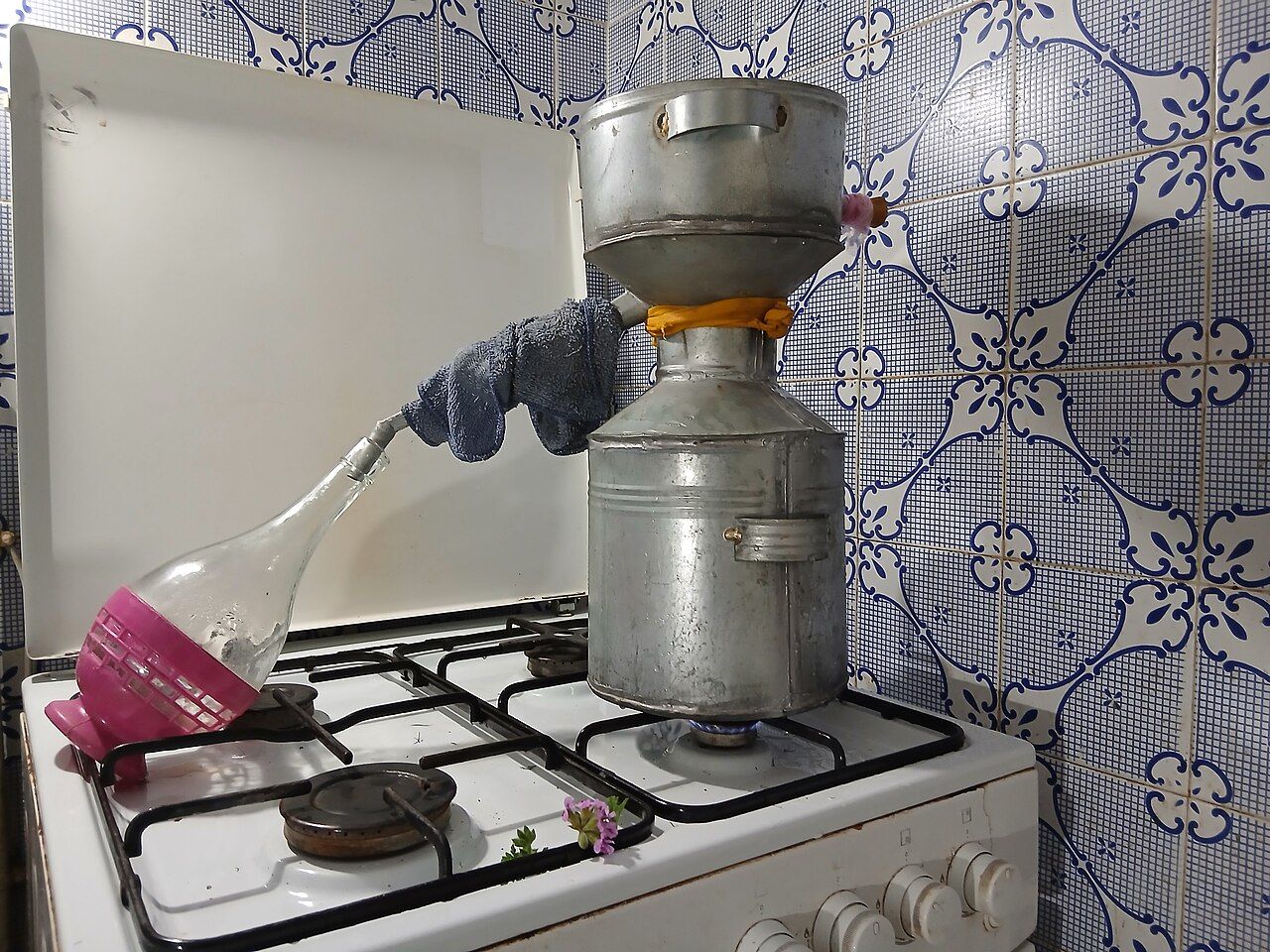
The opening photograph is not the Tokyo venue, but a household-scale distillation photographed in Ariana, Tunisia, in March 2026. Metal equipment stands before blue tile, heated by gas as liquid is collected at the end of a tube. The photographer identifies the material as Pelargonium graveolens, a type of rose geranium. Place and apparatus differ, but the image holds the same act: giving leaves over to heat and steam, then receiving a fragrant liquid.
Tomorrow’s Leaves Come from the Corridor
AEAJ GREEN TERRACE schedules August distillation demonstrations on Wednesdays and Saturdays from 3:00 to 4:00 p.m. Fresh geranium is planned for August 26, explicitly harvested from the building’s Aroma Corridor. Rather than dried material arriving from a distant source, a plant growing in the same building becomes the day’s subject.
The Corridor gathers plants used as essential-oil sources alongside species rooted in Japan. Looking first at leaf surfaces, stem firmness, and the shape of the plant before moving to distillation preserves contours a bottled scent cannot provide. The value lies not in sampling fragrance as a finished product, but in moving back and forth between the plant and the process.
The scheduled herb may change. That note is natural for an event using living material: leaf condition and harvest volume are not uniform industrial products. Check the latest notice before visiting to confirm whether geranium will be used as planned.
Look at the Plant Part Before the Bottled Scent
The Aroma Environment Association of Japan describes essential oils as volatile aromatic substances extracted from flowers, leaves, peel, heartwood, roots, seeds, and other plant parts. Results differ according to the part selected and extraction method, even within one plant. The point of seeing a still is not merely to admire an unusual machine. It is to understand that a bottle begins with decisions about which part of a plant to choose and how to handle it.
Plants of the World Online from Kew accepts Pelargonium graveolens, shown in the photograph, as a shrub in the Geraniaceae native from eastern Zimbabwe to eastern South Africa. AEAJ’s notice, however, identifies the day’s material only as “geranium.” This article does not identify the venue plant as the photographed species. At the demonstration, check the displayed plant name and part used.
What distillation yields is not a substitute for the plant itself. Leaf thickness, branching, and place of growth disappear inside the bottle. In exchange, part of the scent becomes concentrated. Watching before and after together reveals both the form that is lost and the quality that remains.
Hinoki Elements Become a Vessel for Scent
The venue itself was designed to receive scent. Kengo Kuma & Associates describes AEAJ GREEN TERRACE as a 491-square-meter facility completed in 2023. Domestic hinoki cypress members, 105 millimeters square, are assembled like small particles into a tree-like structure inside a glass box.
The scent rising from geranium leaves and the scent of hinoki as building material occupy the same place. One is extracted in a brief distillation; the other continues from the wood supporting the space. Rather than ending with a division between perfume ingredient and building material, the architecture gathers them into an environment where people can walk, stop, and compare.
It is possible to sample a scent once against photogenic architecture and leave. On a distillation day, however, change the order of looking: see the leaves in the Corridor, move to the metal apparatus, inspect the collected liquid, and finally look up into the hinoki framework. The process by which scent leaves a plant contrasts with the process by which wood remains as architecture.
What to Confirm Before You Go
AEAJ GREEN TERRACE is at 6-34-24 Jingumae, Shibuya-ku, Tokyo. It is open Tuesday through Saturday from 1:00 to 6:00 p.m., a seven-minute walk from JR Harajuku Station’s East Exit and three minutes from Tokyo Metro Meiji-jingumae Station’s Exit 7. Reservations are required. The August 26 demonstration is scheduled for 3:00–4:00 p.m.; confirm current availability, admission, participation terms, and any material change on the official reservation screen.
The demonstration is not instruction for recreating the apparatus at home. Distillation involves a heat source, hot steam, and glass or metal equipment. Essential oils are concentrated materials, and AEAJ advises against applying them undiluted to skin or ingesting them and calls for care around flame. After encountering scent at the venue, continue to prioritize product labeling and specialist safety guidance.
If photographing one leaf, record not only the flower but both leaf surfaces, the petiole, and its connection to the stem. Scent cannot appear in a photograph. Still, a record of the part from which it arose can return the plant’s form when the bottle is opened later. Tomorrow’s hour is for seeing where scent lived in a plant before choosing the scent itself.