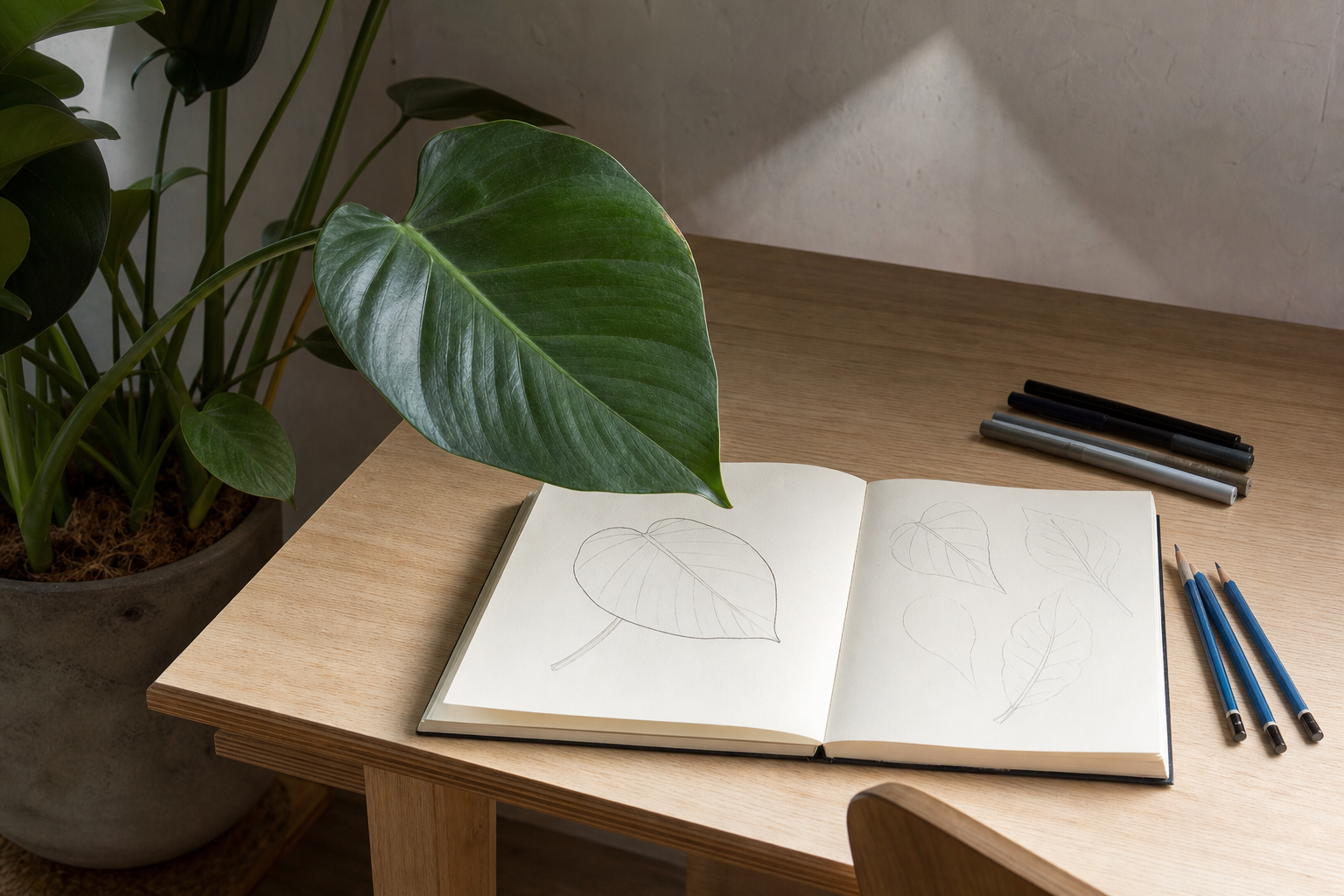
Drawing a plant brings a kind of observation distinct from learning its name. Where does the base of a leaf begin to narrow? At what angle does the midrib travel toward the tip? Royal Botanic Gardens, Kew explains that botanical art serves as scientific record, able to show attachment, scale, and fine detail. Yet a person opening a sketchbook needs more than the precision of a finished reference volume. Recording what you discovered in the leaf before you is also reason to draw.
Daniel the Gardener, a London-based botanical artist from Argentina, moves among illustration, painting, and tattooing. Beyond Botanical: A Guide to Drawing Plants in Nature, listed by Hachette Australia for publication on August 25, uses leaves, stems, and flowers to address perspective, shading, composition, drawing, and journaling. Its publication offers an occasion to place three tools on the table for recording nearby plants.
Make a Place for the Leaf Before Drawing
The first tool is an unruled A5 notebook. Midori’s MD Notebook A5 Blank has 176 pages of thread-bound MD Paper and opens flat to 180 degrees. Because a spread can serve as one field, it readily accommodates a full contour on the left and an enlargement of the petiole or edge on the right. Precisely because it is not paper reserved for botanical art, the date, location, and newly noticed traits can be written freely beside the drawing.
There is no need to begin by drawing the leaf large in the center of a white page. First mark four small points—top, bottom, left, and right—and contain the outline within them. Then place the direction of the petiole and one line for the midrib’s angle. Looking first at where the leaf exists on the page helps loosen the habit of drawing the shape you think you know.
See Inside Green Through Six Values
The second tool is a set of pencils rather than one fixed grade. The Staedtler Mars Lumograph set contains one each of 8B, 7B, 6B, 4B, 2B, and HB. That range can keep contour and shadow from being enclosed in the same black. Place the overall position and midrib lightly with HB or 2B, then deepen only overlapping areas or folds toward the underside with a softer lead.
Even a green leaf is not one color when translated into pencil. The window-facing surface, spaces between veins, a dry tip, and the shadow of the petiole each carry different light. Instead of filling everything, gradually add darker areas while leaving the paper white; thickness and direction hidden by color begin to emerge. There is no need to use all six pencils. Select two or three and notice which differences held your eye.
What Appears Before the Name When Color Is Added
The third tool is Kuretake’s ZIG Clean Color Real Brush 24-color set. These brush pens use water-based dye ink and a bristle tip to make both fine lines and fields of color. Before selecting the green imagined from a plant’s name, view the leaf from two distances. Step back to identify its broadest color, then move close to find smaller differences in veins, margins, variegation, and damage.
Rather than coating the entire leaf evenly, place several separate areas of color and connect them with white paper or pencil gray. If yellow-green, blue-green, and brown appear together in one leaf, that is not a coloring error but information belonging to the leaf that day. Choosing again while pausing the hand lets us read plant change at a different speed from color received instantly in a photograph.
Preserve What You Found, Not a Measure of Skill
After finishing, add one line about something unnoticed before drawing instead of scoring the result. The spacing of serrations differed on the two sides. The midrib was lighter in newer leaves. The petiole’s cross-section was thicker than expected. Such small discoveries become markers for looking at the same plant again, deepening the relationship from another angle than RareDex’s dated photographic record.
The notebook creates a field for observation, pencils separate light from dark, and brush pens gather differences in color. Owning all three does not mean using all three every time. There may be days for contour alone, for following one vein, or for testing two colors. Reconsidering one leaf at a desk is not only a way to turn a plant into art, but a habit of welcoming a familiar specimen again as an unknown form.