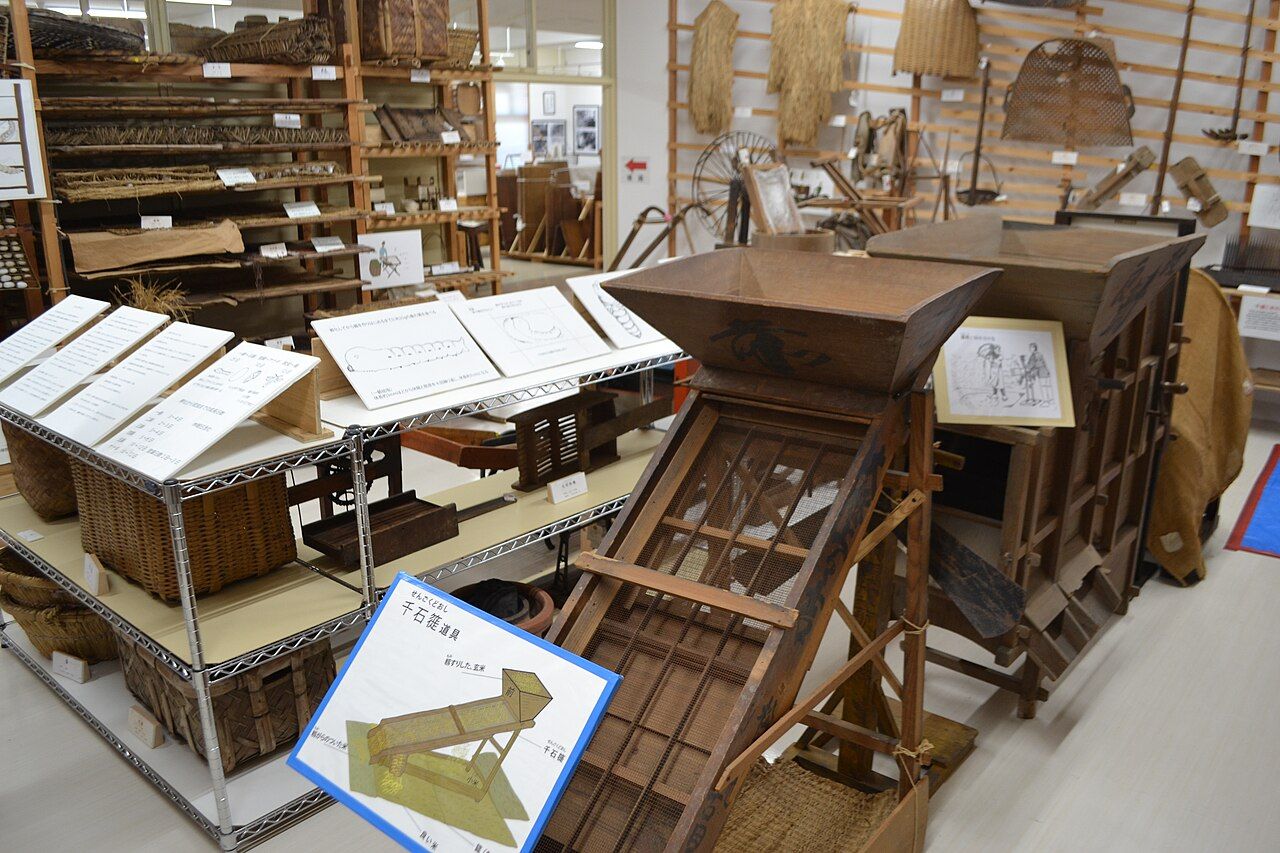
The opening photograph does not show the exhibition or its works. It documents wooden tools and screens once used for papermaking at the Mino Washi Tools Museum Fukube in Mino, Gifu Prefecture. Before a fold there is a sheet of paper; before that, kozo fibers, water, a vat, and the movement of hands. This place serves as the entrance instead of an artwork image because the Honminoshi supporting Hana no Wa’s three-dimensional forms should be seen not as a white surface, but as material holding a process.
Layering Materials Rather Than Reproducing Flowers
Hana no Wa consists of white paper flowers folded one by one from Honminoshi. For this exhibition, Atelier Shimura adds botanical dye to those folds. It neither paints petals realistically nor prints botanical pattern. Paper is made from the kozo plant; color is drawn from the roots, branches, and leaves of another plant; both are layered into a flower made by folding. Before becoming a motif, plants are materials that create both form and color.
In white washi, mountain and valley folds receive light and create the flower’s outline. Once color enters, the placement of light and dark should change even in the same fold. How does dye settle into paper, and what differences appear in overlapping fibers and creases? The interest lies not in naming the flower, but at the threshold where flat paper begins to carry a botanical presence through color and folding.
Kozo Fibers Become the Shadows of Folds
The principal material of Honminoshi is kozo. In the process published by the City of Mino, white bark is soaked, boiled, cleaned, and beaten with wooden mallets to separate the fibers. In the vat, water is combined with mucilage from tororo-aoi roots, and a bamboo screen is rocked both lengthwise and sideways. This motion entangles fibers in two directions, creating an even formation within great thinness. Finally the sheet is brushed onto a board and dried in sunlight. A folded flower shows edges and planes, but its strength comes from long, nearly invisible fibers and the way they were formed.
Along with Sekishu-banshi and Hosokawa-shi, Honminoshi is part of “Washi, craftsmanship of traditional Japanese hand-made paper.” Agency for Cultural Affairs materials identify the three papermaking traditions inscribed on UNESCO’s Representative List of the Intangible Cultural Heritage of Humanity in 2014. Seeing tradition only as a finished style misses the exhibition’s present tense. Turning Honminoshi into folded sculpture and bringing it together with botanical dye is also an attempt to consider preserving technique and renewing the uses of material in the same place.
Even the Same Plant Gives Color Only Once
Atelier Shimura dyes thread by hand in its Saga, Kyoto, studio, drawing color from roots, branches, leaves, and other plant parts. Its official process guide explains that botanical-dye color is affected by season and region. Here the recipient changes from bundles of soft thread to a sheet of Honminoshi. Color is not a finish covering the surface, but an element interacting with the paper’s translucency and the shadows of its folds.
August workshops at the studio feature fresh indigo leaves and safflower; September features kariyasu grass; October includes madder and sharinbai. This does not mean all are used in the exhibition. It shows that plant color is not a fixed swatch, but comes with a harvest season and dyeing process. Which plant appears in which flower should be confirmed from the labels at the venue.
From One Flower to Beeswax Paper for Daily Life
Alongside botanically dyed Hana no Wa, the venue plans to show beeswax paper layered with plant colors. A sculptural flower stands beside paper suggesting uses such as wrapping or lining. As the same dye moves between an object of contemplation and a household tool, ways of owning color multiply. Atelier Shimura, which organized the exhibition, and Good Project Design Lab, committed to carrying forward and circulating washi culture, seek to pass handwork into forms that can be touched rather than confining it to an archive.
Plant Colors Become Flowers runs September 11–October 20, 2026, at Atelier Shimura Gallery & School in Soshigaya, Tokyo. Hours are noon–5:30 p.m.; the gallery is closed Wednesdays and Thursdays but plans to open on holidays. A September 12 talk is also planned with Hiroyuki Hayashi of Hana no Wa and Masashi Shimura, head of Atelier Shimura. Check the official page before visiting for current capacity, fee, and closure information.
When looking at plants, there is no need to follow only the forms of flowers and leaves. Kozo becomes the strength of paper; roots and branches become color entering the outline of another flower. Two routes by which plants become material overlap within the small act of folding one sheet of washi. After seeing that flower, the green of a nearby leaf and the brown of bark may appear not only as names, but as colors not yet transferred to paper.