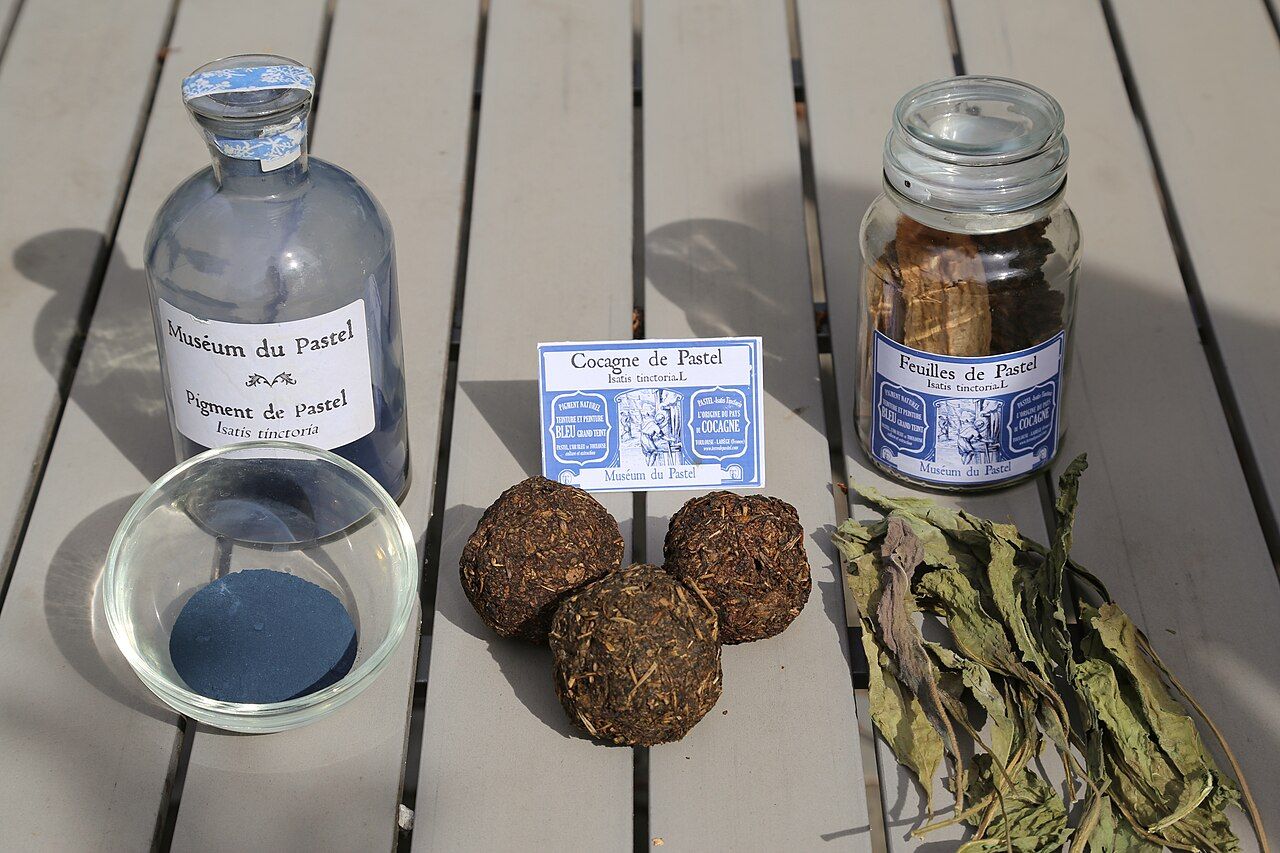
Blue powder, dried balls, freshly picked leaves: together they show that color begins not in a paint tube, but is drawn from a field. The photograph documents dye production from woad (Isatis tinctoria); it does not identify the collection or plants used in it. Studio Claudy Jongstra says it developed plant-derived colors for Louis Vuitton, but has not disclosed which dye plants were used in each look. This article likewise does not infer the use of woad.
Entering Nature Through the Making of Color, Not Its Image
Louis Vuitton Women’s Fall–Winter 2026 was presented March 10, 2026, in the Louvre’s Cour Carrée in Paris. Nicolas Ghesquière linked founder Louis Vuitton’s journey from the Jura to Paris with dress at the intersection of nature and the future. LVMH’s official account includes leather recalling bark, traces of plants and animals, and imagined flowers made from leather. Nature does not settle into one floral pattern; it spreads through the collection as design that changes surface, volume, and outline.
Studio Claudy Jongstra’s role was not to reproduce plants, but to cultivate color and the hand of cloth. According to the studio, it created couture textiles incorporated into several looks using wool, silk, plant-derived color, and historic techniques of botanical dyeing and felting. Instead of printing color onto the surface, it is held within fibers and seen with the cloth’s thickness and nap. That is the core of the collaboration.
Wool and Silk Receive Plant Color
For more than 20 years, Claudy Jongstra has brought wool and plant color together through handwork. The studio connects wool with regenerative agriculture and seasonally harvests madder, woad, weld, and other dye plants. This describes the studio’s broader practice, not the use of all three plants in every Louis Vuitton piece. Still, the continuity of plant growth, harvest, dyeing, carding, and felting offers a way to see a garment’s color not as a name, but as material history.
Wool fibers interlock and, once felted, resist fraying at cut edges. Silk receives color in fine threads while retaining lightness and sheen. Layering these distinct materials creates relief and tonal variation unavailable to flat print. TextielMuseum likewise describes Jongstra’s practice as joining botanical-dye knowledge with felted wool. Plant color does not imitate uniform industrial color; it creates surfaces that include how each fiber absorbs and how the hand applies pressure.
Shortening the Distance from Field to Cour Carrée
Luxury’s botanical expression often directs attention to embroidered flowers and leaves or garden-like staging. Here, processes before dyeing—largely invisible in the finished product—also determine the garment’s contour. Where did the plant grow, when was it harvested, and onto which fiber was it transferred? Not all details are public, so the environmental burden cannot be evaluated from one collaboration alone. Still, the presentation of material process before rhetoric praising nature deserves notice.
Louis Vuitton Japan currently presents Fall–Winter 2026 as a new collection. This does not identify individual Jongstra-textile products, Japanese availability, or prices. When viewing the looks, search not only for plant forms but for boundaries of color, directions of pile, and areas of thickness. Nature may remain in the structure of cloth without moving to the foreground as motif.
Reading Fall–Winter Clothing Through the Origin of Color
“Botanical dye” can suggest only ecru and pale hues. Yet blue emerges from green woad leaves, and madder roots build layers of red: the raw plant and finished impression can differ greatly. Knowing that transformation subtly changes how clothing is chosen. Alongside color name and seasonal trend, one begins to ask what produced the color and which fiber received it.
The Louis Vuitton and Studio Claudy Jongstra collaboration showed not how to add plants as decoration, but how to return them to the process before clothes exist. Color grown in fields, wool and silk, surfaces made by hand: as those distances shorten, a fall–winter garment stands with both its appearance and the route its materials traveled. When looking at the color of familiar cloth, trace its beginning once.