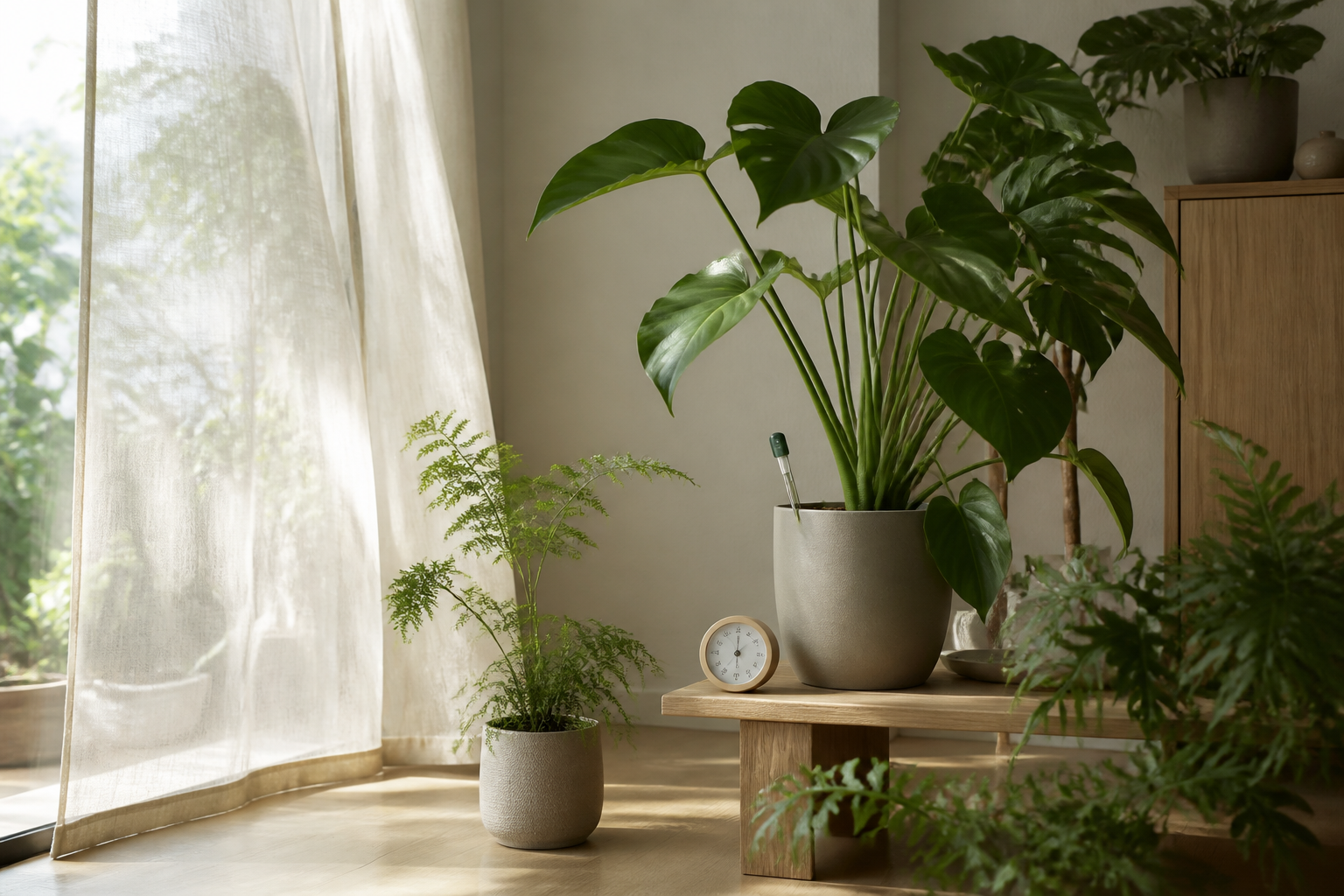
A windowsill in the afternoon becomes a different environment from the room seen in the morning. Light intensifies through the curtain, heat remains between pot and wall, and only the surface of the growing medium appears dry. When leaves dip, we want to add water or fertilizer. Yet wilting can occur not only from dryness, but when excess moisture makes oxygen less available to roots. Summer care begins not with intervention, but with separating what is happening now.
Read Temperature Beside the Pot, Not Across the Room
Even in one room, temperature differs between window and hallway, floor and shelf. The Royal Horticultural Society notes that high temperatures from direct summer sun can damage leaves and recommends checking temperatures across rooms throughout the day. The aim is not to assign one ideal temperature to every plant, but to learn the relationship between the hours when light enters your room and those when temperature rises.
SwitchBot Meter Pro shows temperature and humidity on one screen and allows later review of records. It is not a plant-specific instrument, but can help observe when a windowsill heats up or how humidity changes after air-conditioning stops. Do not turn displayed numbers into universal targets. Use them as clues for moving a pot, drawing a sheer curtain, or finding a place away from direct conditioned air.
Create a Path for Air Rather Than Blowing at Leaves
In summer sunrooms and glasshouses, shade and ventilation help limit rising leaf temperature. The principle is similar indoors, but does not mean continuously directing strong air at foliage. Considering species, drying rate, and air-conditioner position, create a gentle current so heat and moisture do not stagnate in part of the room. Begin with only enough movement to stir a curtain or light leaves slightly.
The Vornado 533DC-JP is designed not as an oscillating fan aimed at one point, but as an air circulator directed toward walls or ceiling. The manufacturer suggests initially using high speed to establish the airflow, then lowering it to a preferred gentle setting. Rather than facing leaves, find a route that returns air from the window toward the room’s interior. The choice treats the entire room as one environment instead of placing a device beside the plant.
Do Not Decide Watering from Surface Color Alone
On a hot day, the surface dries quickly. Daily watering based on that alone can add water while moisture remains inside. The Royal Horticultural Society likewise cautions checking below the surface before watering a wilted houseplant. Base the decision on pot weight, touch, leaf firmness, and days since the previous watering together.
SUSTEE M changes its display from blue to white to indicate watering timing. The manufacturer recommends size M for pots approximately 10.5–18 cm in diameter. Without batteries, it supports the sense of waiting for moisture inside the pot to decline. White is not a command to water immediately. Use it as a marker combined with your observation of plant traits, medium, and location.
Set a Time to Look Before Adding Tools
A thermo-hygrometer, air circulator, and moisture marker do not automatically determine a plant’s condition correctly. Stand beside the pot morning and evening, and inspect leaf direction, medium, light, and air in the same order. If nothing has changed, do nothing. Choose summer tools not to add care, but to remove one unnecessary intervention.