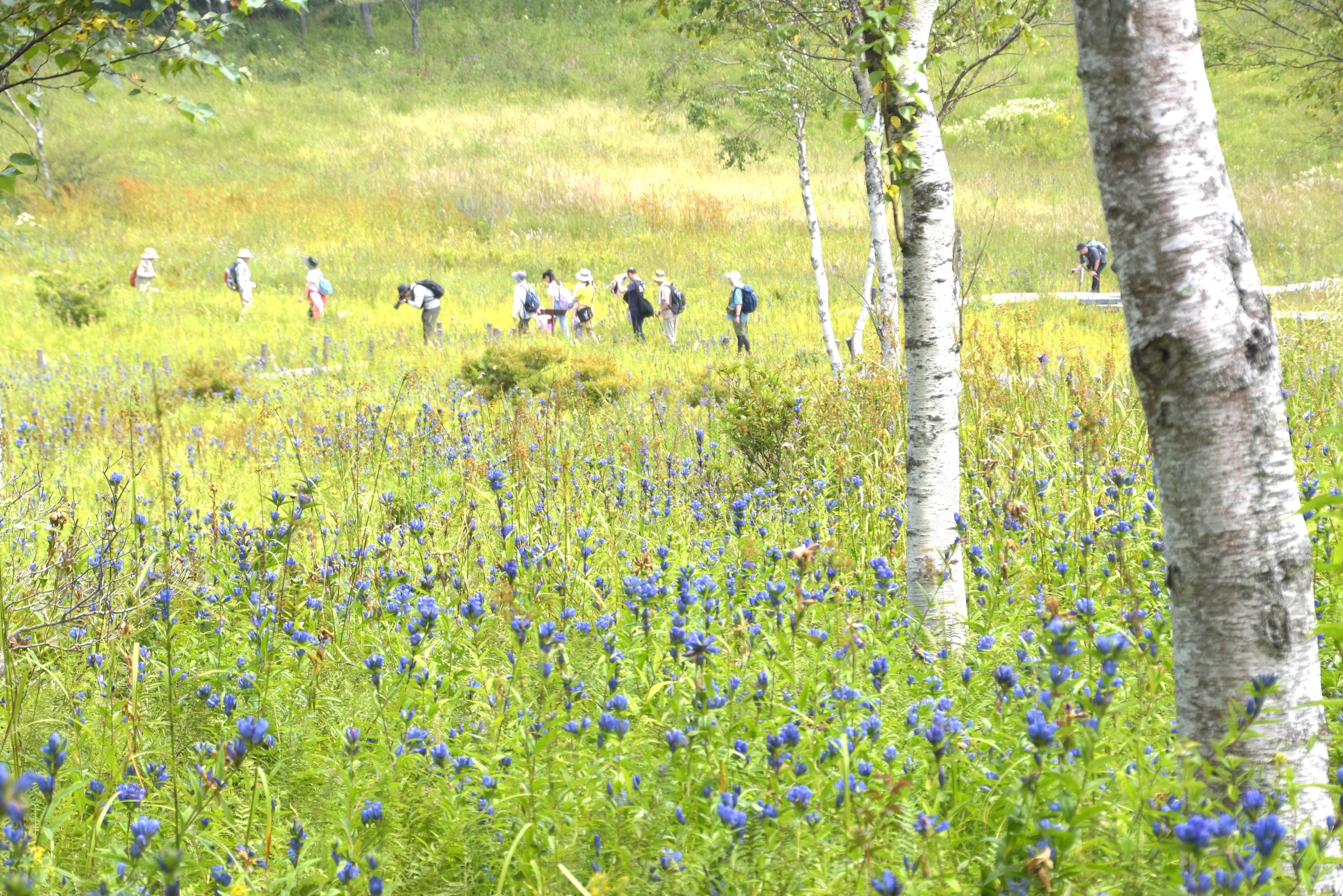
A narrow boardwalk runs between white birch trunks. On both sides, blue-violet flowers continue while shifting slightly in height through the grasses. In a photograph published by Fujimi Panorama Resort, the blooms do not become a uniform band from afar. Close up, each is a stem; farther away, a gathering of points; deeper still, the color of the marsh. Each change of scale changes the way the same flower appears.
Read a Field of Blue-Violet Through Two Flowering Patterns
The festival centers on Ezo-rindō and Oyama-rindō. Both are perennial gentians with tubular blue-violet flowers and can look alike while walking. Botanical-garden explanations offer an entry for distinguishing them: the position of their flowers.
Ezo-rindō bears flowers not only at the stem tip but also in the axils of upper leaves. Oyama-rindō tends to cluster its flowers near the tip. It is easier to follow one stem visually from top to bottom than to memorize names. Do flowers form tiers, or gather at the summit? That difference gives a small rhythm to a marsh that looked uniformly blue-violet from afar.
The scientific name of Ezo-rindō is Gentiana triflora var. japonica. Official plant references and botanical-garden materials describe it from wetlands and grasslands, mainly on Honshu, flowering from late summer into fall. Nyukasa Marsh’s official guide generally identifies late August through mid-September as the viewing period. Bloom advances with weather, however; do not confuse the festival’s stated number or earlier photographs with conditions on a particular day.
A Marsh Is Not Completed by Flowers Alone
Nyukasa Marsh covers approximately 1.85 hectares. Water collects in a basin surrounded by mountains, and plants are viewed from boardwalks. When photographing gentians up close, it is tempting to fill the image with flowers. Yet the character of this place lies in blue-violet situated among wet ground, grass height, birch trunks, and the slope behind.
The boardwalk is both a line for viewing and a boundary that protects the marsh from footsteps. Stay on it and adjust distance with a telephoto lens or framing. To record one plant, include the whole stem. To record the landscape, include some boardwalk and trees along with the flowers. Separating those two approaches keeps the plant record distinct from the record of place.
Plants with overlapping flowering periods enrich the view. Fujimi Panorama Resort’s seasonal guide names marsh lobelia, great burnet, scabious, and other plants in and around Nyukasa Marsh in early fall. They are not guaranteed to appear together, but looking beyond blue-violet to reddish-brown spikes and other inflorescences makes the seasonal transition more dimensional.
Update Flower and Mountain Conditions on the Morning You Go
The 30,000 Gentian Festival runs August 22–September 23, 2026. Official information places Nyukasa Marsh about a ten-minute walk from the gondola summit station. The gondola operates 8:30 a.m.–4:00 p.m., with the final descent at 4:30. Round-trip fares are listed as ¥2,600 for adults, ¥1,300 for children, and ¥800 for pets. Dates, fares, and operation can change with weather and daily conditions, so confirm them officially before departure.
At elevation, do not dress by the heat at the foot of the mountain alone. Bring walking shoes, a layer for sudden rain, and water; check local weather and gondola operation. If current bloom information is available, read beyond the word “peak” to which species have begun blooming and where. This narrows the distance between the expected landscape and the one present that day.
There is no single right answer between hurrying to opening day and waiting for September’s deeper color. At first bloom, individual outlines are visible; as flowers multiply, layers of color spread across the marsh. Later, the surrounding grasses change as well. Recording the same place on different dates reveals fall’s movement beyond the count of flowers.
Knowing the Name Returns the Landscape to Detail
Thirty thousand may begin the journey, but in the marsh it may be one flowering pattern—not the number—that stops the eye. Ezo-rindō layers flowers along the stem; Oyama-rindō gathers them near the tip. Two plants that share a distant color become distinct as you approach.
When recording them in RareDex, add an image showing the entire stem along with date and place. It can later help confirm identification and keep the memory of that day from becoming only a quantity of flowers. Visiting a blue-violet landscape is not simply taking home a distant view. It is training the eye on differences among similar things and returning with a slightly finer way of seeing.