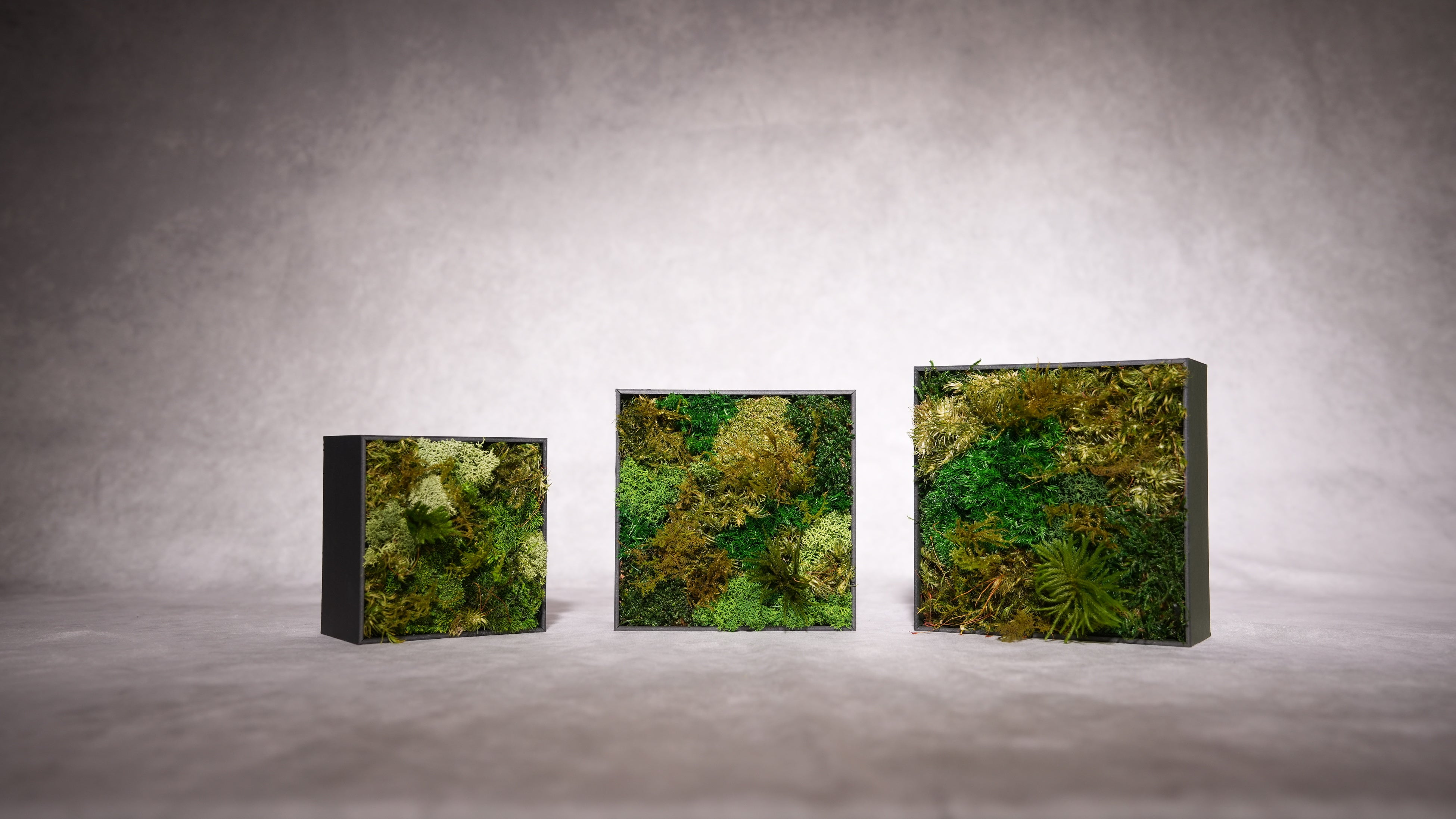
Three square black and gray frames sit on a gray wall. Moss does not cover them uniformly: rounded mounds, slender branches, and dense planes occupy different depths. What catches the eye in the new KOKE photographs is less the amount of green than the contours left between it. Rather than increasing plants until a room is full, the work asks how far to place them and where to return to the wall.
Choose the Composition, Not Merely the Moss
KOKE is a natural-moss interior series by Tokyo-based AND LLC. The third edition adds plant-free BLANK TILE to moss-filled KOKE TILE. Green does not fill the frame; blank space can be selected as a component of the same standard. It is less like buying one finished picture than making a small composition to suit wall dimensions and furniture lines.
Paper-based frames come in S, M, and horizontal RECTANGLE sizes and three colors. KOKE TILE and BLANK TILE combinations can be selected within those shown on the product page. Lightness is more than convenience: it helps move botanical material onto walls and shelves where large pots are difficult. The spatial logic differs from a living plant that includes pot, soil, and water catchment.
The official description says 12 to 15 moss types are used, but does not publish individual species or the composition of each tile. Species cannot be inferred from photographs to make claims about rarity or traits. What deserves attention is not a collection of varieties, but how density, relief, and fineness of branching meet within square frames.
When Growth Stops, Form Moves Toward the Room
The moss is specially processed to retain its condition, and the official page states clearly that it is not alive. It needs no watering, misting, sunlight, or pruning. This differs from welcoming a plant whose roots extend, shoots appear, and color changes with season. Choosing only for low maintenance misses that difference.
A growing plant gradually exceeds a planned composition. Leaves turn toward the window, branches overlap furniture, and each rotation changes the front. Processed moss suppresses that change in order to preserve the installed composition. KOKE TILE may be closer to wall art chosen for material shadow, or furniture composed from upholstery, than to a small garden.
Neither is the correct relationship with plants. Someone who enjoys observing leaves and checking dry soil may find a living pot richer. A fixed botanical composition can suit rooms with frequent travel, limited light, or retail spaces unable to add care. What matters is not choosing it under the impression that it will grow.
“Maintenance-Free” Still Has Placement Conditions
No watering does not mean it can go anywhere. Official precautions say to avoid direct sun, high temperature and humidity, and sudden drying. Misting is unnecessary and moisture is not intended. Before placing it by a window, air outlet, or bathroom, consider changing sun, heat, and humidity.
As a natural material, color, form, and volume vary. A tile may not look exactly like the photograph. It is chosen as material retaining variation, not as an overly uniform industrial product. Conversely, it does not suit a use seeking specimen-level species consistency or change through cultivation. Understanding that boundary clarifies its expected role.
Support purchases for the third edition began August 14 on Makuake. Shipment timing differs by combination and quantity, with some rewards scheduled for February or March 2027. Support status, remaining quantity, delivery, and specifications may change, so confirm current conditions on the official page. Measuring the wall width and nearby furniture height suits this product better than chasing changing numbers.
Choose the Distance from Botanical Material First
Potted plants are not the only way to place plants indoors. Cut flowers, dried branches, wood furniture, and plant-fiber textiles connect nature with life at different distances. KOKE moves moss from an object of growth into material for composition. Whether one agrees with that shift becomes part of the reason to choose it.
A RareDex record should note not only a plant name, but whether the subject is a living pot or processed botanical material. Years later, a record recalling leaves that changed and one recalling a wall composition intended not to change will tell different stories, even in the same green. Moss released from cultivation does not thin the meaning of living with plants; it asks where that meaning is placed.