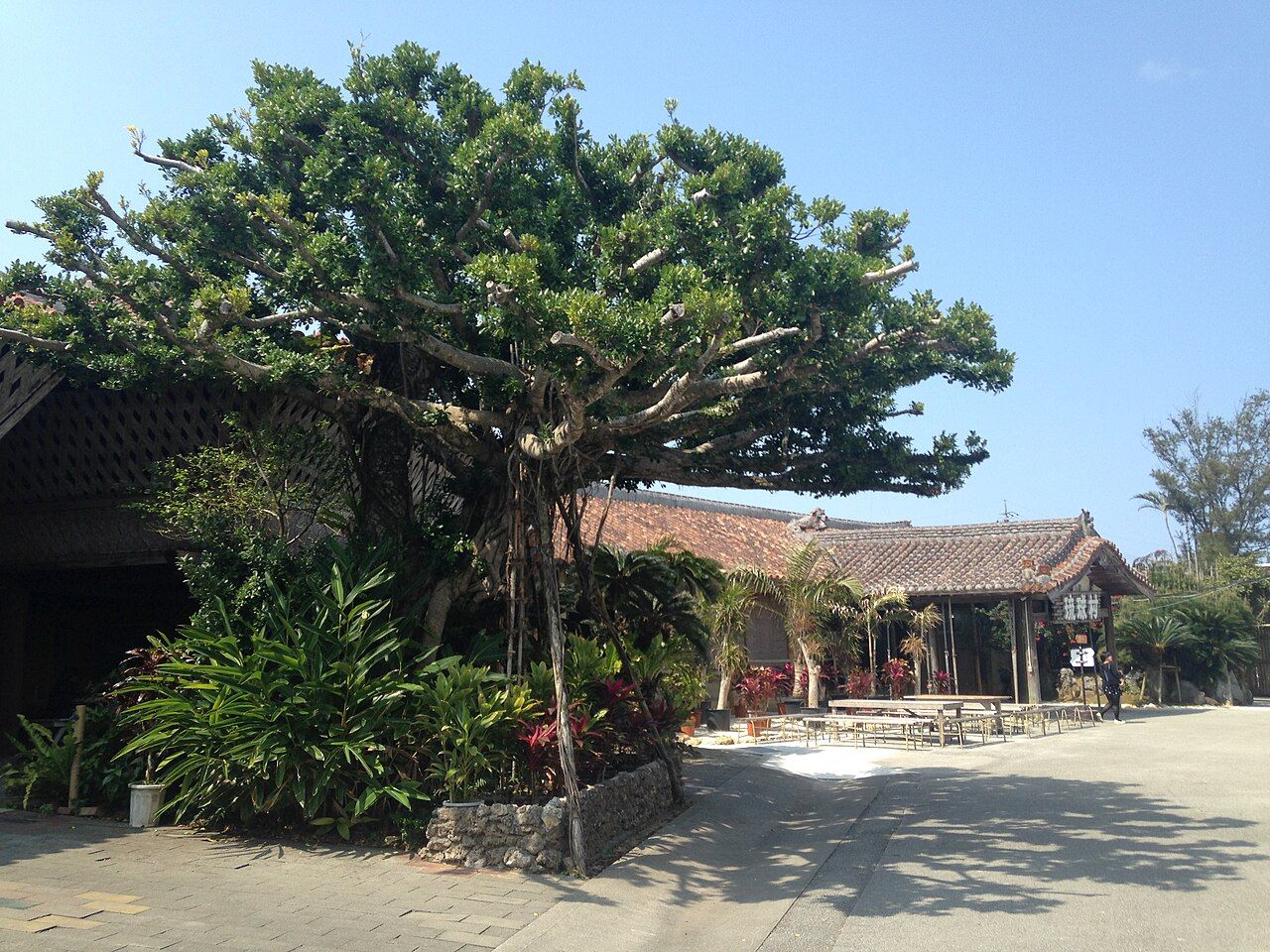
Thick branches extend sideways from the trunk, sending slender aerial roots in search of ground. The opening banyan was photographed before the main gate of Ryukyu Mura, Okinawa, in 2015. It is neither selected for this project nor photographed by Takehiro Komachi. Still, its crown spreading before a building and standing within human circulation shows why a banyan cannot be seen only as an entry in a plant guide.
Place the Storyteller Inside the Tree Photograph
The Banyan Documentation Project, launched August 16, visits banyans across Okinawa and assembles photographs of individual trees with local history and personal memory into a photobook. Nanto Group organized it for its 55th anniversary. A June call asked prefectural residents about “banyans worth preserving” and received 63 stories, including childhood play and family time as well as location and features.
At the center are more than 1,000 banyans Komachi has photographed over 20 years, joined by trees newly photographed from submitted information. The book records not only whole trees, but who played, met, rested, and prayed there. Whether or not people appear in the frame, the edit places storytellers just beyond the photograph.
A frontal image of one tree can document its form. Include pavement around the roots, a roof behind it, and a bench under its branches, and the tree’s community use begins to emerge. A story is not merely a caption explaining the photograph; it becomes another coordinate identifying the position of people outside the frame.
Aerial Roots Grow, and the Landscape’s Uses Change
The Okinawa Prefectural Forest Resources Research Center records the banyan as Ficus microcarpa in the mulberry family. Ocean Expo Park’s plant guide describes its varied growth in Okinawa’s lowlands, on rock faces, and on other trees. Aerial roots descend from trunk and branches according to humidity and surroundings, eventually thickening like trunks. Years of lines multiply inside one tree.
Change does not happen only to the tree. Roads arrive, houses are rebuilt, typhoons take branches, and people once gathered in its shade move elsewhere. The project notes that fallen trees, development, changing living environments, and fewer storytellers can erase memories with the trees. Not every banyan has the same cultural meaning, and outsiders cannot combine distinct places and beliefs into one story. That is why each place must preserve not only the tree name, but the scope of what local people said.
One Earlier Book and One Yet to Be Photographed
Komachi also published the photobook Gajumaru in 2009. Bibliographic information from Nihon no Furuhonya identifies photography by Takehiro Komachi, published by Aoyama-dori, in a 38-centimeter volume. A first edition is among rewards on the current support page. Set old and new books side by side, and one may see not only whether the same trees remain, but how image selection and the physical scale of a book have changed.
The new photobook has the working title Ai ni Iku: Gajumaru OKINAWA. It is planned as a 128-page, full-color A5 volume, with rewards anticipating shipment in October 2026. The campaign uses an All-in model and was active when checked on the morning of August 17. Amounts, remaining days, and contents may change; prospective supporters should confirm current terms on the official CAMPFIRE page.
A Photobook Offers a Relationship with a Tree Without Owning It
A large banyan cannot be taken home. Branches and fruit should not be collected, and at some sites even approaching may call for restraint. Yet one can open a book and read time another person remembers beside a tree. A photobook is not a tool for collecting plants, but can become a vessel for maintaining distance from a plant that cannot be owned while still forming a relationship with it.
An old tree encountered while traveling cannot be exhausted by age and size. Chairs nearby, paths curving around it, and building entrances facing the trunk also hold the time people and tree shared. The forms of people protecting a tree and a tree changing human behavior remain in the same landscape. In a RareDex image, include not only a close leaf but something of the pot, window, or walked path. The place where time was spent with a plant may recall life’s outline before an isolated portrait does.